

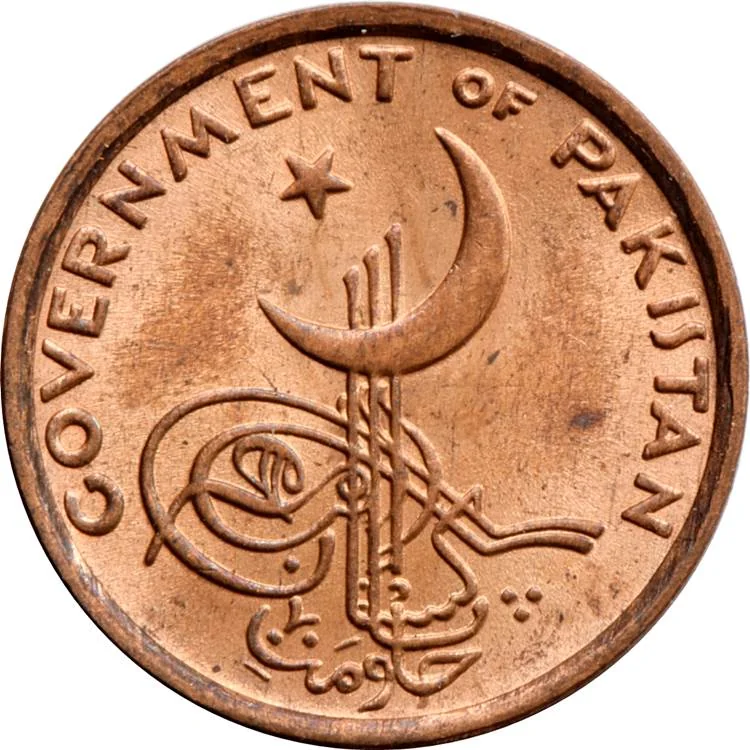
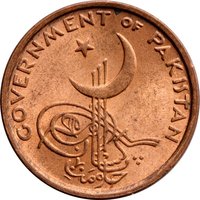
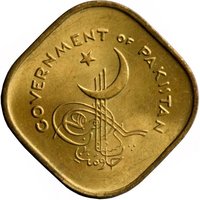
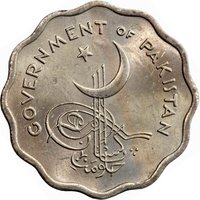
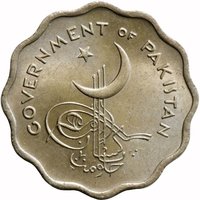
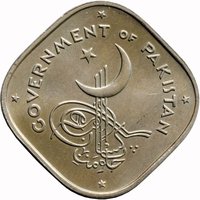
Obverse
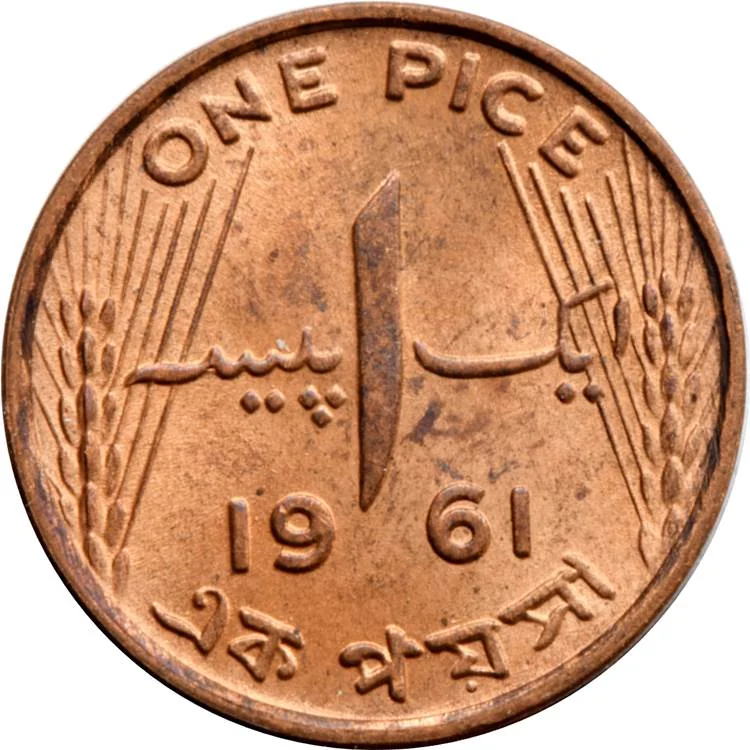
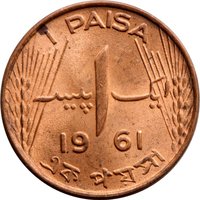
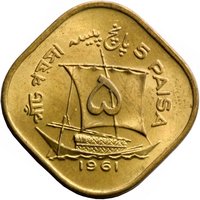
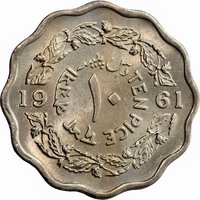
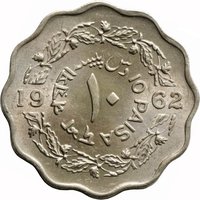
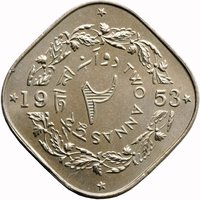
Reverse
Edge
Plain
Mints
| Name | Mark |
|---|---|
| Lahore | — |
Mintings
| Year | Mint Mark | Mintage | Quality | Collection |
|---|---|---|---|---|
| 1961 | — | 74,910,000 |
Historical background
In 1961, Pakistan's currency situation was defined by its recent transition to a decimal system and its position within a managed exchange rate regime. Just two years prior, in 1959, the country had replaced the British-era annas and pies, introducing a new rupee subdivided into 100 "paisa." This reform, completed by 1961, modernized the monetary system and simplified transactions. The Pakistani rupee was pegged to the British pound sterling under the Bretton Woods system, which indirectly linked it to the U.S. dollar, ensuring relative stability in its external value.
Economically, this period was one of controlled growth under President Ayub Khan's military government, which emphasized industrial development. The currency's fixed peg provided predictability for foreign trade and aid, the latter being crucial as Pakistan was a major recipient of U.S. assistance. However, the underlying economy faced persistent challenges, including a large agricultural sector vulnerable to shocks and a growing need for imports, which created pressures on the balance of payments that would later intensify.
Overall, the currency scenario in 1961 appeared stable on the surface, with a newly decimalized system and a fixed exchange rate. This stability was administratively maintained, but it masked longer-term structural economic weaknesses. The managed peg would come under increasing strain in the subsequent decades, leading to significant devaluations, but in the early 1960s, it supported a period of what was termed "decade of development."
Economically, this period was one of controlled growth under President Ayub Khan's military government, which emphasized industrial development. The currency's fixed peg provided predictability for foreign trade and aid, the latter being crucial as Pakistan was a major recipient of U.S. assistance. However, the underlying economy faced persistent challenges, including a large agricultural sector vulnerable to shocks and a growing need for imports, which created pressures on the balance of payments that would later intensify.
Overall, the currency scenario in 1961 appeared stable on the surface, with a newly decimalized system and a fixed exchange rate. This stability was administratively maintained, but it masked longer-term structural economic weaknesses. The managed peg would come under increasing strain in the subsequent decades, leading to significant devaluations, but in the early 1960s, it supported a period of what was termed "decade of development."
Series: 1961 Pakistan circulation coins
🌱 Common