

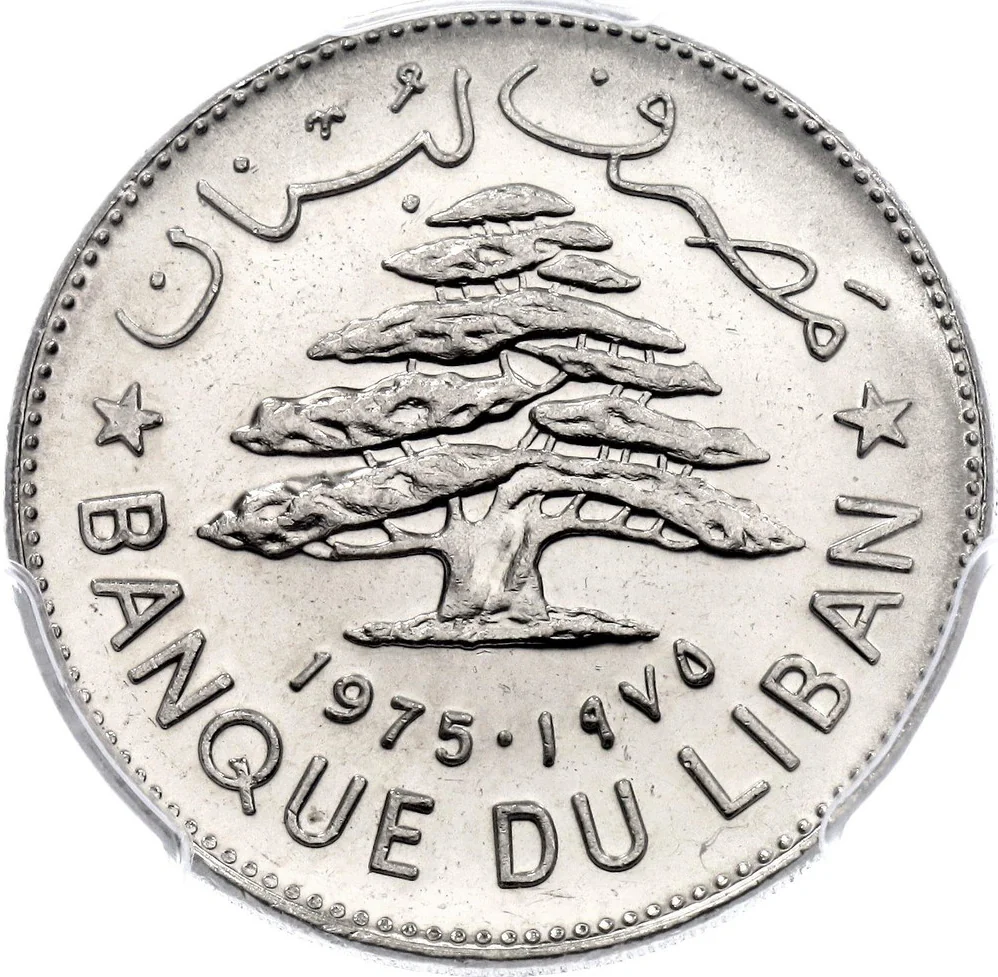
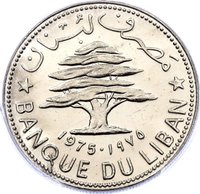
Obverse
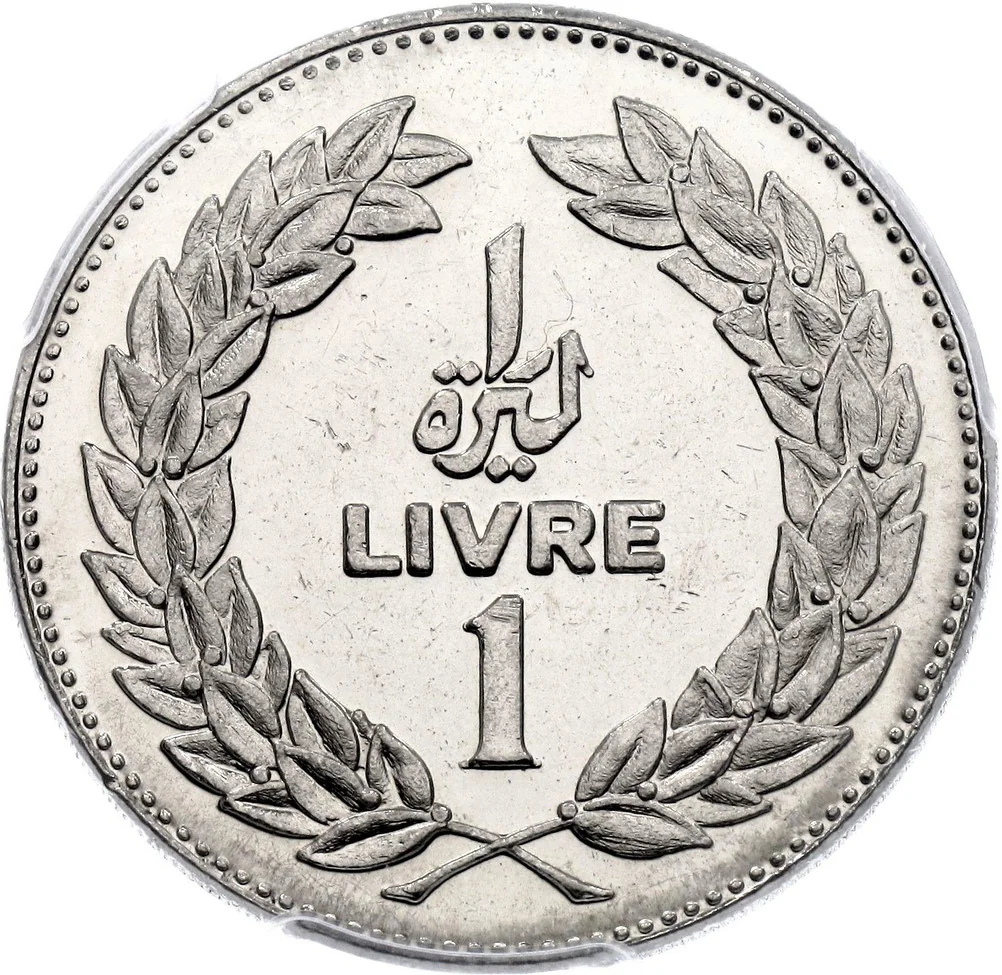
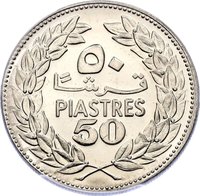
Reverse
Edge
Reeded
Mints
| Name | Mark |
|---|---|
| Royal Mint | — |
| Staatliche Münze Baden-Württemberg | — |
Mintings
| Year | Mint Mark | Mintage | Quality | Collection |
|---|---|---|---|---|
| 1975 | — | 7,236,000 | ||
| 1975 | — | — | Proof | |
| 1977 | — | 8,000,000 | ||
| 1980 | — | 12,000,000 | ||
| 1981 | — | — |
Historical background
Lebanon entered 1975 with a currency that was a symbol of its pre-war stability and prosperity. The Lebanese pound (lira) had been pegged to the French franc and later to the U.S. dollar since the 1950s, maintaining a strong and stable exchange rate. This stability, backed by substantial gold reserves and a robust, laissez-faire banking sector known as the "Switzerland of the Middle East," facilitated Beirut's role as a regional financial and services hub. The pound's strength was a point of national pride and a cornerstone of the country's economic identity.
However, this monetary stability existed atop profound and worsening political and social fractures. The National Pact of 1943, which distributed power among confessional groups, was under immense strain from demographic shifts, the presence of armed Palestinian factions, and rising sectarian tensions. The currency's health was entirely dependent on a functioning state and a consensus among the ruling elite, both of which were rapidly eroding. The outbreak of full-scale civil war in April 1975, following the Ain al-Rummaneh bus massacre, shattered this fragile foundation. The conflict immediately disrupted the economy, closing the port of Beirut, damaging infrastructure, and beginning a capital flight that would steadily drain the financial system's reserves.
Consequently, while the pound remained formally pegged throughout 1975, the year marked the critical juncture where its fate was sealed. The war destroyed the very pillars that supported the currency: a secure environment for banking, a productive economy, and a unified state authority. The Central Bank was forced to begin drawing down its foreign reserves to defend the fixed exchange rate, initiating a process of depletion that would continue for years. Thus, 1975 did not see a currency collapse, but it was the definitive beginning of the end for the Lebanese pound's stability, as the political collapse made a future monetary crisis inevitable.
However, this monetary stability existed atop profound and worsening political and social fractures. The National Pact of 1943, which distributed power among confessional groups, was under immense strain from demographic shifts, the presence of armed Palestinian factions, and rising sectarian tensions. The currency's health was entirely dependent on a functioning state and a consensus among the ruling elite, both of which were rapidly eroding. The outbreak of full-scale civil war in April 1975, following the Ain al-Rummaneh bus massacre, shattered this fragile foundation. The conflict immediately disrupted the economy, closing the port of Beirut, damaging infrastructure, and beginning a capital flight that would steadily drain the financial system's reserves.
Consequently, while the pound remained formally pegged throughout 1975, the year marked the critical juncture where its fate was sealed. The war destroyed the very pillars that supported the currency: a secure environment for banking, a productive economy, and a unified state authority. The Central Bank was forced to begin drawing down its foreign reserves to defend the fixed exchange rate, initiating a process of depletion that would continue for years. Thus, 1975 did not see a currency collapse, but it was the definitive beginning of the end for the Lebanese pound's stability, as the political collapse made a future monetary crisis inevitable.
🌱 Very Common