

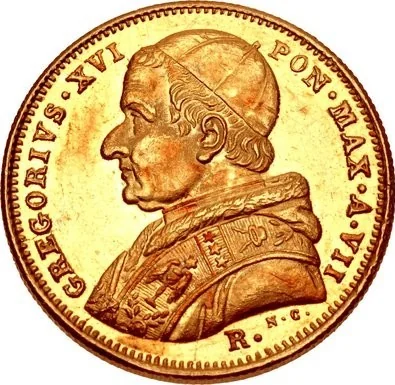
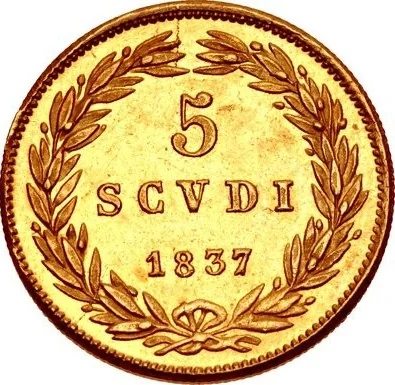
5 Scudi – Papal States
Vatican City
Context
Years: 1835–1846
Country: Vatican City 
Issuer: Papal States
Ruler: Gregory XVI
Currency:
(1835—1866)
Subdivision: 5 Scudi = 500 Baiocchi
Demonetized: Yes
Total mintage: 139,901
Material
References
KM: #Click to copy to clipboard1107
Numista: #131475
Value
Bullion value: $1303.63
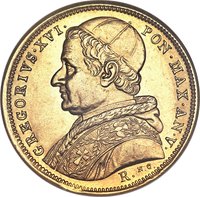
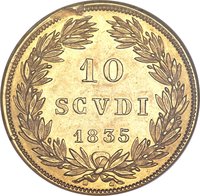
Obverse
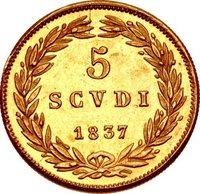
Reverse
Edge
Mintings
| Year | Mint Mark | Mintage | Quality | Collection |
|---|---|---|---|---|
| 1835 | B | — | ||
| 1835 | R | 75,637 | ||
| 1836 | R | 26,342 | ||
| 1837 | R | 21,961 | ||
| 1838 | R | 5,912 | ||
| 1839 | R | — | ||
| 1840 | R | 694 | ||
| 1841 | B | — | ||
| 1841 | R | — | ||
| 1842 | R | 1,031 | ||
| 1842 | B | — | ||
| 1843 | B | — | ||
| 1843 | R | 1,418 | ||
| 1845 | R | 6,906 | ||
| 1846 | R | — |
Historical background
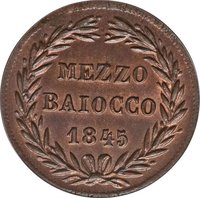
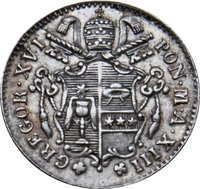
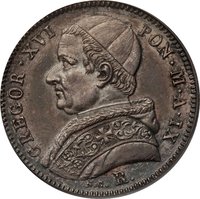
In 1835, the Papal States found themselves in a complex and challenging monetary situation, characterized by a fragmented and debased currency system. The territory lacked a unified, modern coinage, instead circulating a bewildering array of physical coins from various eras and origins. These included old papal scudi, coins from the Napoleonic era, and currencies from neighbouring Italian states like Tuscany and the Kingdom of the Two Sicilies, all with fluctuating and often arbitrary exchange rates. This chaos severely hampered trade, created opportunities for fraud, and reflected the broader administrative and economic stagnation of the pre-unification Italian peninsula under Pope Gregory XVI's conservative rule.
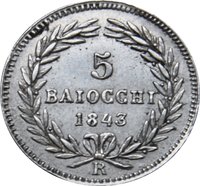
The core of the problem lay in the severe depreciation of the standard silver coin, the baiocco. Originally intended to be a subdivision of the Papal scudo, rampant debasement over decades had drastically reduced its silver content, leading to a wide and unstable gap between its face value and its intrinsic metal worth. This situation was exacerbated by chronic budget deficits, which the government often addressed through inflationary practices like issuing copper token coinage and low-quality paper money known as biglietti di cass. Public trust in these instruments was low, and they frequently traded at a steep discount to their nominal value, further complicating everyday transactions.
Consequently, the monetary landscape was one of confusion and inefficiency, acting as a significant drag on the regional economy. While some technical reforms were attempted in the 1830s, such as the introduction of a new scudo divided into 100 baiocchi, they failed to establish stability or confidence. The fundamental issues of structural deficit, metallurgic debasement, and a lack of centralized monetary authority remained unresolved, leaving the Papal States with a backward currency system that would persist until its absorption into the Kingdom of Italy in 1870.
The core of the problem lay in the severe depreciation of the standard silver coin, the baiocco. Originally intended to be a subdivision of the Papal scudo, rampant debasement over decades had drastically reduced its silver content, leading to a wide and unstable gap between its face value and its intrinsic metal worth. This situation was exacerbated by chronic budget deficits, which the government often addressed through inflationary practices like issuing copper token coinage and low-quality paper money known as biglietti di cass. Public trust in these instruments was low, and they frequently traded at a steep discount to their nominal value, further complicating everyday transactions.
Consequently, the monetary landscape was one of confusion and inefficiency, acting as a significant drag on the regional economy. While some technical reforms were attempted in the 1830s, such as the introduction of a new scudo divided into 100 baiocchi, they failed to establish stability or confidence. The fundamental issues of structural deficit, metallurgic debasement, and a lack of centralized monetary authority remained unresolved, leaving the Papal States with a backward currency system that would persist until its absorption into the Kingdom of Italy in 1870.
✨ Legendary