

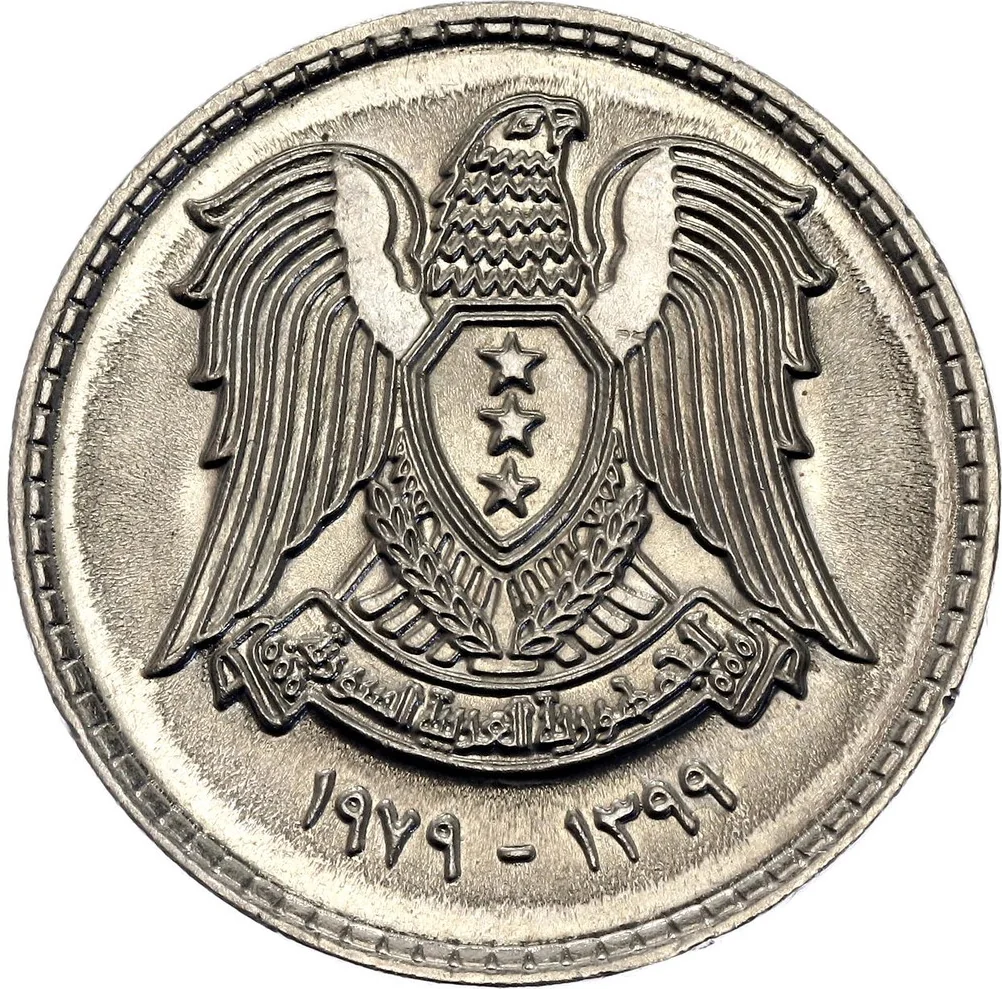
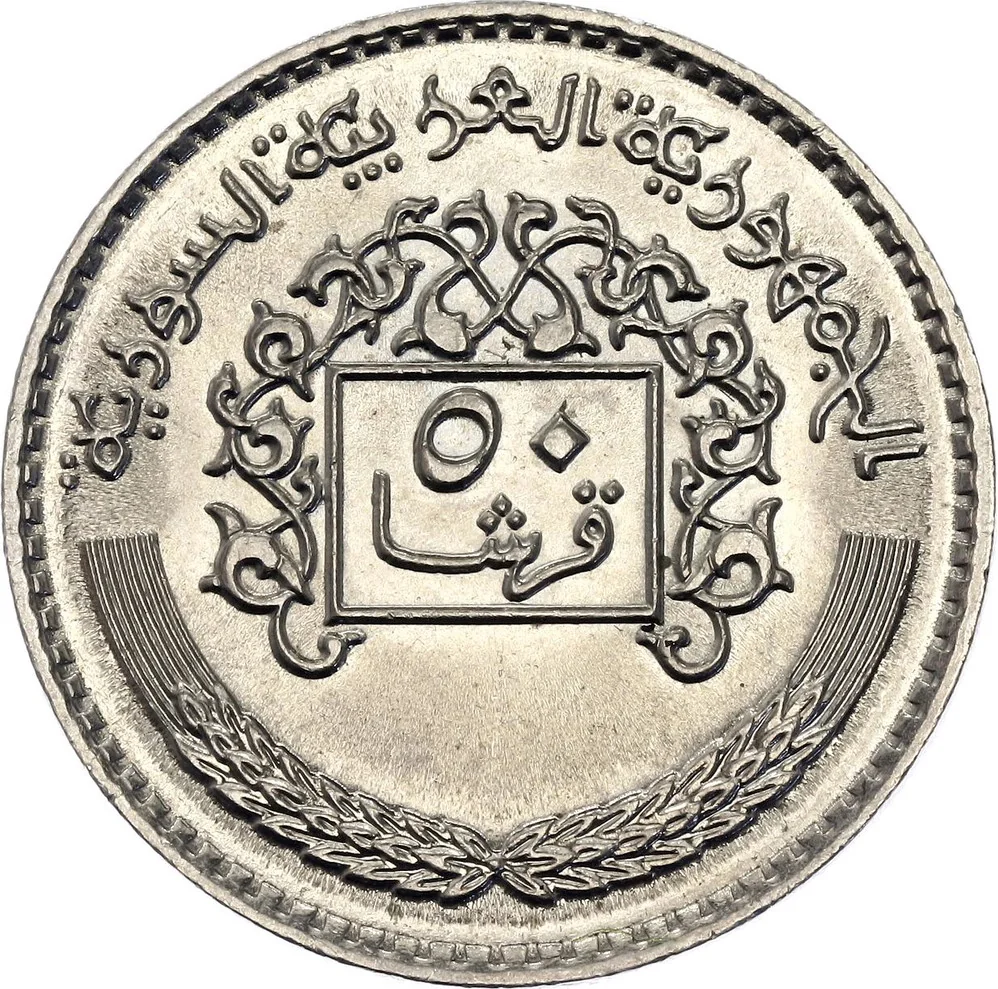
50 piastres – Syria
Add to wishlist
Syria
Context
Year: 1979
Islamic (Hijri) Year:: 1399
Issuer: Syria
Period:
(since 1961)
Currency:
(since 1919)
Demonetized: Yes
Material
References
KM: #
Numista: #1311
Value
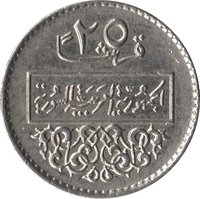
Exchange value: 0.50 SYP
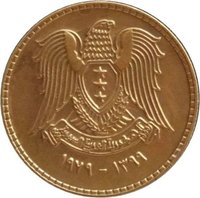
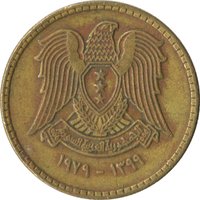
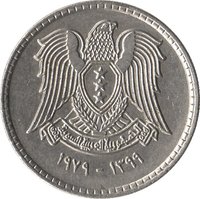
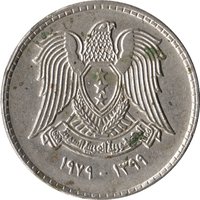
Obverse
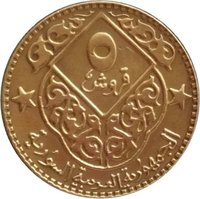
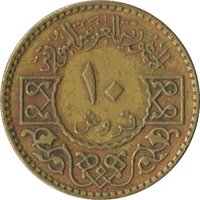
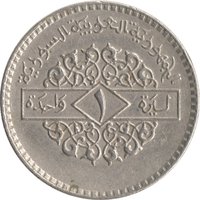
Reverse
Edge
Reeded
Categories
| Animal> Bird |
| Symbols> Coat of Arms |
Mints
| Name | Mark |
|---|---|
| VDM Metals / Vereinigte Deutsche Metallwerke | — |
Mintings
| Year | Mint Mark | Mintage | Quality | Collection |
|---|---|---|---|---|
| 1979 | — | — |
Historical background
In 1979, Syria's currency situation was characterized by relative stability but underlying vulnerabilities, largely propped up by state control and external factors. The Syrian pound (S£) was officially pegged to the U.S. dollar at a fixed rate of S£3.925 = $1, a parity maintained by the authoritarian Ba'athist government of Hafez al-Assad through strict exchange controls and a centralized economy. This official rate, however, masked a growing disparity with the black market, where the pound traded at a modest but telling discount, reflecting pressures from limited foreign exchange reserves and a reliance on imports.
The economy's health, and thus the currency's stability, was heavily dependent on two key revenue streams: aid from fellow Arab oil states and remittances from Syrian workers in the Gulf. The 1979 Islamic Revolution in Iran and the subsequent Iran-Iraq War, which began in 1980, intensified regional tensions and soon redirected Gulf financial support away from Damascus and toward Baghdad, beginning a slow erosion of this crucial support. Furthermore, a significant military buildup and substantial public sector spending strained the state's finances, creating long-term inflationary pressures that would later challenge the currency's fixed value.
Consequently, while 1979 did not see a dramatic currency crisis, it represented a critical juncture. The fixed exchange rate was an artifact of state power rather than economic fundamentals, and the geopolitical shifts of that year started to unravel the external financial pillars that supported it. The situation set the stage for the gradual but severe depreciation of the Syrian pound in the coming decades, as regional alliances shifted, aid diminished, and economic mismanagement accumulated, exposing the fragility behind the officially stable facade.
The economy's health, and thus the currency's stability, was heavily dependent on two key revenue streams: aid from fellow Arab oil states and remittances from Syrian workers in the Gulf. The 1979 Islamic Revolution in Iran and the subsequent Iran-Iraq War, which began in 1980, intensified regional tensions and soon redirected Gulf financial support away from Damascus and toward Baghdad, beginning a slow erosion of this crucial support. Furthermore, a significant military buildup and substantial public sector spending strained the state's finances, creating long-term inflationary pressures that would later challenge the currency's fixed value.
Consequently, while 1979 did not see a dramatic currency crisis, it represented a critical juncture. The fixed exchange rate was an artifact of state power rather than economic fundamentals, and the geopolitical shifts of that year started to unravel the external financial pillars that supported it. The situation set the stage for the gradual but severe depreciation of the Syrian pound in the coming decades, as regional alliances shifted, aid diminished, and economic mismanagement accumulated, exposing the fragility behind the officially stable facade.
Series: 1979 Syria circulation coins
🌱 Very Common