

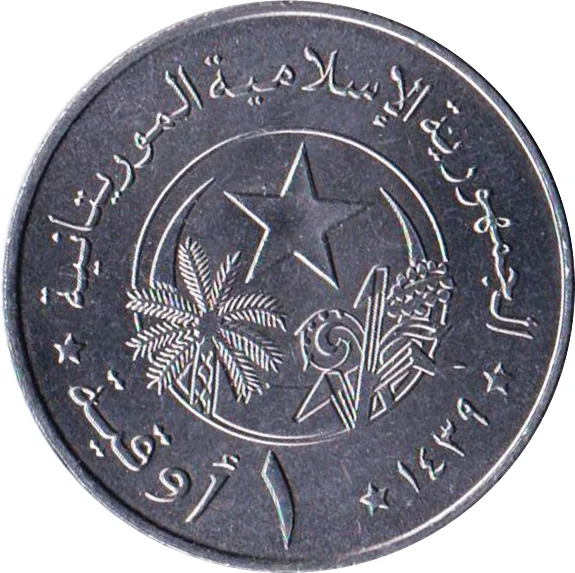
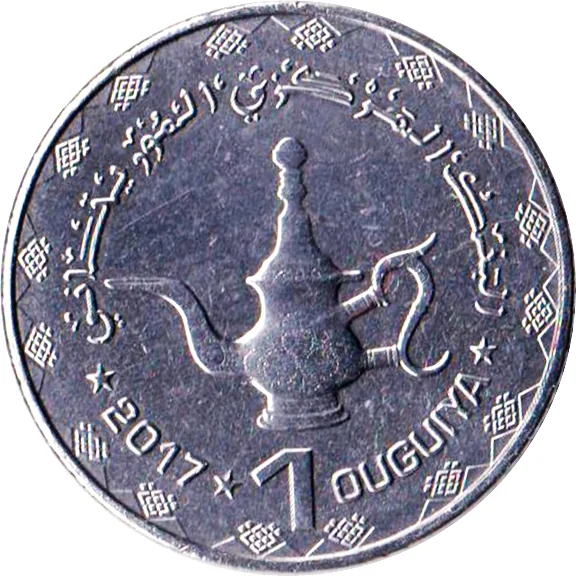
1 ouguiya – Mauritania
Add to wishlist
Mauritania
Context
Material
References
KM: #
Numista: #130025
Value
Exchange value: 1 MRU
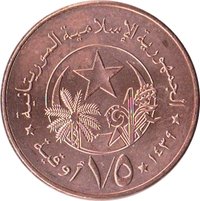
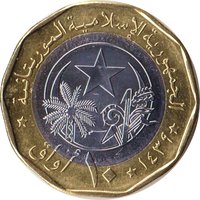
Obverse
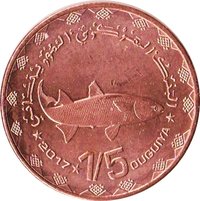
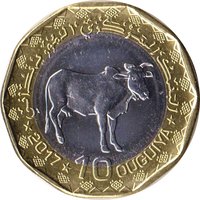
Reverse
Edge
Reeded
Mintings
| Year | Mint Mark | Mintage | Quality | Collection |
|---|---|---|---|---|
| 2017 | — | — | ||
| 2018 | — | — |
Historical background
In 2017, Mauritania's currency situation was characterized by a period of relative stability for the Ouguiya (MRU), but within a context of significant structural economic challenges. The year followed a historic monetary reform completed at the end of 2014, where the country introduced a new Ouguiya (MRU) to replace the old Ouguiya (MRO) at a rate of 1:10. By 2017, this transition was fully bedded in, and the currency was not subject to the high volatility seen in some other African economies. The exchange rate was effectively managed through a crawling peg system, loosely tied to a basket of currencies, which the Central Bank of Mauritania (BCM) used to maintain stability against major currencies like the US Dollar and the Euro.
This stability, however, masked deeper economic pressures. Mauritania's economy remained heavily dependent on extractive industries, particularly iron ore and, increasingly, gold. Fluctuations in global commodity prices directly impacted foreign exchange reserves and fiscal revenues. Furthermore, the country continued to grapple with a persistent trade deficit, as it relied heavily on imports for food, machinery, and manufactured goods. This imbalance exerted underlying pressure on the Ouguiya, with the central bank utilizing its reserves to manage the exchange rate and curb inflation.
Consequently, while the official exchange rate was stable, a parallel foreign exchange market persisted, albeit less pronounced than in previous years. The disparity between the official and parallel rates highlighted the ongoing constraints in access to hard currency for some businesses and individuals. Overall, 2017 represented a year of managed calm for the Ouguiya, but the fundamental vulnerabilities of a resource-dependent, import-reliant economy meant that this stability was fragile and heavily reliant on continued prudent central bank management and stable commodity exports.
This stability, however, masked deeper economic pressures. Mauritania's economy remained heavily dependent on extractive industries, particularly iron ore and, increasingly, gold. Fluctuations in global commodity prices directly impacted foreign exchange reserves and fiscal revenues. Furthermore, the country continued to grapple with a persistent trade deficit, as it relied heavily on imports for food, machinery, and manufactured goods. This imbalance exerted underlying pressure on the Ouguiya, with the central bank utilizing its reserves to manage the exchange rate and curb inflation.
Consequently, while the official exchange rate was stable, a parallel foreign exchange market persisted, albeit less pronounced than in previous years. The disparity between the official and parallel rates highlighted the ongoing constraints in access to hard currency for some businesses and individuals. Overall, 2017 represented a year of managed calm for the Ouguiya, but the fundamental vulnerabilities of a resource-dependent, import-reliant economy meant that this stability was fragile and heavily reliant on continued prudent central bank management and stable commodity exports.
🌱 Common