

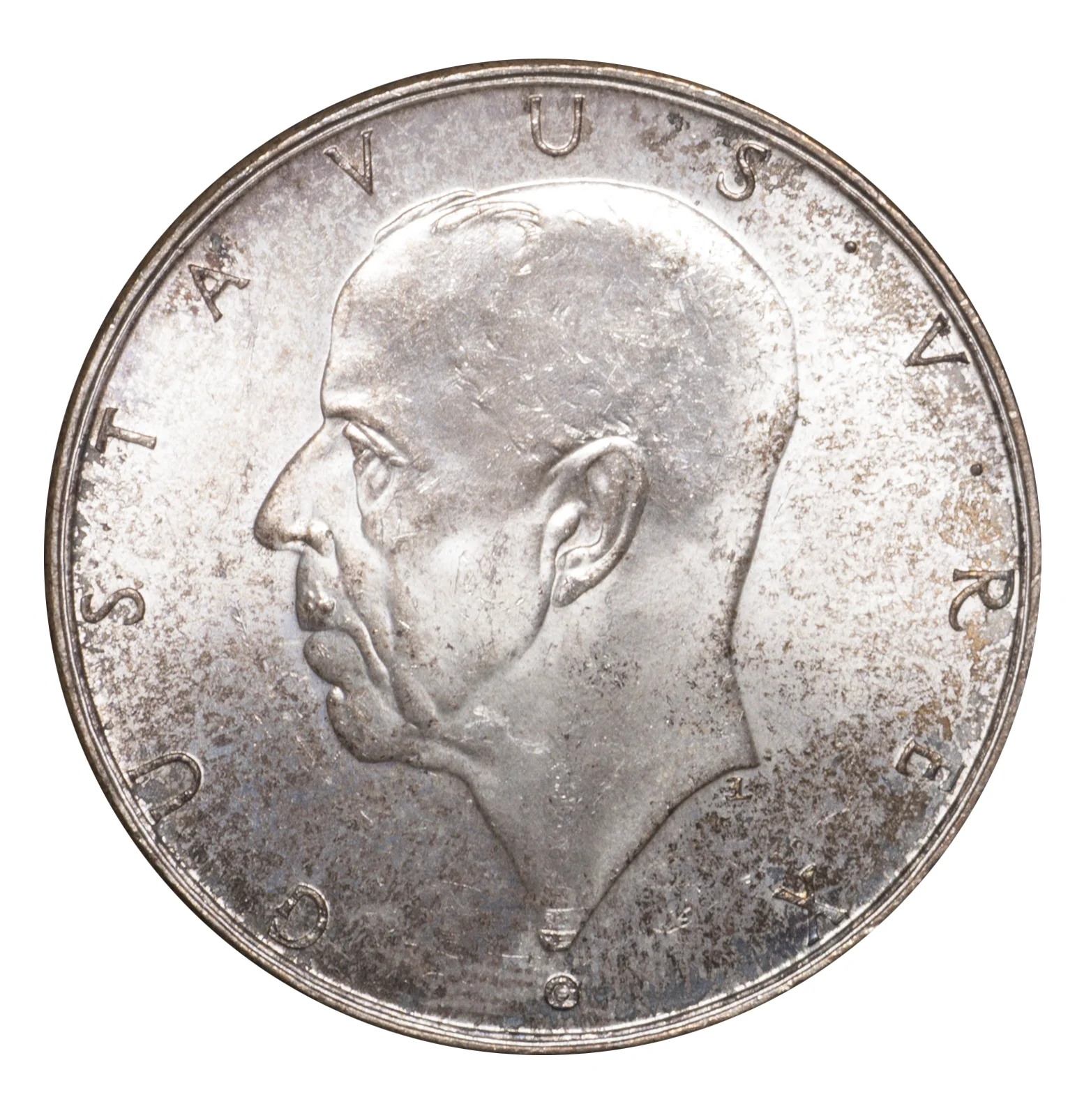
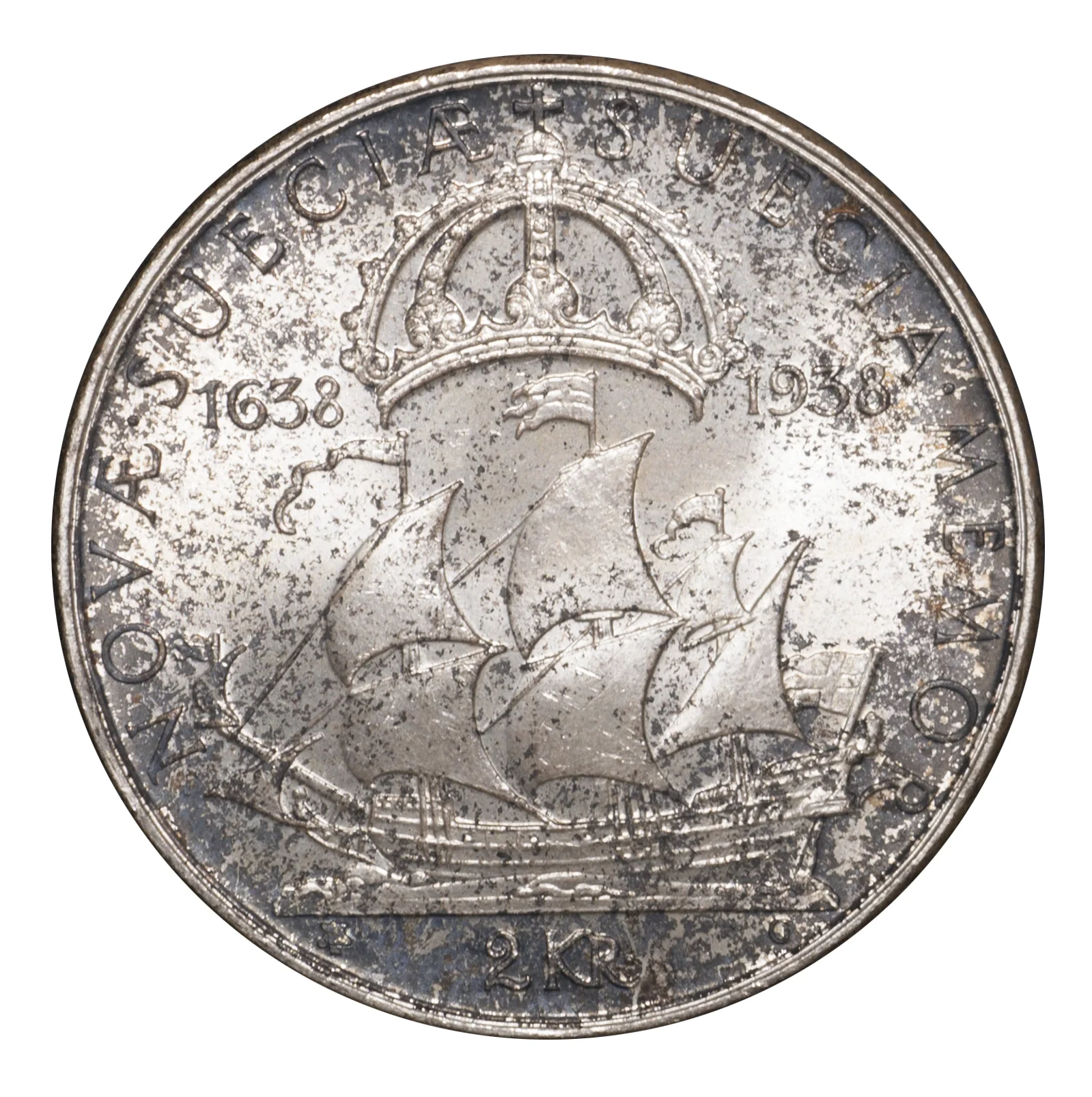
2 kronor (New Sweden Settlement in Delaware) – Sweden
Add to wishlist
Circulating commemorative coins
Commemoration: 300th Anniversary of the founding of New Sweden Settlement in Delaware
Sweden
Obverse
Description:
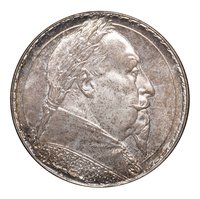
Gustaf V left-facing bust, encircled by legend.
Inscription:
GUSTAVUS · V · REX
EL
EL
Translation:
GUSTAVUS V KING
Script: Latin
Language: Latin
Engraver: Erik Lindberg
Reverse
Description:
The "Kalmar Nyckel" ship sails left under full sail. A crown separates the anniversary dates above. Below, the value is flanked by the mintmark and the Governor's initial.
Inscription:
NOVÆ·SUECIÆ SUECIA·MEMOR
1638 1938
2 KR·
G
1638 1938
2 KR·
G
Translation:
New Sweden Sweden remembers
1638 1938
2 Crowns
1638 1938
2 Crowns
Script: Latin
Engraver: Erik Lindberg
Edge
Reeded
Categories
| Transportation> Watercraft |
| Symbol> Crown |
| Person> Monarch |
| Symbol> Flag |
Mints
| Name | Mark |
|---|---|
| Kungliga Myntet | — |
Mintings
| Year | Mint Mark | Mintage | Quality | Collection |
|---|---|---|---|---|
| 1938 | — | 508,815 |
Historical background
In 1938, Sweden’s currency was firmly anchored within the framework of the Scandinavian Monetary Union (SMU), a system established with Denmark and Norway in 1873 that had effectively ceased to function after the outbreak of World War I. Although the formal union was defunct, Sweden maintained a gold standard policy, pegging the value of the Swedish krona (SEK) to gold. This provided a stable and predictable exchange rate, which was a cornerstone of the economic policy pursued by the Social Democratic government and the influential Minister of Finance, Ernst Wigforss. This stability was seen as crucial for international trade and economic planning during a volatile global period.
Domestically, the currency stability occurred alongside a period of significant economic growth and rising living standards, often referred to as the beginning of the "Swedish model." However, this was not without its tensions. The government was actively pursuing an expansive fiscal policy to combat unemployment and fund a burgeoning welfare state, while the central bank (Riksbanken) was tasked with defending the gold peg. This created an underlying policy conflict between domestic stimulus goals and the external constraint of the fixed exchange rate, a tension that would define coming years.
Internationally, the situation was precarious. With the shadows of the Great Depression lingering and the threat of a new European war growing, Sweden’s commitment to the gold standard was increasingly an outlier. Many major economies, including the United Kingdom and the United States, had abandoned gold convertibility. Sweden’s adherence was therefore a deliberate, and somewhat vulnerable, choice to project economic credibility. This policy would be put to an extreme test just one year later, with the outbreak of World War II forcing Sweden to abandon the gold standard in September 1939, impose strict currency controls, and manage the krona through a managed, "blocked" system for the duration of the conflict.
Domestically, the currency stability occurred alongside a period of significant economic growth and rising living standards, often referred to as the beginning of the "Swedish model." However, this was not without its tensions. The government was actively pursuing an expansive fiscal policy to combat unemployment and fund a burgeoning welfare state, while the central bank (Riksbanken) was tasked with defending the gold peg. This created an underlying policy conflict between domestic stimulus goals and the external constraint of the fixed exchange rate, a tension that would define coming years.
Internationally, the situation was precarious. With the shadows of the Great Depression lingering and the threat of a new European war growing, Sweden’s commitment to the gold standard was increasingly an outlier. Many major economies, including the United Kingdom and the United States, had abandoned gold convertibility. Sweden’s adherence was therefore a deliberate, and somewhat vulnerable, choice to project economic credibility. This policy would be put to an extreme test just one year later, with the outbreak of World War II forcing Sweden to abandon the gold standard in September 1939, impose strict currency controls, and manage the krona through a managed, "blocked" system for the duration of the conflict.
🌱 Common