

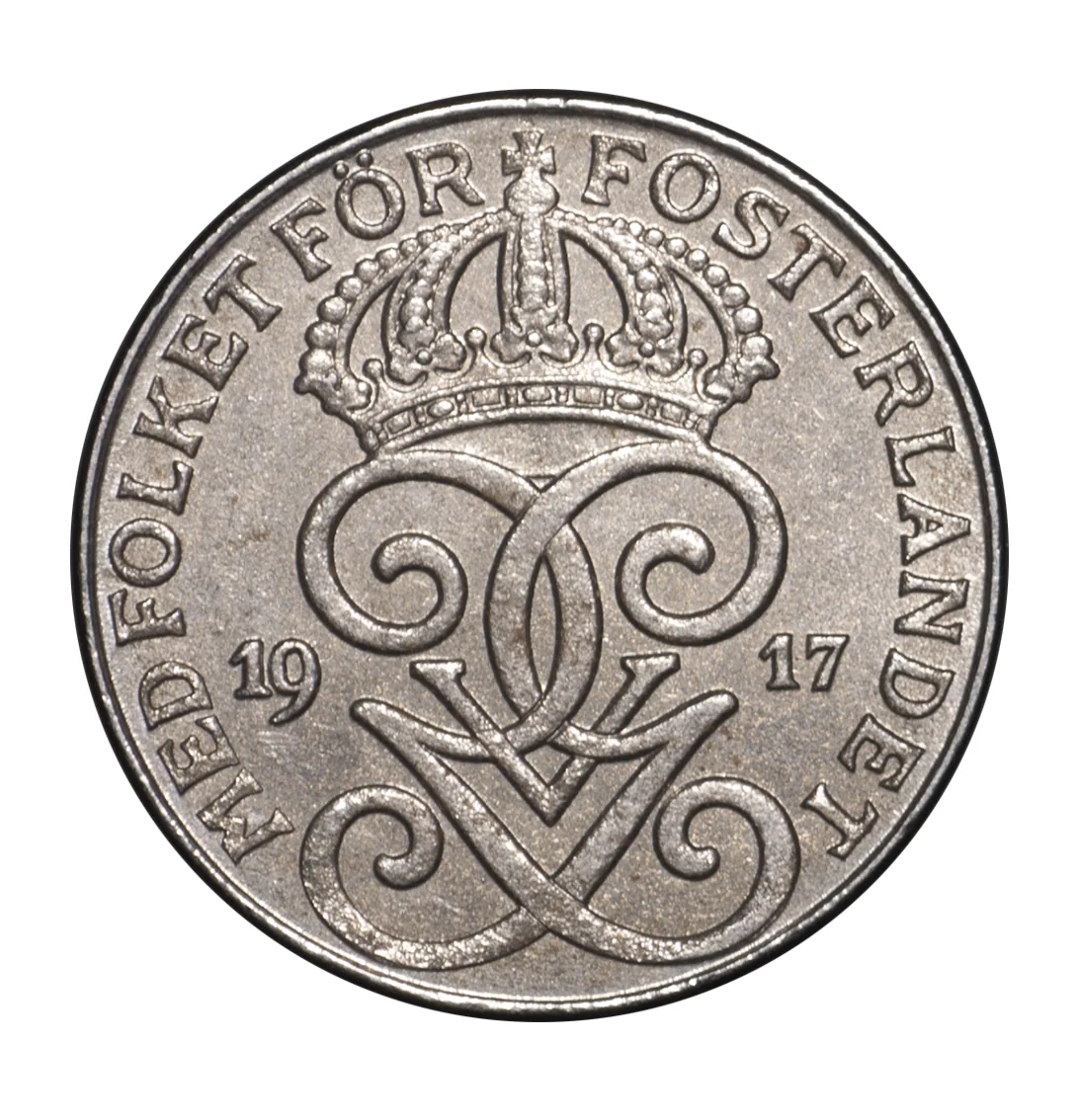
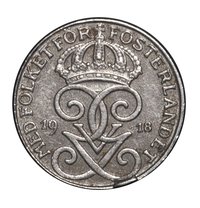
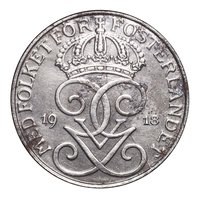
Obverse
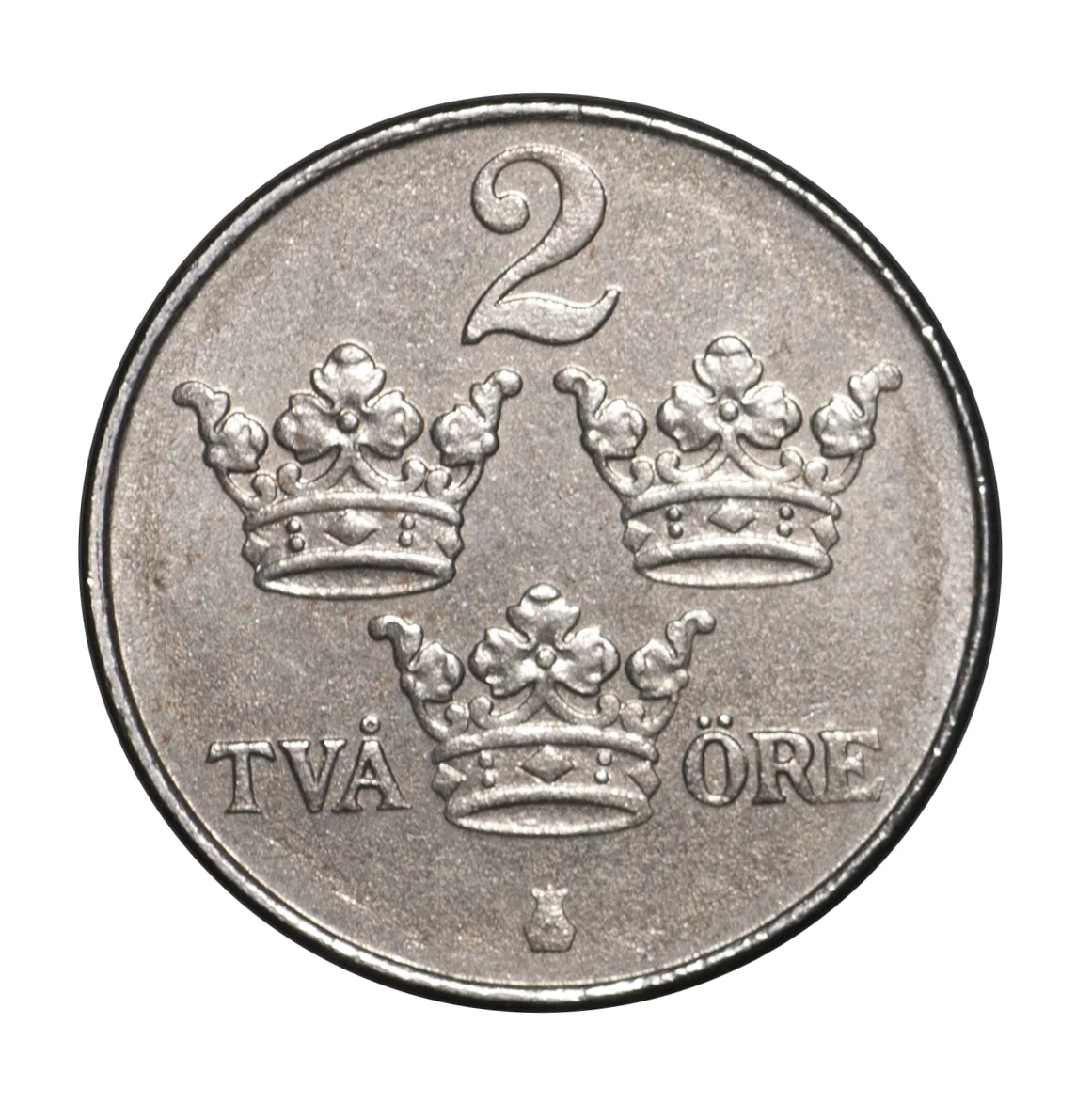
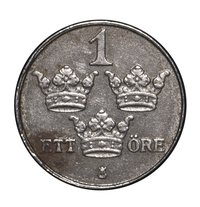
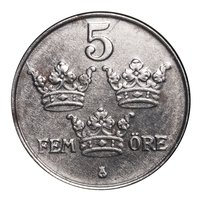
Reverse
Edge
Plain
Mints
| Name | Mark |
|---|---|
| Kungliga Myntet | — |
Mintings
| Year | Mint Mark | Mintage | Quality | Collection |
|---|---|---|---|---|
| 1917 | — | 4,576,200 | ||
| 1918 | — | 4,981,750 | ||
| 1919 | — | 2,923,100 | ||
| 1920 | — | — |
Historical background
In 1917, Sweden’s currency situation was defined by the strains of World War I and the collapse of the international gold standard. Although officially neutral, Sweden faced severe economic disruption, including trade blockades, inflation, and soaring prices for imported goods. To conserve its gold reserves and maintain financial stability, the Riksbank (Sweden’s central bank) had suspended the convertibility of the krona into gold in 1914, effectively abandoning the classical gold standard. This meant the krona became a fiat currency, its value no longer fixed to a specific weight of gold but instead managed by the central bank.
The primary monetary tool during this period was the "paper gold standard," where the Riksbank pegged the krona to the US dollar rather than to gold directly, aiming to stabilize exchange rates. However, this policy was difficult to sustain. Wartime pressures led to a significant expansion of the money supply to finance essential imports and government spending, fueling inflation and causing the krona's value to fluctuate widely on foreign exchange markets. Public and political concern over rising living costs and currency instability was high, creating a contentious economic environment.
This turbulent backdrop set the stage for major political and financial reforms. The currency challenges of 1917, occurring alongside a democratic breakthrough that year, highlighted the need for a more independent and technically adept central bank. The experience directly influenced the creation of the 1931 Riksbank Act, which formally established its independence. Thus, the currency situation of 1917 was a critical juncture, moving Sweden from a pre-war metallic system toward a modern managed currency and laying the groundwork for twentieth-century central banking policy.
The primary monetary tool during this period was the "paper gold standard," where the Riksbank pegged the krona to the US dollar rather than to gold directly, aiming to stabilize exchange rates. However, this policy was difficult to sustain. Wartime pressures led to a significant expansion of the money supply to finance essential imports and government spending, fueling inflation and causing the krona's value to fluctuate widely on foreign exchange markets. Public and political concern over rising living costs and currency instability was high, creating a contentious economic environment.
This turbulent backdrop set the stage for major political and financial reforms. The currency challenges of 1917, occurring alongside a democratic breakthrough that year, highlighted the need for a more independent and technically adept central bank. The experience directly influenced the creation of the 1931 Riksbank Act, which formally established its independence. Thus, the currency situation of 1917 was a critical juncture, moving Sweden from a pre-war metallic system toward a modern managed currency and laying the groundwork for twentieth-century central banking policy.
🌱 Common