

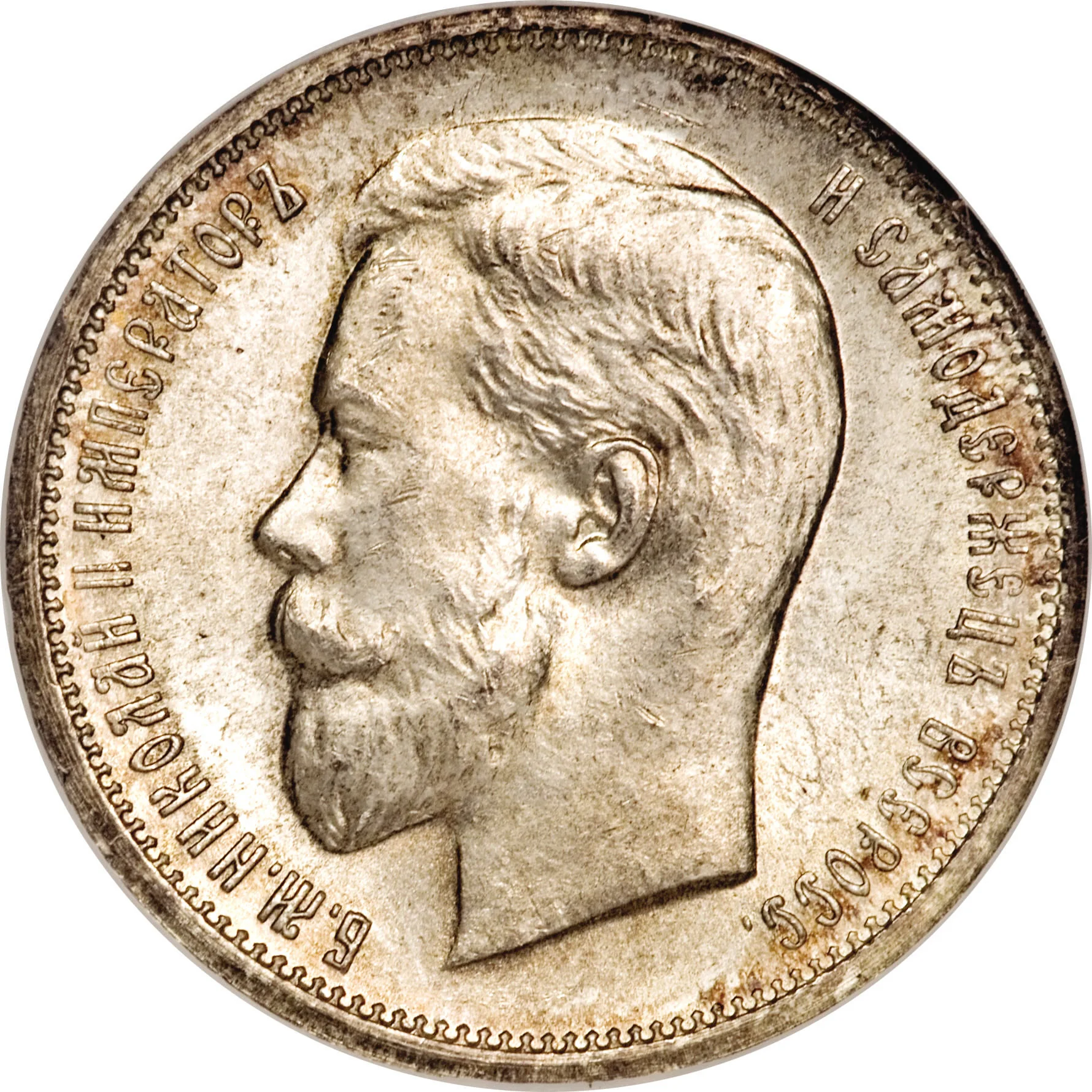
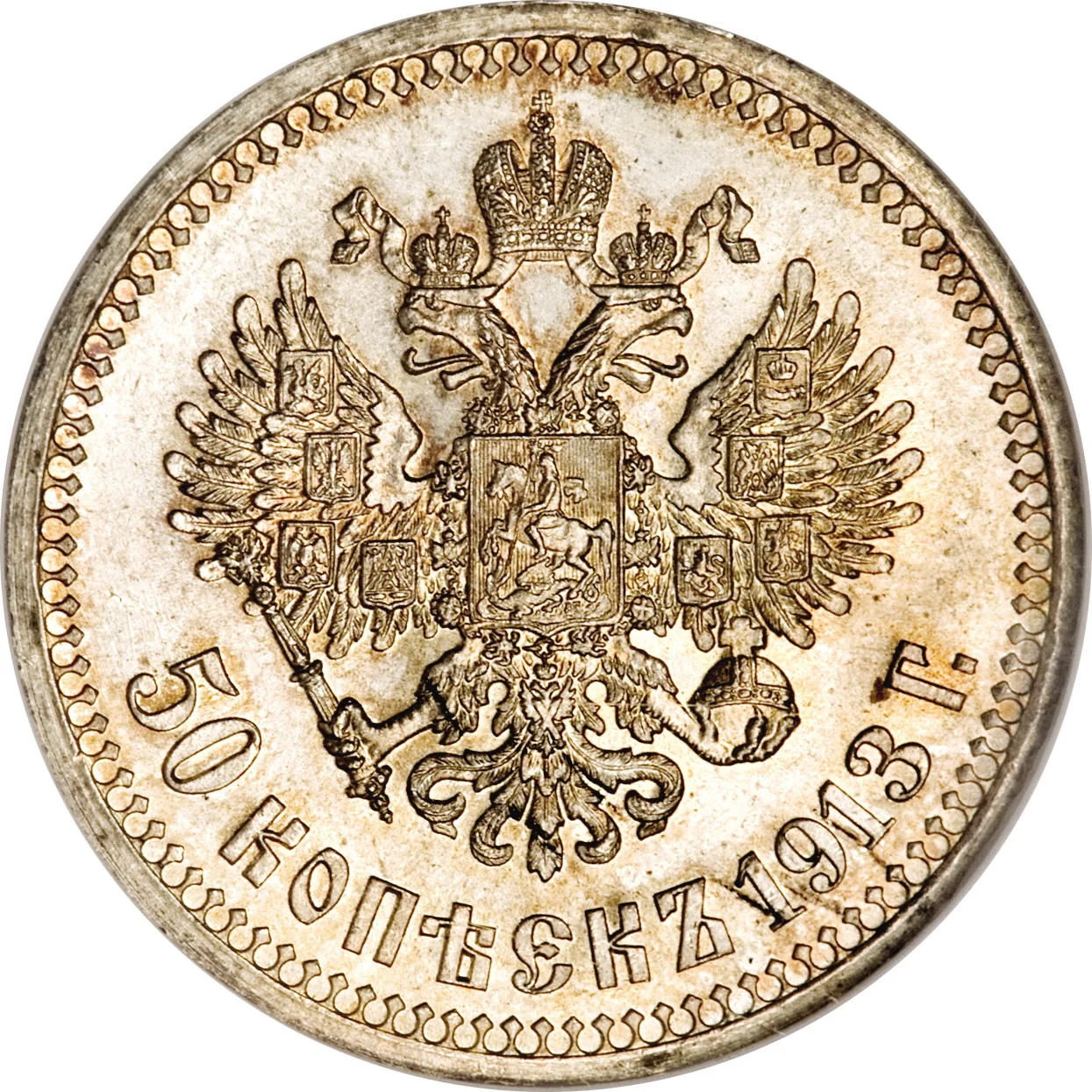
50 kopecks – Russian Empire
Add to wishlist
Russia
Context
Years: 1895–1914
Country: Russia
Issuer: Russian Empire
Ruler: Nicholas II
Currency:
(1700—1917)
Demonetized: Yes
Total mintage: 114,409,194
Material
References
Y: #
Numista: #1292
Value
Bullion value: $21.90
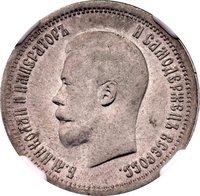
Obverse
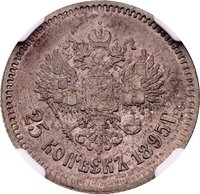
Reverse
Edge
Smooth with inscription or completely smooth
Legend:
(В С) ЧИСТАГО СЕРЕБРА 2 ЗОЛОТНИКА 10.5 ДОЛЕЙ
Translation:
In (C) 2 Zolotniks 10.5 Doli of Pure Silver
Language: Russian
Categories
| Symbols> Coat of Arms |
| Person> Monarch |
Mints
| Name | Mark |
|---|---|
| Saint Petersburg | — |
| Monnaie de Paris | * |
Mintings
| Year | Mint Mark | Mintage | Quality | Collection |
|---|---|---|---|---|
| 1895 | АГ | 2,000,004 | BU | |
| 1896 | — | — | BU | |
| 1896 | * | 244,562 | ||
| 1896 | АГ | 20,000,032 | BU | |
| 1897 | — | — | ||
| 1897 | * | 46,755,438 | ||
| 1898 | АГ | — | Proof | |
| 1899 | * | 10,000,000 | ||
| 1899 | ЗБ | — | BU | |
| 1899 | — | — | BU | |
| 1899 | АГ | 15,442,021 | BU | |
| 1899 | ФЗ | — | BU | |
| 1900 | ФЗ | 3,360,000 | BU | |
| 1901 | АР | — | BU | |
| 1901 | ФЗ | 412,020 | BU | |
| 1902 | АР | 36,009 | BU | |
| 1903 | АР | — | Proof | |
| 1904 | АР | 4,010 | BU | |
| 1906 | ЭБ | 10,009 | BU | |
| 1907 | ЭБ | 200,009 | BU | |
| 1908 | ЭБ | 40,009 | BU | |
| 1909 | ЭБ | 50,011 | BU | |
| 1910 | ЭБ | 150,009 | BU | |
| 1911 | ЭБ | 1,000,011 | BU | |
| 1912 | ЭБ | 7,085,008 | BU | |
| 1913 | ВС | — | BU | |
| 1913 | ЭБ | 6,420,017 | BU | |
| 1914 | ВС | 1,200,015 | BU |
Historical background
By 1895, the Russian Empire’s currency system was defined by its commitment to the gold standard, a transition formally completed under Finance Minister Sergei Witte in 1897. However, in 1895, this reform was in its final, decisive phase of preparation. The empire had long suffered from a chronically depreciated paper ruble (the assignat and later credit ruble) and a complex, unstable bimetallic system. Witte’s goal was to stabilize the ruble, attract vital foreign investment for industrialization, and integrate Russia more securely into the global financial system. Key measures in 1895 included official state transactions beginning to be conducted in gold rubles and the establishment of a fixed exchange rate for the credit ruble, pegging it to gold in anticipation of full convertibility.
This push for the gold standard was driven by both economic necessity and geopolitical ambition. The silver-based currency had proven volatile and inadequate for financing massive state-led projects, like the Trans-Siberian Railway. A gold-backed ruble was seen as essential for securing large international loans, primarily from France, which were crucial for state budgets and industrial development. The reform, however, was contentious within government circles; conservative and agrarian interests feared that tying the currency to gold would lead to deflation, making Russian grain exports more expensive on the world market and hurting the indebted landed nobility.
Thus, the currency situation in 1895 was one of deliberate and tense transition. The groundwork laid that year—including the de facto gold peg and the accumulation of a substantial gold reserve—set the stage for the formal decrees of 1897. These would finally establish the gold ruble as the sole legal tender, marking a watershed moment that brought monetary stability and facilitated an investment boom, but also entrenched an economic policy that critics argued prioritized financial orthodoxy and industrial growth over the welfare of the rural majority.
This push for the gold standard was driven by both economic necessity and geopolitical ambition. The silver-based currency had proven volatile and inadequate for financing massive state-led projects, like the Trans-Siberian Railway. A gold-backed ruble was seen as essential for securing large international loans, primarily from France, which were crucial for state budgets and industrial development. The reform, however, was contentious within government circles; conservative and agrarian interests feared that tying the currency to gold would lead to deflation, making Russian grain exports more expensive on the world market and hurting the indebted landed nobility.
Thus, the currency situation in 1895 was one of deliberate and tense transition. The groundwork laid that year—including the de facto gold peg and the accumulation of a substantial gold reserve—set the stage for the formal decrees of 1897. These would finally establish the gold ruble as the sole legal tender, marking a watershed moment that brought monetary stability and facilitated an investment boom, but also entrenched an economic policy that critics argued prioritized financial orthodoxy and industrial growth over the welfare of the rural majority.
🌱 Very Common