

2 pengos (Rakoczi's Death) – Hungary
Add to wishlist
Circulating commemorative coins
Commemoration: 200th Anniversary of the Death of Rakoczi
Hungary
Context
Year: 1935
Issuer: Hungary
Ruler: Nicolas Horthy
Currency:
(1927—1946)
Demonetization: 31 January 1942
Total mintage: 100,000
Material
References
KM: #
Numista: #12867
Value
Bullion value: $15.84
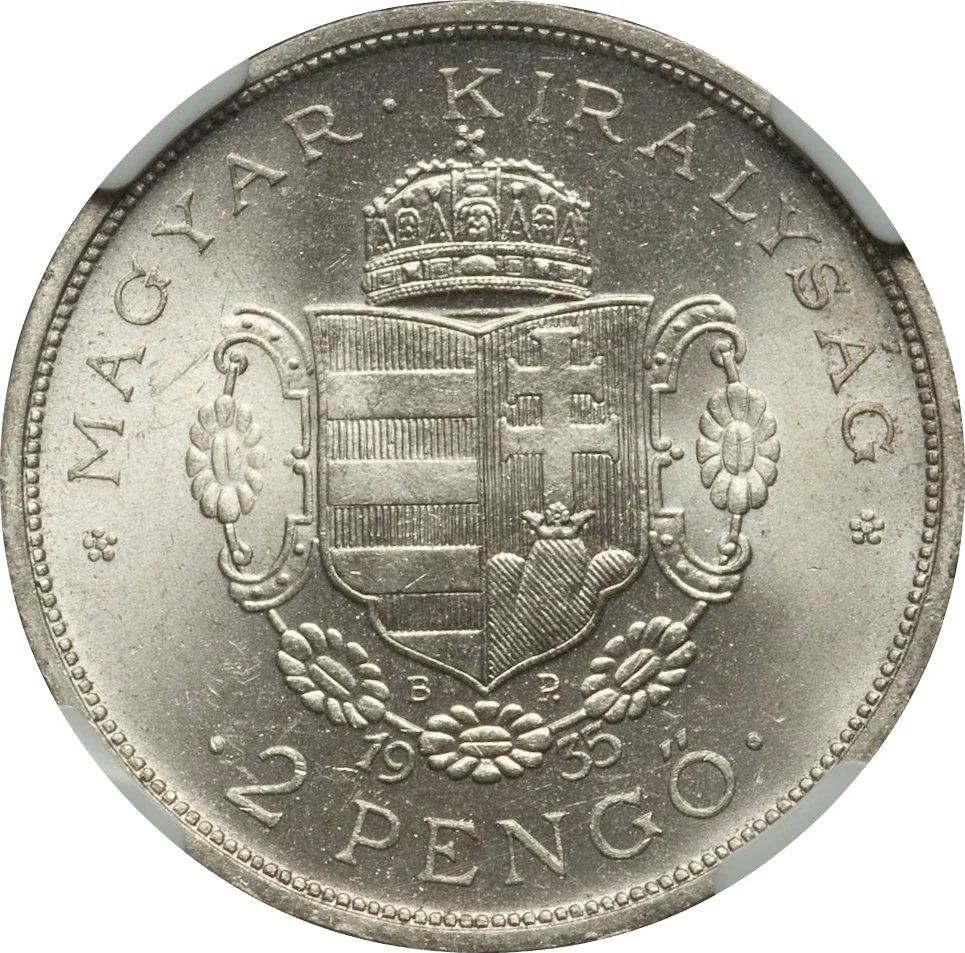
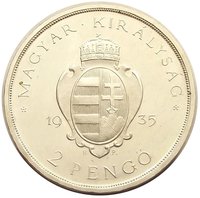
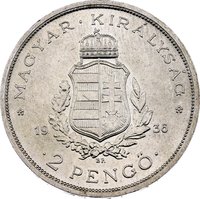
Obverse
Description:
Coat of arms above, value below.
Inscription:
MAGYAR KIRÁLYSÁG
2 PENGŐ
BP
1935
2 PENGŐ
BP
1935
Translation:
Kingdom of Hungary
2 Pengő
Budapest
1935
2 Pengő
Budapest
1935
Script: Latin
Language: Hungarian
Engraver: Lajos Berán
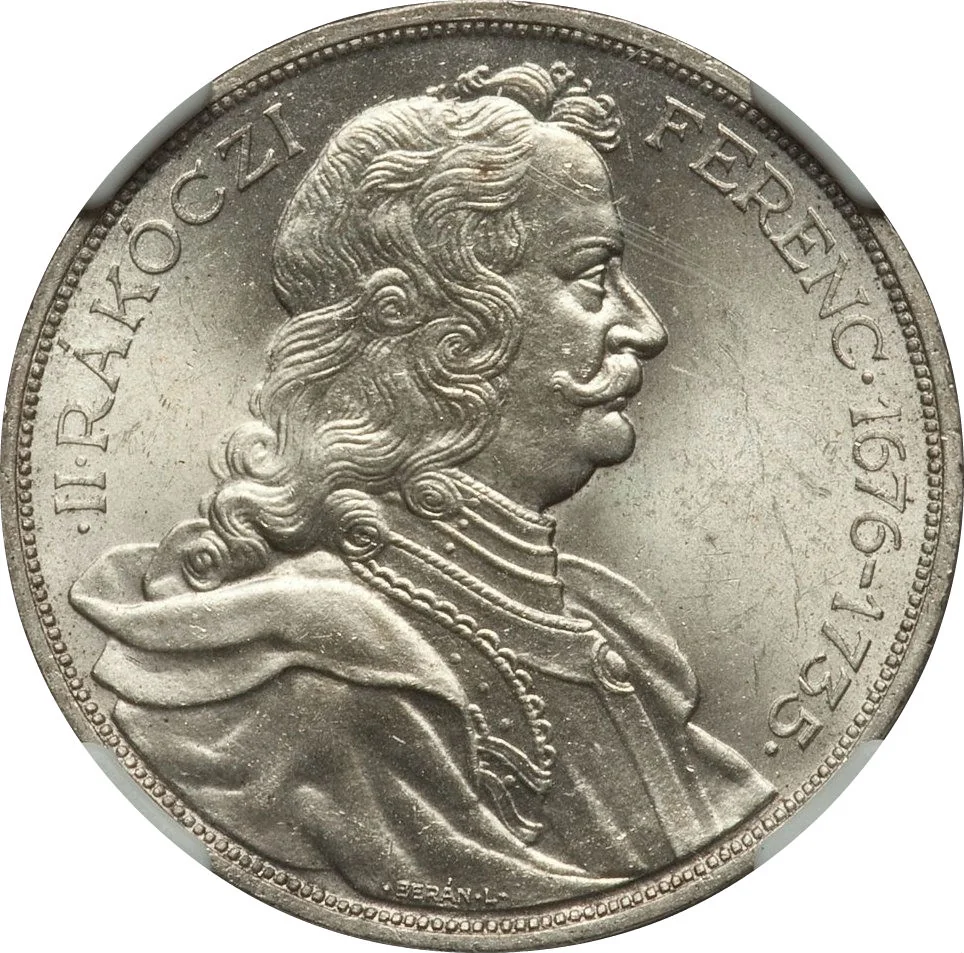
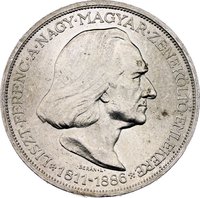
Reverse
Description:
Francis II Rákóczi, right.
Inscription:
II. RÁKÓCZI FERENC 1676-1735
.BERÁN.L.
.BERÁN.L.
Translation:
Francis II Rákóczi 1676-1735
Bearer of the Lamb
Bearer of the Lamb
Script: Latin
Engraver: Lajos Berán
Edge
Incused
Categories
| Event> Death anniversary |
Mints
| Name | Mark |
|---|---|
| Hungarian mint | — |
Mintings
| Year | Mint Mark | Mintage | Quality | Collection |
|---|---|---|---|---|
| 1935 | — | 100,000 | ||
| 1935 | — | — | Proof |
Historical background
In 1935, Hungary’s currency situation was defined by the lasting impact of the 1929 Great Depression and the nation's continued struggle for financial stability under the constraints of the interwar gold exchange system. The country was still recovering from the hyperinflation that had obliterated the Hungarian korona after World War I, leading to its 1927 replacement with the pengő, which was introduced at a fixed parity to gold. However, the global economic collapse caused a severe downturn, collapsing agricultural prices (a key export), triggering capital flight, and depleting the gold and foreign exchange reserves of the Hungarian National Bank. By the early 1930s, Hungary, like many nations, was forced to abandon the gold standard de facto, imposing strict foreign exchange controls and trade restrictions to defend the pengő's official value.
The government of Prime Minister Gyula Gömbös, in power from 1932, pursued a policy of economic nationalism and sought closer ties with Nazi Germany and Fascist Italy to secure markets for Hungarian goods. This period was characterized by a system of "clearing agreements" with major trading partners, designed to bypass the need for hard currency by balancing trade bilaterally. While this provided some relief for exporters, particularly in agriculture, it distorted trade and tied the economy increasingly to the German sphere of influence. Domestically, the National Bank maintained a tight grip, supporting the pengő’s artificial stability through stringent regulations, but the economy operated under a regime of scarcity and controlled allocation of foreign currency for essential imports.
Consequently, by 1935, Hungary had a nominally stable but fundamentally fragile and controlled currency. The pengő’s official rate was upheld administratively, not by market confidence or ample reserves, creating a significant gap between the official and black-market rates. This environment of exchange controls and bilateral trade set the stage for Hungary’s deeper economic and political dependence on Germany later in the decade. The underlying weaknesses, including a large external debt and an export-reliant economic structure, remained unresolved, leaving the currency vulnerable to future geopolitical and economic shocks.
The government of Prime Minister Gyula Gömbös, in power from 1932, pursued a policy of economic nationalism and sought closer ties with Nazi Germany and Fascist Italy to secure markets for Hungarian goods. This period was characterized by a system of "clearing agreements" with major trading partners, designed to bypass the need for hard currency by balancing trade bilaterally. While this provided some relief for exporters, particularly in agriculture, it distorted trade and tied the economy increasingly to the German sphere of influence. Domestically, the National Bank maintained a tight grip, supporting the pengő’s artificial stability through stringent regulations, but the economy operated under a regime of scarcity and controlled allocation of foreign currency for essential imports.
Consequently, by 1935, Hungary had a nominally stable but fundamentally fragile and controlled currency. The pengő’s official rate was upheld administratively, not by market confidence or ample reserves, creating a significant gap between the official and black-market rates. This environment of exchange controls and bilateral trade set the stage for Hungary’s deeper economic and political dependence on Germany later in the decade. The underlying weaknesses, including a large external debt and an export-reliant economic structure, remained unresolved, leaving the currency vulnerable to future geopolitical and economic shocks.
🌱 Fairly Common