

2½ Gulden (Union of Utrecht) – Netherlands
Circulating commemorative coins
Commemoration: 400th Anniversary of the Union of Utrecht
Netherlands
Context
Year: 1979
Issuer: Netherlands 
Ruler: Juliana
Currency:
(1817—2001)
Demonetization: 28 February 2002
Total mintage: 20,000,000
Material
References
KM: #Click to copy to clipboard197
Numista: #1286
Value
Exchange value: 2.5 NLG
Inflation-adjusted value: 7.71 NLG
Obverse
Description:
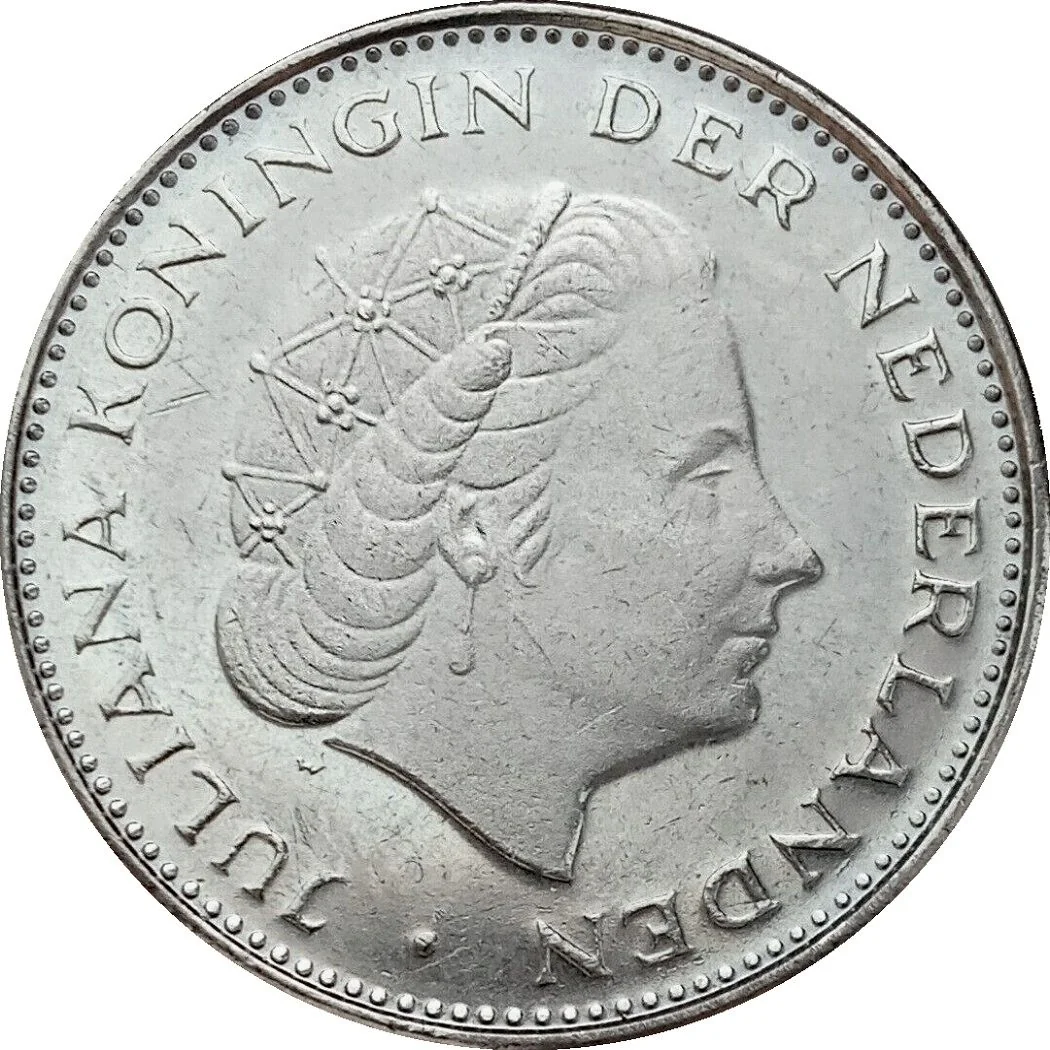
Queen Juliana facing right
Inscription:
JULIANA KONINGIN DER NEDERLANDEN •
W
W
Translation:
Juliana Queen of the Netherlands •
Script: Latin
Language: Dutch
Engraver: Ludwig Oswald Wenckebach
Reverse
Description:
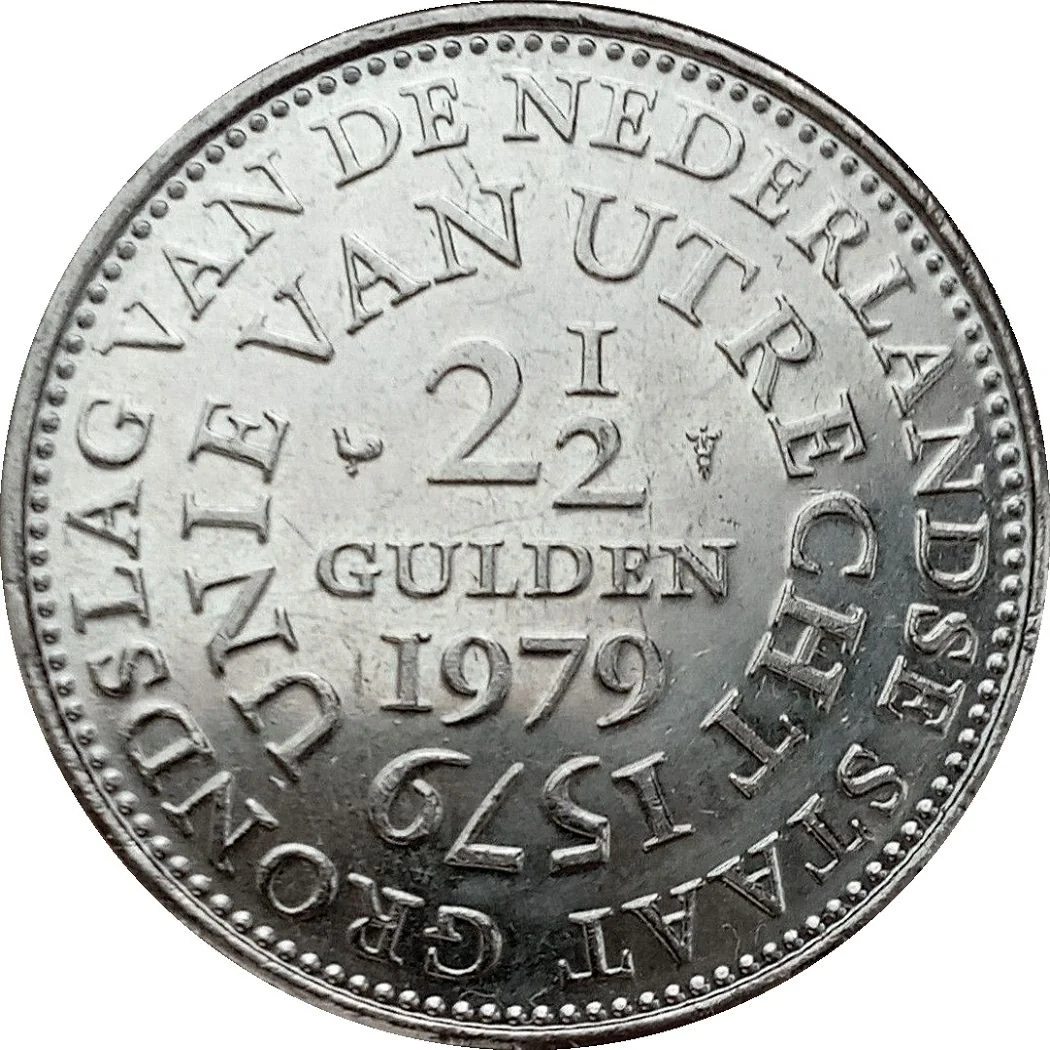
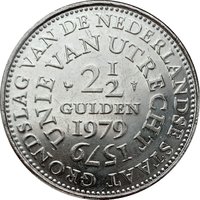
Denomination encircled by text.
Inscription:
GRONDSLAG VAN DE NEDERLANDSE STAAT
UNIE VAN UTRECHT 1579
2 12
GULDEN
1979
UNIE VAN UTRECHT 1579
2 12
GULDEN
1979
Translation:
Foundation of the Dutch State
Union of Utrecht 1579
2 1/2
Guilders
1979
Union of Utrecht 1579
2 1/2
Guilders
1979
Script: Latin
Language: Dutch
Engraver: Gerrit Noordzij
Edge
Plain with incuse lettering
Legend:
★ GOD ★ ZIJ ★ MET ★ ONS
Translation:
God be with us
Language: Dutch
Mints
| Name | Mark |
|---|---|
| Royal Dutch Mint | — |
Mintings
| Year | Mint Mark | Mintage | Quality | Collection |
|---|---|---|---|---|
| 1979 | — | 20,000,000 |
Historical background
In 1979, the Netherlands was a committed and influential member of the European Monetary System (EMS), which had launched that very year. The Dutch guilder was a cornerstone of the system's "snake in the tunnel" mechanism and its successor, the Exchange Rate Mechanism (ERM). The country's monetary policy was firmly anchored by the Deutsche Bundesbank, with the guilder maintaining an unwavering peg to the West German Deutsche Mark (DM). This close linkage, often called the "hard guilder" policy, was a fundamental tenet of Dutch economic policy, prioritizing low inflation and exchange rate stability over independent monetary maneuvering.
Domestically, this commitment came at a cost. To maintain the strict parity with the DM, the Nederlandsche Bank was forced to shadow German interest rates closely, even when the domestic economic cycle might have warranted a different approach. This constraint was particularly felt as the 1970s oil crises had created stagflationary pressures—a mix of high inflation and rising unemployment. While the hard-currency policy successfully imported German anti-inflation credibility, it limited the government's ability to use monetary tools to stimulate the Dutch economy and tackle joblessness.
Thus, the currency situation in 1979 was one of stability externally but constraint internally. The guilder was a pillar of the new European monetary cooperation project, enjoying a reputation as one of the continent's strongest currencies. However, this strength was achieved by effectively ceding monetary sovereignty to West Germany, a trade-off accepted by Dutch authorities to ensure price stability and foster deep economic integration with its most important trading partner, setting a precedent that would ultimately lead to Dutch participation in the euro.
Domestically, this commitment came at a cost. To maintain the strict parity with the DM, the Nederlandsche Bank was forced to shadow German interest rates closely, even when the domestic economic cycle might have warranted a different approach. This constraint was particularly felt as the 1970s oil crises had created stagflationary pressures—a mix of high inflation and rising unemployment. While the hard-currency policy successfully imported German anti-inflation credibility, it limited the government's ability to use monetary tools to stimulate the Dutch economy and tackle joblessness.
Thus, the currency situation in 1979 was one of stability externally but constraint internally. The guilder was a pillar of the new European monetary cooperation project, enjoying a reputation as one of the continent's strongest currencies. However, this strength was achieved by effectively ceding monetary sovereignty to West Germany, a trade-off accepted by Dutch authorities to ensure price stability and foster deep economic integration with its most important trading partner, setting a precedent that would ultimately lead to Dutch participation in the euro.
🌱 Very Common