

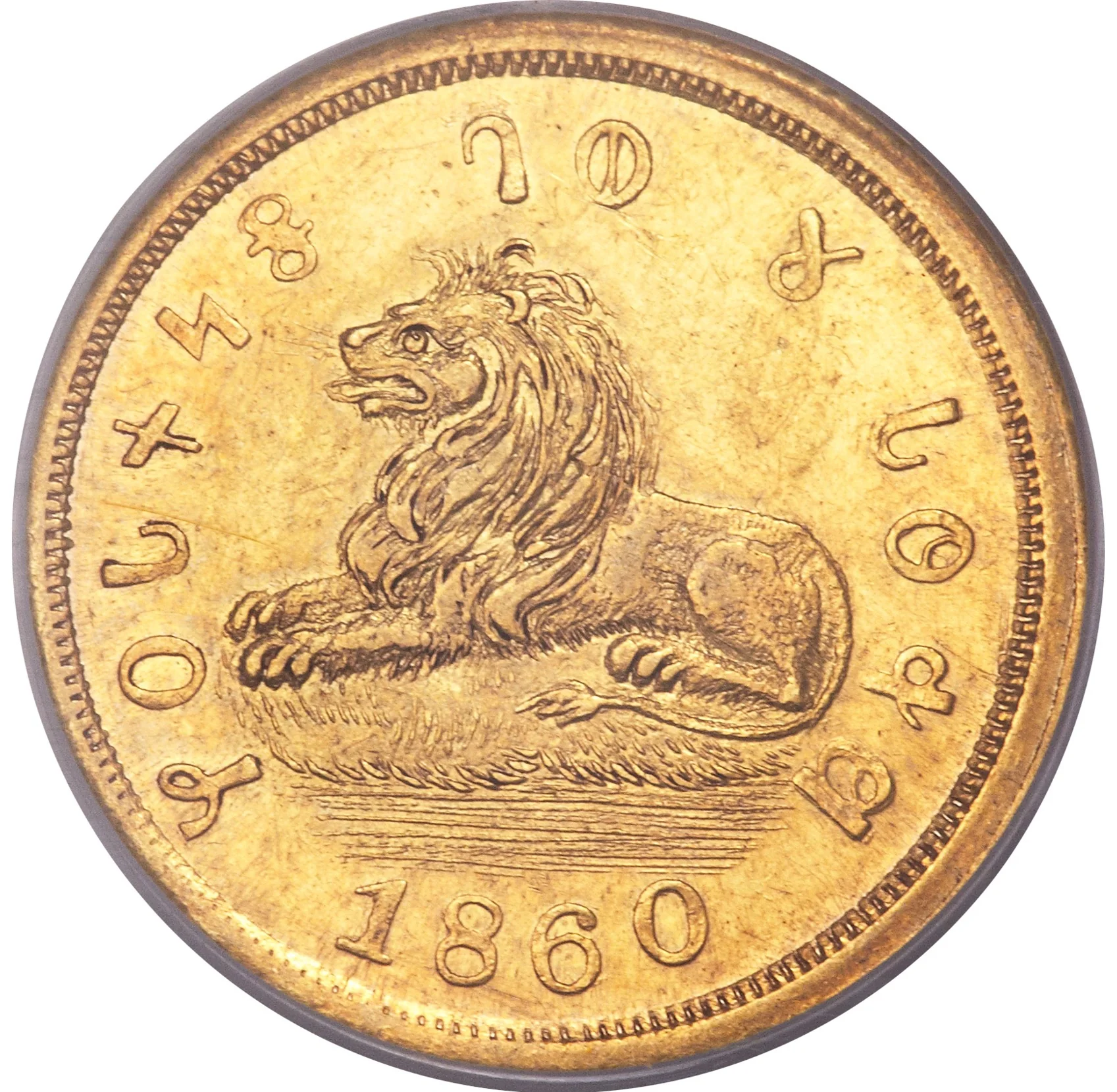
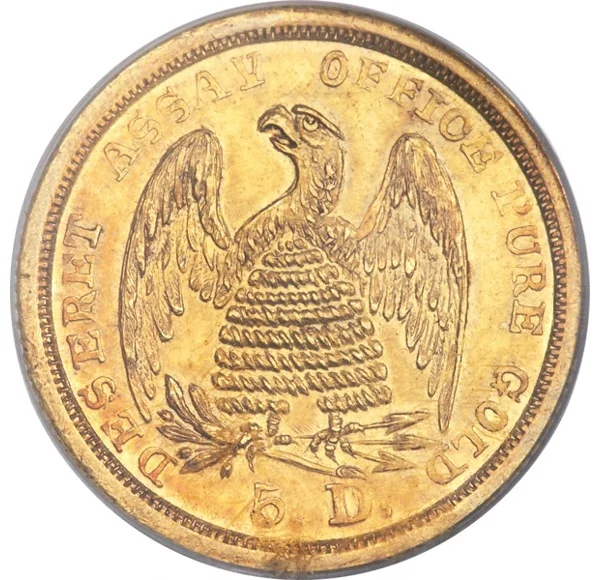
5 dollars – Utah
Add to wishlist
United States
Obverse
Reverse
Description:
Eagle with spread wings, beehive torso and legs.
Inscription:
DESERET ASSAY OFFICE PURE GOLD 5 D.
Script: Latin
Edge
Mints
| Name | Mark |
|---|---|
| Salt Lake City | — |
Mintings
| Year | Mint Mark | Mintage | Quality | Collection |
|---|---|---|---|---|
| 1860 | — | 472 |
Historical background
In 1860, Utah Territory operated under a unique and self-reliant monetary system, largely isolated from the national banking structures of the United States. The territory, dominated by members of the Church of Jesus Christ of Latter-day Saints, faced chronic shortages of federal coinage (specie) due to its remote location and the economic aftermath of the Utah War (1857-1858). Furthermore, distrust of eastern banks following the Panic of 1857 and a desire for economic independence led Brigham Young and the church leadership to actively discourage the use of outside banknotes, which were often seen as unreliable or worthless in the remote territory.
To facilitate commerce, the community relied heavily on a barter system, with livestock, farm produce, and labor serving as common mediums of exchange. More formally, the primary circulating currency was locally issued paper scrip, most notably the "Deseret Currency Association" notes. First issued in 1858, these notes were not legal tender but were widely accepted on faith within the Mormon community. They were backed not by gold or silver held in a vault, but by the credibility of the church-owned association and its promise to eventually redeem them in livestock or property. Concurrently, the church also minted a small quantity of gold coins in 1849 and 1860, using gold dust from California, but these were limited in quantity and did not solve the broader currency shortage.
Thus, Utah's 1860 economy functioned on a dual track: an internal, community-based system of scrip and barter, existing alongside and often deliberately separated from the external national currency system. This arrangement underscored the territorial goal of economic sovereignty and provided a functional, though fragile, solution to the isolation and lack of hard currency. The situation would begin to change only with the arrival of the transcontinental telegraph in 1861 and the railroad in 1869, which increasingly integrated Utah into the national economy and monetary framework.
To facilitate commerce, the community relied heavily on a barter system, with livestock, farm produce, and labor serving as common mediums of exchange. More formally, the primary circulating currency was locally issued paper scrip, most notably the "Deseret Currency Association" notes. First issued in 1858, these notes were not legal tender but were widely accepted on faith within the Mormon community. They were backed not by gold or silver held in a vault, but by the credibility of the church-owned association and its promise to eventually redeem them in livestock or property. Concurrently, the church also minted a small quantity of gold coins in 1849 and 1860, using gold dust from California, but these were limited in quantity and did not solve the broader currency shortage.
Thus, Utah's 1860 economy functioned on a dual track: an internal, community-based system of scrip and barter, existing alongside and often deliberately separated from the external national currency system. This arrangement underscored the territorial goal of economic sovereignty and provided a functional, though fragile, solution to the isolation and lack of hard currency. The situation would begin to change only with the arrival of the transcontinental telegraph in 1861 and the railroad in 1869, which increasingly integrated Utah into the national economy and monetary framework.
✨ Legendary