

10 Cents – Australia
Australia
Context
Years: 1966–2019
Issuer: Australia 
Ruler: Elizabeth II
Currency:
(since 1966)
Total mintage: 720,657,845
Material
References
KM: #Click to copy to clipboard65
Numista: #1282
Value
Exchange value: 0.10 AUD = $0.07
Inflation-adjusted value: 1.66 AUD
Obverse
Description:
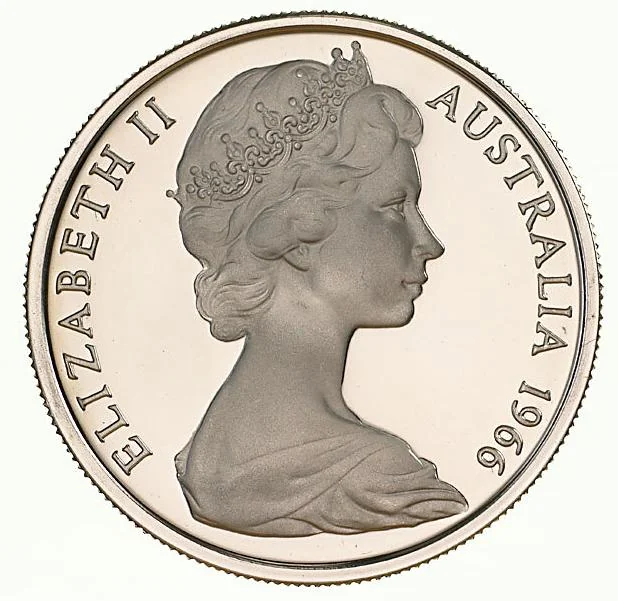
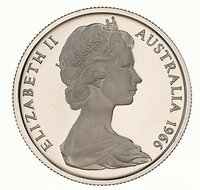
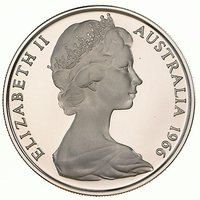
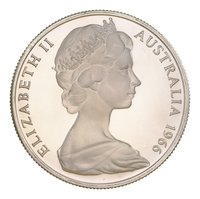
Queen Elizabeth II facing right in the Girls of Great Britain and Ireland Tiara.
Inscription:
ELIZABETH II
AUSTRALIA 1975
AUSTRALIA 1975
Script: Latin
Designer: Arnold Machin
Reverse
Description:
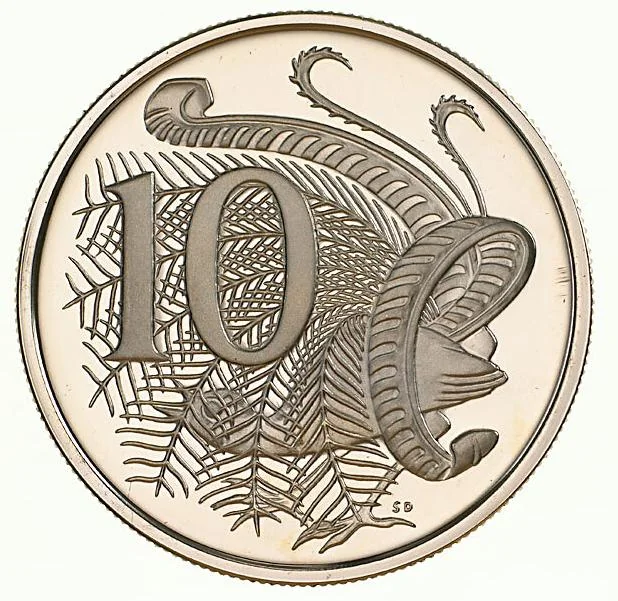
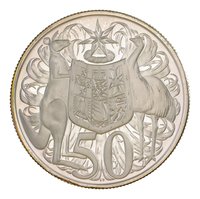
Male Superb Lyrebird with value overlay.
Inscription:
10 SD
Script: Latin
Designer: Stuart Devlin
Edge
Reeded
Mints
| Name | Mark |
|---|---|
| Royal Australian Mint | — |
| Royal Mint (Tower Hill) | — |
| Royal Mint | — |
Mintings
| Year | Mint Mark | Mintage | Quality | Collection |
|---|---|---|---|---|
| 1966 | — | 18,054 | Proof | |
| 1966 | — | — | BU | |
| 1966 | — | 30,000,000 | ||
| 1967 | — | 51,032,000 | ||
| 1968 | — | 57,206,000 | ||
| 1969 | — | 22,234,000 | ||
| 1969 | — | 13,056 | Proof | |
| 1969 | — | 14,351 | BU | |
| 1970 | — | 40,230 | BU | |
| 1970 | — | 22,306,000 | ||
| 1970 | — | 15,368 | Proof | |
| 1971 | — | 20,726,000 | ||
| 1971 | — | 10,066 | Proof | |
| 1971 | — | 28,572 | BU | |
| 1972 | — | 39,065 | BU | |
| 1972 | — | 10,272 | Proof | |
| 1972 | — | 12,502,000 | ||
| 1973 | — | 30,928 | BU | |
| 1973 | — | 27,320,000 | ||
| 1973 | — | 10,090 | Proof | |
| 1974 | — | 25,475 | BU | |
| 1974 | — | 46,550,000 | ||
| 1974 | — | 10,918 | Proof | |
| 1975 | — | 30,121 | BU | |
| 1975 | — | 50,900,000 | ||
| 1975 | — | 23,021 | Proof | |
| 1976 | — | 40,004 | BU | |
| 1976 | — | 57,060,000 | ||
| 1976 | — | 21,200 | Proof | |
| 1977 | — | 128,010 | BU | |
| 1977 | — | 10,940,000 | ||
| 1977 | — | 55,006 | Proof | |
| 1978 | — | 70,006 | BU | |
| 1978 | — | 48,400,000 | ||
| 1978 | — | 38,519 | Proof | |
| 1979 | — | 70,006 | BU | |
| 1979 | — | 36,950,000 | ||
| 1979 | — | 36,006 | Proof | |
| 1980 | — | 100,000 | BU | |
| 1980 | — | 55,084,000 | ||
| 1980 | — | 68,000 | Proof | |
| 1981 | — | 86,100 | Proof | |
| 1981 | — | 120,000 | BU | |
| 1981 | — | 1 | ||
| 1982 | — | 100,000 | Proof | |
| 1982 | — | 195,950 | BU | |
| 1982 | — | 61,492,000 | ||
| 1983 | — | 155,700 | BU | |
| 1983 | — | 82,318,000 | ||
| 1983 | — | 80,000 | Proof | |
| 1984 | — | 150,014 | BU | |
| 1984 | — | 25,728,000 | ||
| 1984 | — | 61,000 | Proof | |
| 2019 | — | 14,736 | BU |
Historical background
In 1966, Australia underwent a profound monetary transformation with the introduction of the Australian dollar on 14 February, a change known as decimalisation. This move replaced the centuries-old, complex system of pounds, shillings, and pence—a legacy of British colonial rule—with a decimal currency where one dollar equalled 100 cents. The decision, driven by a desire for modernisation and simplification in an increasingly globalised post-war economy, followed years of public debate and meticulous planning by the Decimal Currency Board, which oversaw the public education campaign and logistical challenge of the changeover.
The new currency was launched with a series of distinctive banknotes and coins featuring entirely Australian themes, a significant symbolic departure from the previous British imagery. The notes, from the $1 to the $10, portrayed notable Australian figures and, most iconically, the $1 coin (the "round dollar" was not introduced until 1984) was replaced in daily use by the $1 and $2 paper notes. The initial coin series included the one- and two-cent pieces, the five-cent (replacing the shilling), the ten-cent (replacing the florin), the twenty-cent (a new denomination), and the fifty-cent, a distinctive twelve-sided coin made of 80% silver.
The transition was remarkably smooth, aided by an extensive public information campaign featuring the cheerful cartoon character "Dollar Bill" and his jingle "In come the dollars and in come the cents / to replace the pounds and the shillings and the pence." Economically, the change did not alter the value of money itself—the new dollar was pegged at two to the old pound—but it streamlined commerce, banking, and education. The 1966 decimalisation is now viewed as a pivotal moment in Australia's economic and cultural maturation, marking a confident step away from its colonial past and aligning its financial systems with international standards.
The new currency was launched with a series of distinctive banknotes and coins featuring entirely Australian themes, a significant symbolic departure from the previous British imagery. The notes, from the $1 to the $10, portrayed notable Australian figures and, most iconically, the $1 coin (the "round dollar" was not introduced until 1984) was replaced in daily use by the $1 and $2 paper notes. The initial coin series included the one- and two-cent pieces, the five-cent (replacing the shilling), the ten-cent (replacing the florin), the twenty-cent (a new denomination), and the fifty-cent, a distinctive twelve-sided coin made of 80% silver.
The transition was remarkably smooth, aided by an extensive public information campaign featuring the cheerful cartoon character "Dollar Bill" and his jingle "In come the dollars and in come the cents / to replace the pounds and the shillings and the pence." Economically, the change did not alter the value of money itself—the new dollar was pegged at two to the old pound—but it streamlined commerce, banking, and education. The 1966 decimalisation is now viewed as a pivotal moment in Australia's economic and cultural maturation, marking a confident step away from its colonial past and aligning its financial systems with international standards.
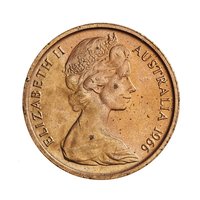
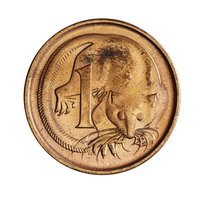
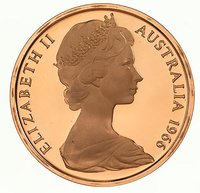
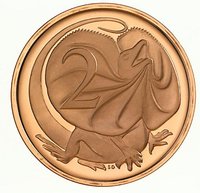
Series: 1966 Australia circulation coins
🌱 Very Common