

200 Pesetas – Spain
Non-circulating coins
Commemoration: Alonso de Ercilla
Spain
Context
Year: 1990
Issuer: Spain 
Ruler: Juan Carlos I
Currency:
(1868—2001)
Demonetized: Yes
Total mintage: 53,945
Material
References
KM: #Click to copy to clipboard856
Numista: #101345
Value
Exchange value: 200 ESP
Bullion value: $8.68
Inflation-adjusted value: 547.27 ESP
Obverse
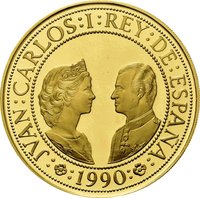
Description:
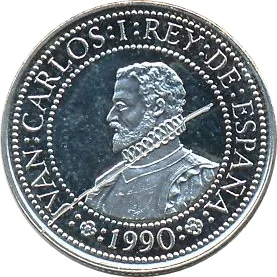
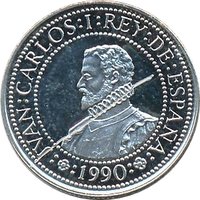
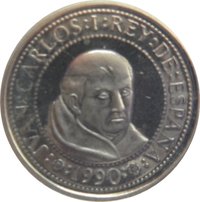
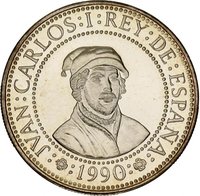
Bust of Alonso de Ercilla, left-facing.
Inscription:
: JVAN : CARLOS : I : REY : DE : ESPAÑA :
🏵: 1990 :🏵
🏵: 1990 :🏵
Translation:
JUAN CARLOS I KING OF SPAIN: 1990 :
Script: Latin
Language: Spanish
Engraver: Manuel Martinez Tornero
Reverse
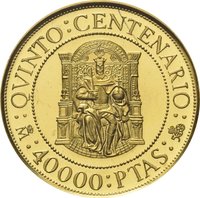
Description:
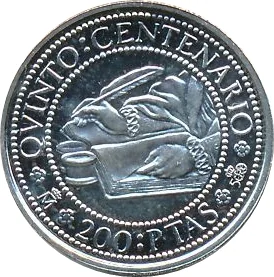
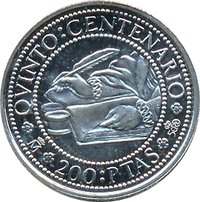
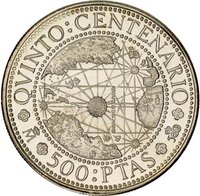
Pen writing in a book.
Inscription:
🏵 QVINTO : CENTENARIO 🏵
M 🏵 200 : PTAS 🏵 500
M 🏵 200 : PTAS 🏵 500
Translation:
QUINTO : CENTENARIO
M 200 : PTAS 500
M 200 : PTAS 500
Script: Latin
Engraver: Manuel Martinez Tornero
Edge
Segmented reeding (BU)Reeded (Proof)
Categories
| Art> Literature |
Mints
| Name | Mark |
|---|---|
| Royal Mint of Madrid | (M) |
Mintings
| Year | Mint Mark | Mintage | Quality | Collection |
|---|---|---|---|---|
| 1990 | M | 26,973 | BU | |
| 1990 | M | 26,972 | Proof |
Historical background
In 1990, Spain's currency situation was defined by its pivotal role within the European Monetary System (EMS) and its ongoing battle with domestic inflation. The country's currency, the peseta, had been a member of the EMS Exchange Rate Mechanism (ERM) since 1989, committing it to maintaining its value within a narrow band against other European currencies, most importantly the German Deutsche Mark. This membership was a strategic political and economic choice, signaling Spain's commitment to European integration and providing a disciplinary anchor for its economy. The primary goal was to import the anti-inflation credibility of the Bundesbank, thereby stabilizing the peseta and preparing the ground for eventual participation in a single European currency.
However, this period was marked by significant tension. While the peseta's ERM membership helped reduce inflation from the high double-digits of the early 1980s, it remained stubbornly high at around 6.5% in 1990, significantly above the German rate. This disparity created persistent pressure on the peseta, as high inflation eroded its competitiveness and real value. To defend the peseta's ERM parity, the Banco de España was forced to maintain high interest rates, which in turn stifled domestic economic growth. This policy dilemma—balancing the external constraint of a fixed exchange rate with internal economic needs—was the central challenge of Spanish monetary policy at the time.
The situation in 1990 set the stage for the currency crises that would follow in 1992-93. The underlying economic imbalances made the peseta vulnerable to speculative attacks, which materialized after the Maastricht Treaty was signed in 1992. Ultimately, the pressures proved too great, leading to a series of devaluations of the peseta within the ERM in September 1992 and May 1993. Thus, 1990 represents a critical juncture: a year of formal monetary alignment with Europe, but one where the foundational economic convergence required for a stable fixed exchange rate had not yet been fully achieved, foreshadowing the turbulence ahead.
However, this period was marked by significant tension. While the peseta's ERM membership helped reduce inflation from the high double-digits of the early 1980s, it remained stubbornly high at around 6.5% in 1990, significantly above the German rate. This disparity created persistent pressure on the peseta, as high inflation eroded its competitiveness and real value. To defend the peseta's ERM parity, the Banco de España was forced to maintain high interest rates, which in turn stifled domestic economic growth. This policy dilemma—balancing the external constraint of a fixed exchange rate with internal economic needs—was the central challenge of Spanish monetary policy at the time.
The situation in 1990 set the stage for the currency crises that would follow in 1992-93. The underlying economic imbalances made the peseta vulnerable to speculative attacks, which materialized after the Maastricht Treaty was signed in 1992. Ultimately, the pressures proved too great, leading to a series of devaluations of the peseta within the ERM in September 1992 and May 1993. Thus, 1990 represents a critical juncture: a year of formal monetary alignment with Europe, but one where the foundational economic convergence required for a stable fixed exchange rate had not yet been fully achieved, foreshadowing the turbulence ahead.


⭐ Rare