

10 cents – Fiji
Add to wishlist
Fiji
Context
Years: 1969–1985
Issuer: Fiji
Ruler: Elizabeth II
Currency:
(since 1969)
Demonetization: 30 June 2009
Total mintage: 11,805,500
Material
References
KM: #
Numista: #1279
Value
Exchange value: 0.10 FJD
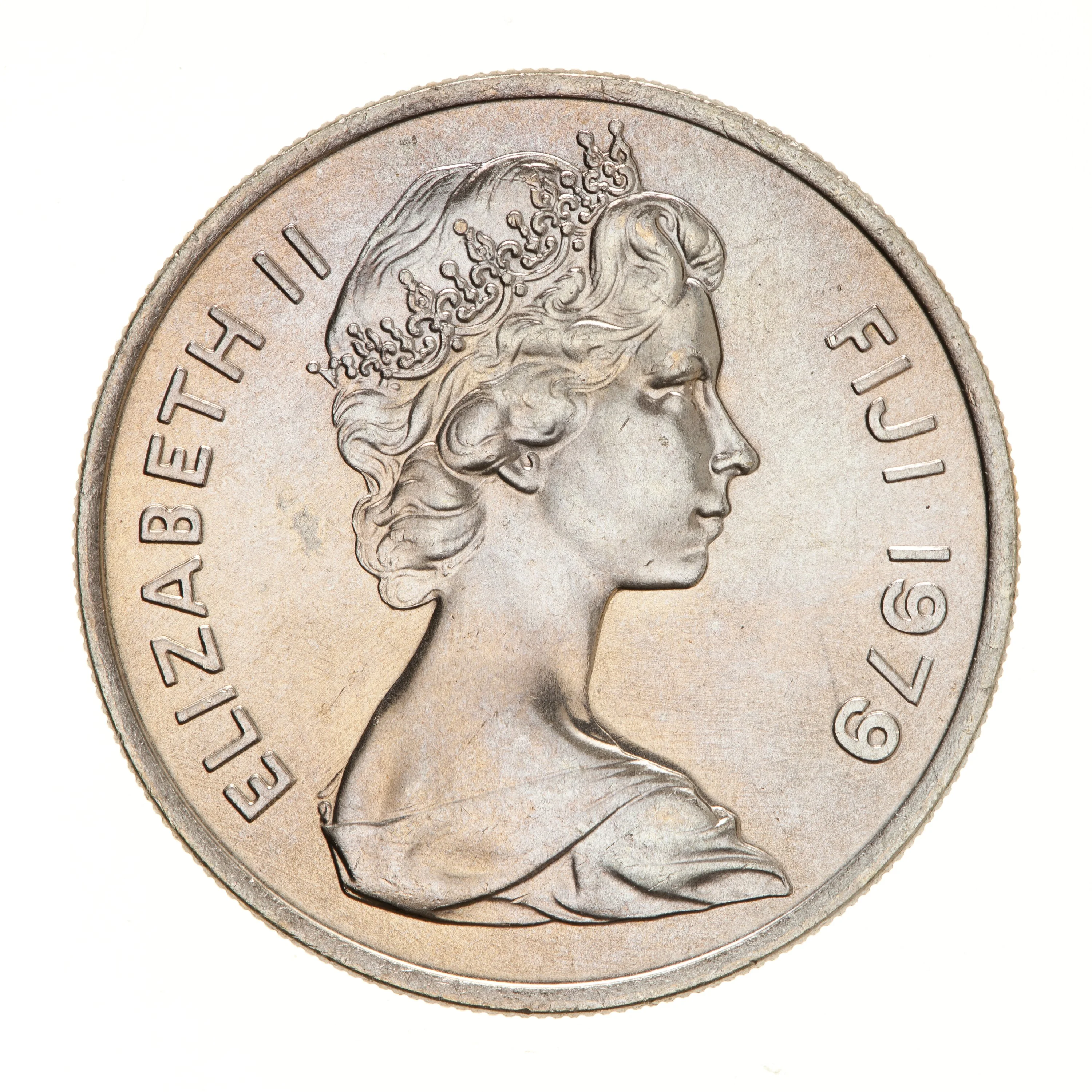
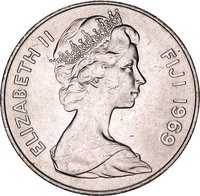
Obverse
Description:
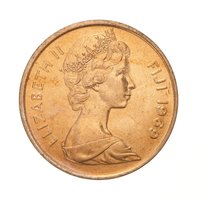
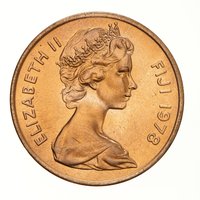
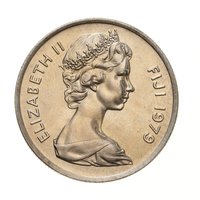
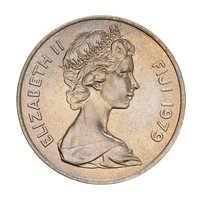
Young facing right, date beneath.
Inscription:
ELIZABETH II FIJI 1976
Translation:
ELIZABETH II FIJI 1976
Script: Latin
Language: English
Engraver: Arnold Machin
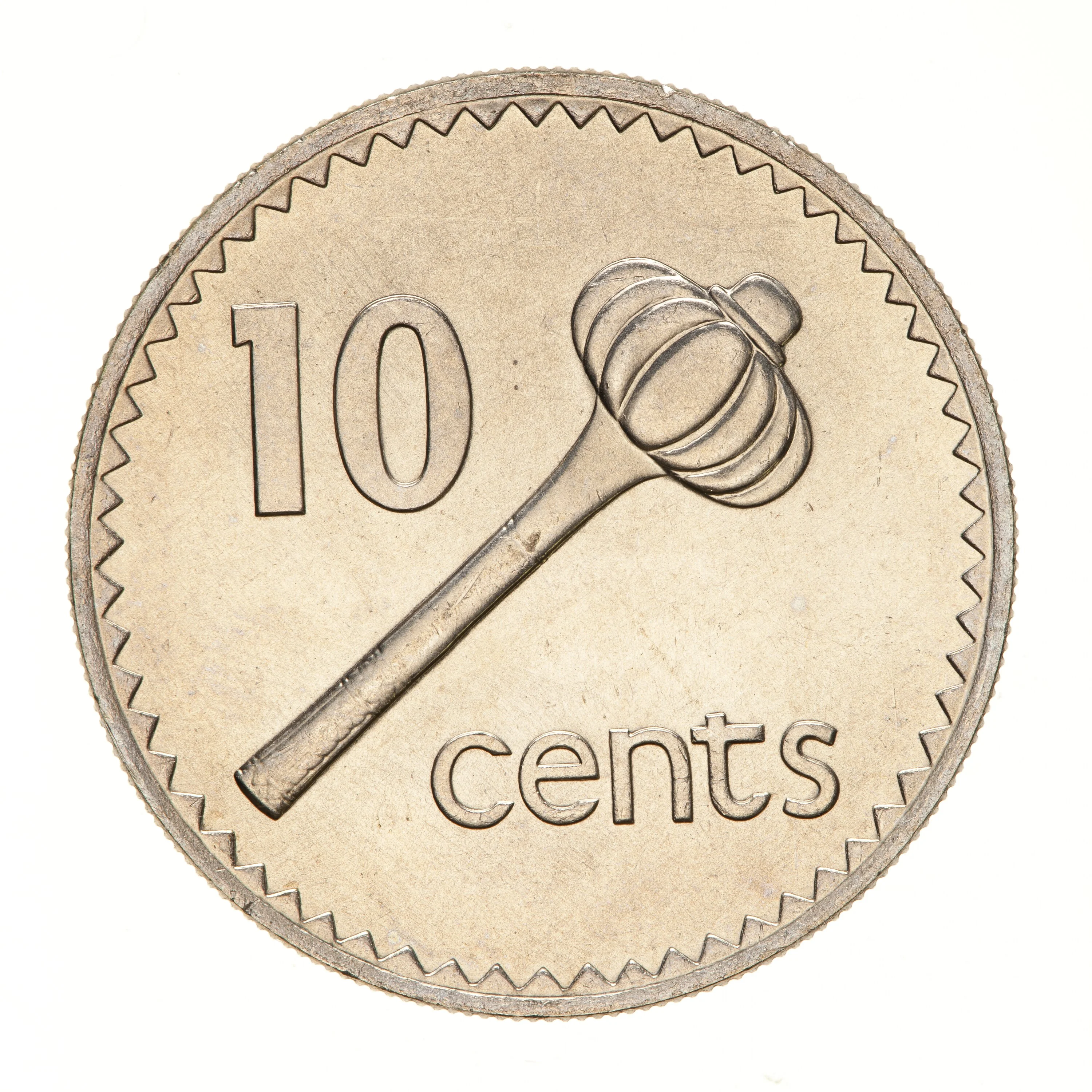
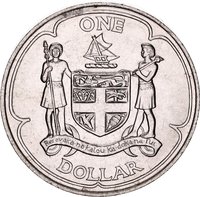
Reverse
Edge
Reeded
Categories
| Person> Monarch |
| Object> Cold weapons |
Mints
| Name | Mark |
|---|---|
| Royal Australian Mint | — |
| Royal Mint (Tower Hill) | — |
| Royal Mint | — |
| Singapore Mint | — |
Mintings
| Year | Mint Mark | Mintage | Quality | Collection |
|---|---|---|---|---|
| 1969 | — | 3,500,000 | ||
| 1969 | — | 10,000 | Proof | |
| 1973 | — | 750,000 | ||
| 1975 | — | 752,000 | ||
| 1976 | — | 805,000 | ||
| 1977 | — | 240,000 | ||
| 1978 | — | 664,000 | ||
| 1978 | — | 4,000 | BU | |
| 1978 | — | 2,000 | Proof | |
| 1979 | — | 702,000 | ||
| 1980 | — | 1,000,000 | ||
| 1980 | — | 2,500 | Proof | |
| 1981 | — | 1,200,000 | ||
| 1982 | — | 1,500,000 | ||
| 1982 | — | 3,000 | Proof | |
| 1983 | — | 3,000 | In sets | |
| 1983 | — | 3,000 | Proof | |
| 1984 | — | 5,000 | In sets | |
| 1985 | — | 660,000 |
Historical background
In 1969, Fiji was a British Crown Colony operating under a currency board system, with the Fijian pound (£F) pegged at par to the British pound sterling. This arrangement, established in 1934, ensured full convertibility and provided monetary stability by backing the local currency with sterling reserves. The economy was heavily dependent on sugar exports and a growing tourism sector, and the sterling peg facilitated predictable trade and investment flows with the United Kingdom, which was still its dominant economic partner. However, this system also meant Fiji had no independent monetary policy, leaving its currency vulnerable to the economic conditions and policy decisions made in Britain.
The period was one of quiet transition, as political developments towards independence, achieved in 1970, prompted a re-evaluation of the colonial monetary framework. Discussions were already underway regarding the creation of a distinct national currency as a symbol of sovereignty and a tool for future economic management. The stability of the currency board was appreciated, but there was a growing recognition that a newly independent nation might eventually require greater flexibility to respond to its own unique economic circumstances and diversify its international trade relationships beyond the Sterling Area.
Consequently, 1969 represents the final chapter of the classic colonial currency system in Fiji. The formal and stable environment of the Fijian pound, pegged to sterling, provided a solid foundation for the economy on the eve of independence. The groundwork was being laid for the significant monetary change that would follow just a few years later, with the introduction of the Fijian dollar in 1969, severing the direct link to the British pound and establishing a new decimalized currency fully backed by the soon-to-be sovereign state.
The period was one of quiet transition, as political developments towards independence, achieved in 1970, prompted a re-evaluation of the colonial monetary framework. Discussions were already underway regarding the creation of a distinct national currency as a symbol of sovereignty and a tool for future economic management. The stability of the currency board was appreciated, but there was a growing recognition that a newly independent nation might eventually require greater flexibility to respond to its own unique economic circumstances and diversify its international trade relationships beyond the Sterling Area.
Consequently, 1969 represents the final chapter of the classic colonial currency system in Fiji. The formal and stable environment of the Fijian pound, pegged to sterling, provided a solid foundation for the economy on the eve of independence. The groundwork was being laid for the significant monetary change that would follow just a few years later, with the introduction of the Fijian dollar in 1969, severing the direct link to the British pound and establishing a new decimalized currency fully backed by the soon-to-be sovereign state.
Series: 1969 Fiji circulation coins
🌱 Very Common