

Obverse
Description:
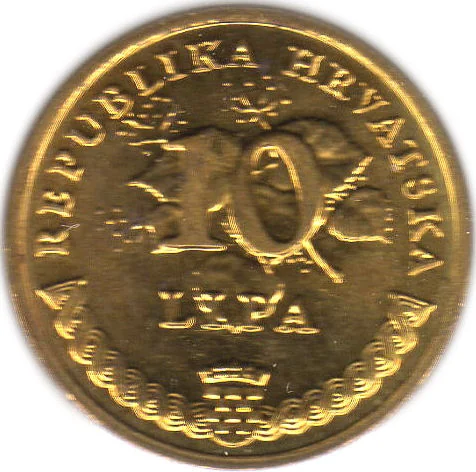
A stylized linden branch in bloom, with the coin value "10" on its leaves and "LIPA" below. "REPUBLIKA HRVATSKA" arches above, with the Croatian coat of arms and braided ornaments below.
Inscription:
REPUBLIKA HRVATSKA
10
LIPA
10
LIPA
Translation:
Republic of Croatia
10
Lipa
10
Lipa
Script: Latin
Language: Croatian
Engraver: Kuzma Kovačić
Reverse
Description:
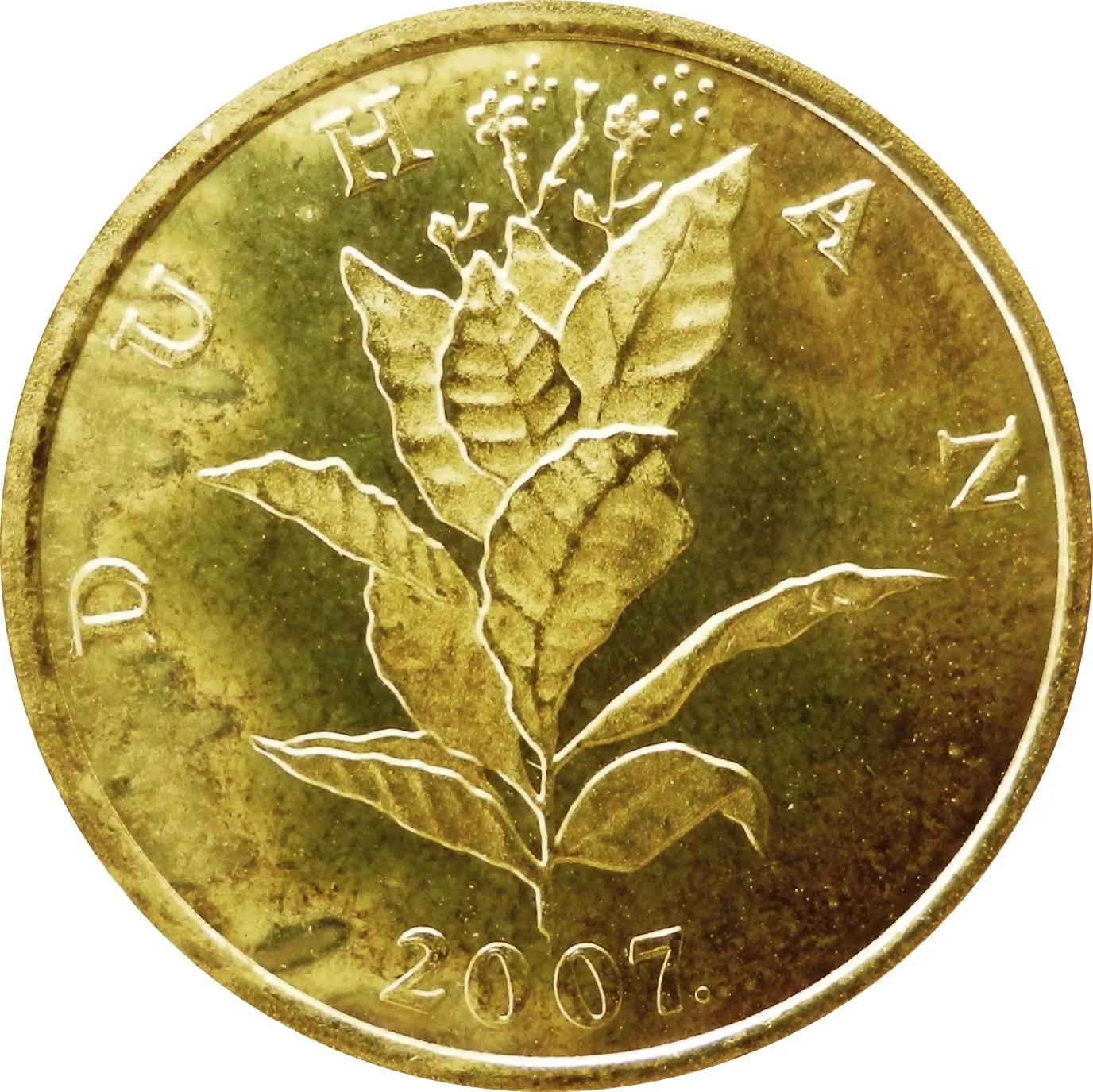
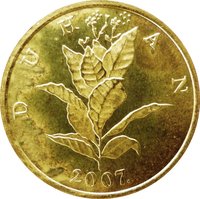
A tobacco stalk centers the inflorescence, with "DUHAN" above, the minting year and artist's initials on a leaf.
Inscription:
DUHAN
KK
2007.
KK
2007.
Translation:
Two Thousand Seven.
Script: Latin
Language: Hungarian
Engraver: Kuzma Kovačić
Edge
Smooth, without notches.
Mints
| Name | Mark |
|---|---|
| Croatian Mint | — |
Mintings
| Year | Mint Mark | Mintage | Quality | Collection |
|---|---|---|---|---|
| 1993 | — | 63,689,778 | ||
| 1993 | — | 17,000 | Proof | |
| 1995 | — | 26,335,500 | ||
| 1995 | — | 4,000 | Proof | |
| 1997 | — | 39,995,500 | ||
| 1997 | — | 1,000 | Proof | |
| 1999 | — | 51,500,000 | ||
| 1999 | — | 2,000 | Proof | |
| 2001 | — | 31,500,000 | ||
| 2001 | — | 1,000 | Proof | |
| 2003 | — | 1,000 | Proof | |
| 2003 | — | 28,000,000 | ||
| 2005 | — | 2,000 | Proof | |
| 2005 | — | 48,000,000 | ||
| 2007 | — | 1,000 | Proof | |
| 2007 | — | 57,000,000 | ||
| 2009 | — | 35,000,000 | ||
| 2009 | — | 1,000 | Proof | |
| 2011 | — | 47,000,000 | ||
| 2011 | — | 1,000 | Proof | |
| 2013 | — | 31,000,000 | ||
| 2013 | — | 1,000 | Proof | |
| 2015 | — | 1,000 | Proof | |
| 2015 | — | 56,315,000 | ||
| 2017 | — | 52,200,000 | ||
| 2017 | — | 500 | Proof | |
| 2019 | — | 43,485,000 | ||
| 2019 | — | 1,000 | Proof | |
| 2021 | — | 13,845,000 | ||
| 2021 | — | 500 | Proof |
Historical background
In 1993, Croatia was in the midst of its War of Independence (1991-1995), a period defined by severe economic disruption, hyperinflation, and monetary instability. The national currency, the Croatian dinar (HRD), introduced in 1991 to replace the Yugoslav dinar, was failing. It succumbed to rampant hyperinflation, driven by the enormous costs of war, a collapse in industrial production, trade blockades, and the financing of government deficits through money printing. Prices skyrocketed daily, eroding savings and wages, and creating a widespread reliance on barter and foreign currencies, particularly the German Deutsche Mark, for everyday transactions.
Recognizing the crisis, the government under President Franjo Tuđman undertook a radical and decisive monetary reform on October 1, 1993. This involved the introduction of a new currency, the kuna (HRK), replacing the dinar at a rate of 1 kuna for 1,000 dinars. The reform was not merely a redenomination; it was a comprehensive stabilization program backed by tight fiscal and monetary policies, including a sharp reduction in public spending and a commitment to not finance the deficit by printing money. The kuna was pegged to the Deutsche Mark to immediately import credibility and halt inflationary expectations.
The 1993 currency reform was a critical turning point. While the war's economic pressures continued, the introduction of the kuna successfully halted hyperinflation almost overnight and restored a basic level of monetary stability. It represented the first major step in rebuilding Croatia's independent economic institutions and establishing the sovereignty that would underpin its post-war recovery. The kuna remained the national currency until Croatia's adoption of the euro in 2023, marking the end of a monetary journey that began with this pivotal stabilization effort during a period of national crisis.
Recognizing the crisis, the government under President Franjo Tuđman undertook a radical and decisive monetary reform on October 1, 1993. This involved the introduction of a new currency, the kuna (HRK), replacing the dinar at a rate of 1 kuna for 1,000 dinars. The reform was not merely a redenomination; it was a comprehensive stabilization program backed by tight fiscal and monetary policies, including a sharp reduction in public spending and a commitment to not finance the deficit by printing money. The kuna was pegged to the Deutsche Mark to immediately import credibility and halt inflationary expectations.
The 1993 currency reform was a critical turning point. While the war's economic pressures continued, the introduction of the kuna successfully halted hyperinflation almost overnight and restored a basic level of monetary stability. It represented the first major step in rebuilding Croatia's independent economic institutions and establishing the sovereignty that would underpin its post-war recovery. The kuna remained the national currency until Croatia's adoption of the euro in 2023, marking the end of a monetary journey that began with this pivotal stabilization effort during a period of national crisis.
Series: 1993 Croatia circulation coins
🌱 Very Common