

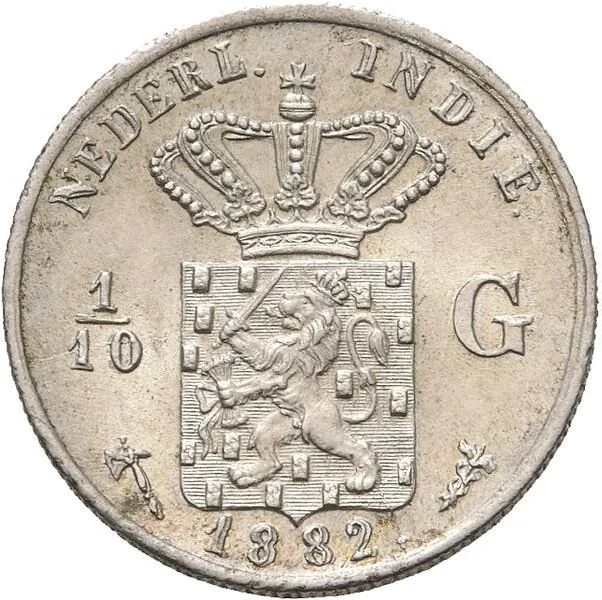
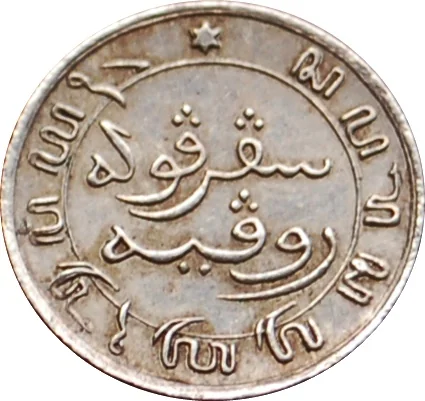
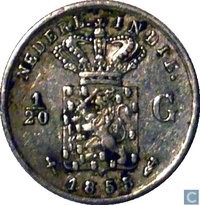
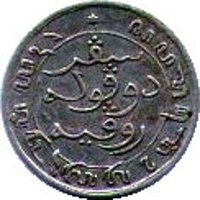
⅒ gulden – Netherlands East Indies
Add to wishlist
Indonesia
Context
Years: 1854–1901
Country: Indonesia
Issuer: Netherlands East Indies
Ruler: Wilhelmina
Currency:
(1854—1948)
Demonetization: 1 January 1952
Total mintage: 77,302,000
Material
References
KM: #
Numista: #12709
Value
Bullion value: $2.30
Obverse
Reverse
Edge
Reeded
Categories
| Symbol> Crown |
| Symbols> Coat of Arms |
Mints
| Name | Mark |
|---|---|
| Royal Dutch Mint | — |
Mintings
| Year | Mint Mark | Mintage | Quality | Collection |
|---|---|---|---|---|
| 1854 | — | 3,550,000 | ||
| 1854 | — | — | Proof | |
| 1855 | — | 6,452,000 | ||
| 1855 | — | — | Proof | |
| 1856 | — | 3,000,000 | ||
| 1857 | — | 11,000,000 | ||
| 1857 | — | — | Proof | |
| 1858 | — | 14,000,000 | ||
| 1882 | — | 7,500,000 | ||
| 1884 | — | 3,550,000 | ||
| 1884 | — | — | Proof | |
| 1885 | — | 825,000 | ||
| 1891 | — | 5,000,000 | ||
| 1891 | — | — | Proof | |
| 1893 | — | 5,000,000 | ||
| 1893 | — | — | Proof | |
| 1896 | — | 3,075,000 | ||
| 1896 | — | — | Proof | |
| 1898 | — | 2,500,000 | ||
| 1898 | — | — | Proof | |
| 1900 | — | 6,850,000 | ||
| 1901 | — | — | Proof | |
| 1901 | — | 5,000,000 |
Historical background
In 1854, the currency system of the Netherlands East Indies (NEI) was a complex and often problematic dual system, officially based on the Dutch guilder but dominated in everyday use by the Spanish silver dollar (known as the rijksdaalder or "Spanish mat"). The official currency was the silver Netherlands Indies guilder, pegged at par with its metropolitan counterpart. However, the colony suffered from a chronic shortage of these official coins, leading to the widespread circulation and de facto acceptance of various foreign silver coins, primarily the Spanish and later Mexican dollars. This created a situation where accounting was done in guilders, but physical transactions were often settled in silver dollars valued at a fluctuating market premium.
The Dutch authorities attempted to impose order through the Muntwet van 1854 (Coinage Act of 1854). This legislation aimed to standardize the currency by introducing new, distinct silver and copper coinage for the colony and demonetizing the foreign silver. Crucially, it sought to establish a fixed exchange rate between the silver guilder and the copper duit, the small-change coin vital for daily markets. However, the act was immediately controversial. It set the silver-to-copper exchange rate artificially low, failing to reflect the intrinsic metal value, which led to widespread hoarding of silver coins and a severe shortage of small change, disrupting local trade.
Consequently, the currency situation in 1854 was one of transition and turmoil. While the colonial government had taken a definitive legislative step to create a unified, sovereign currency system, the practical implementation was flawed. The economy remained in a state of adjustment, caught between the lingering old system of heterogeneous silver and the struggling new order, with the resulting coin shortages causing significant economic friction and discontent among both the European and indigenous populations.
The Dutch authorities attempted to impose order through the Muntwet van 1854 (Coinage Act of 1854). This legislation aimed to standardize the currency by introducing new, distinct silver and copper coinage for the colony and demonetizing the foreign silver. Crucially, it sought to establish a fixed exchange rate between the silver guilder and the copper duit, the small-change coin vital for daily markets. However, the act was immediately controversial. It set the silver-to-copper exchange rate artificially low, failing to reflect the intrinsic metal value, which led to widespread hoarding of silver coins and a severe shortage of small change, disrupting local trade.
Consequently, the currency situation in 1854 was one of transition and turmoil. While the colonial government had taken a definitive legislative step to create a unified, sovereign currency system, the practical implementation was flawed. The economy remained in a state of adjustment, caught between the lingering old system of heterogeneous silver and the struggling new order, with the resulting coin shortages causing significant economic friction and discontent among both the European and indigenous populations.
🌱 Common