

25 Korun (Czechoslovakian Liberation) – Czechoslovakia
Non-circulating coins
Commemoration: 20th Anniversary - Czechoslovakian Liberation
Context
Year: 1965
Issuer: Czechoslovakia 
Period:
(1960—1990)
Currency:
(1953—1992)
Demonetization: 30 September 2000
Total mintage: 155,000
Material
References
KM: #Click to copy to clipboard59
Numista: #12632
Value
Exchange value: 25 CSK
Bullion value: $23.24
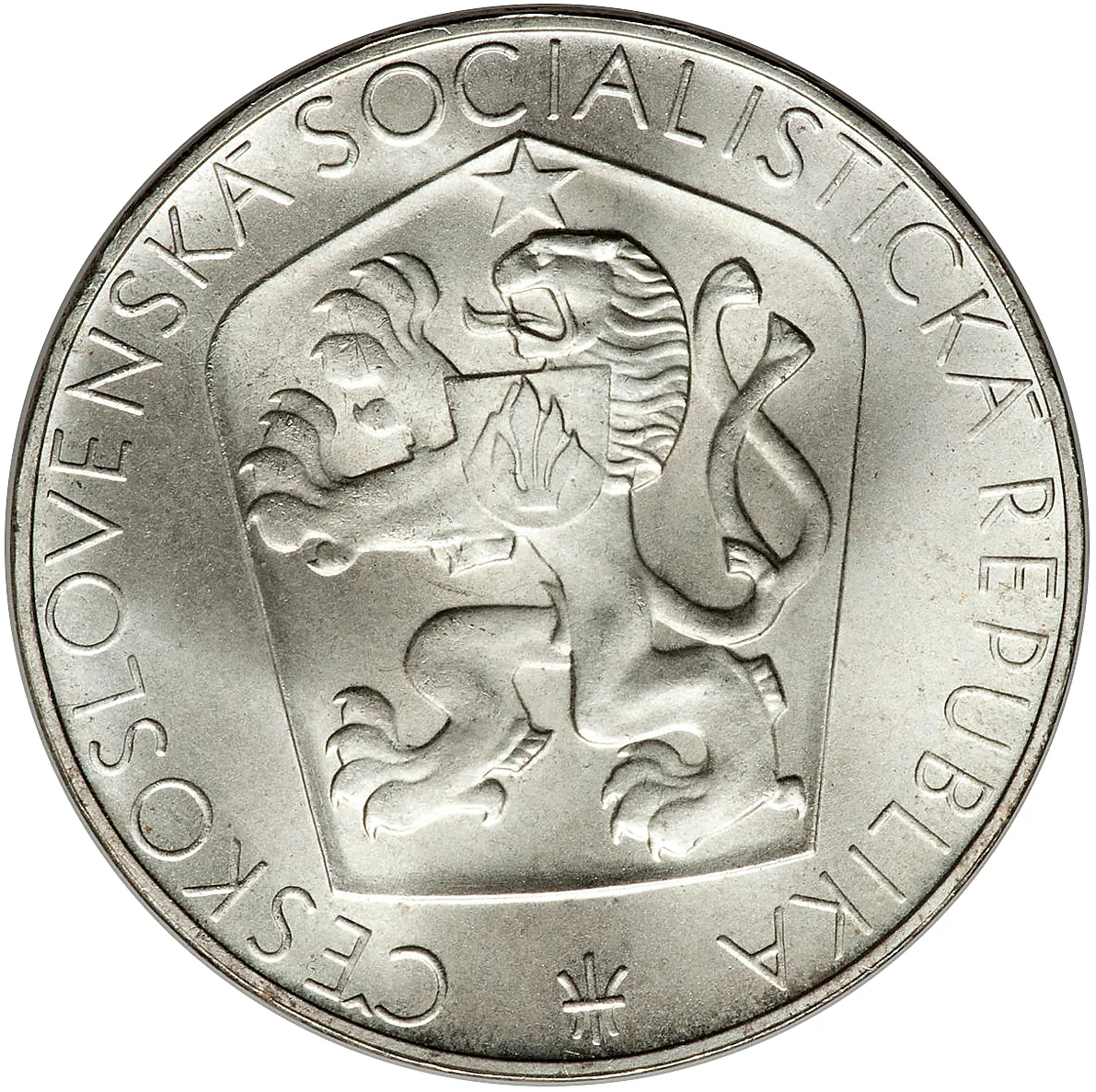
Obverse
Description:
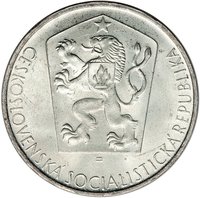
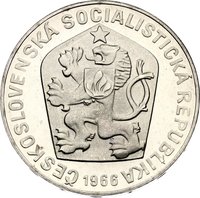
Czechoslovak socialist emblem.
Inscription:
ČESKOSLOVENSKÁ SOCIALISTICKÁ REPUBLIKA
Translation:
Czechoslovak Socialist Republic
Script: Latin
Engraver: Zdeněk Kolářský
Reverse
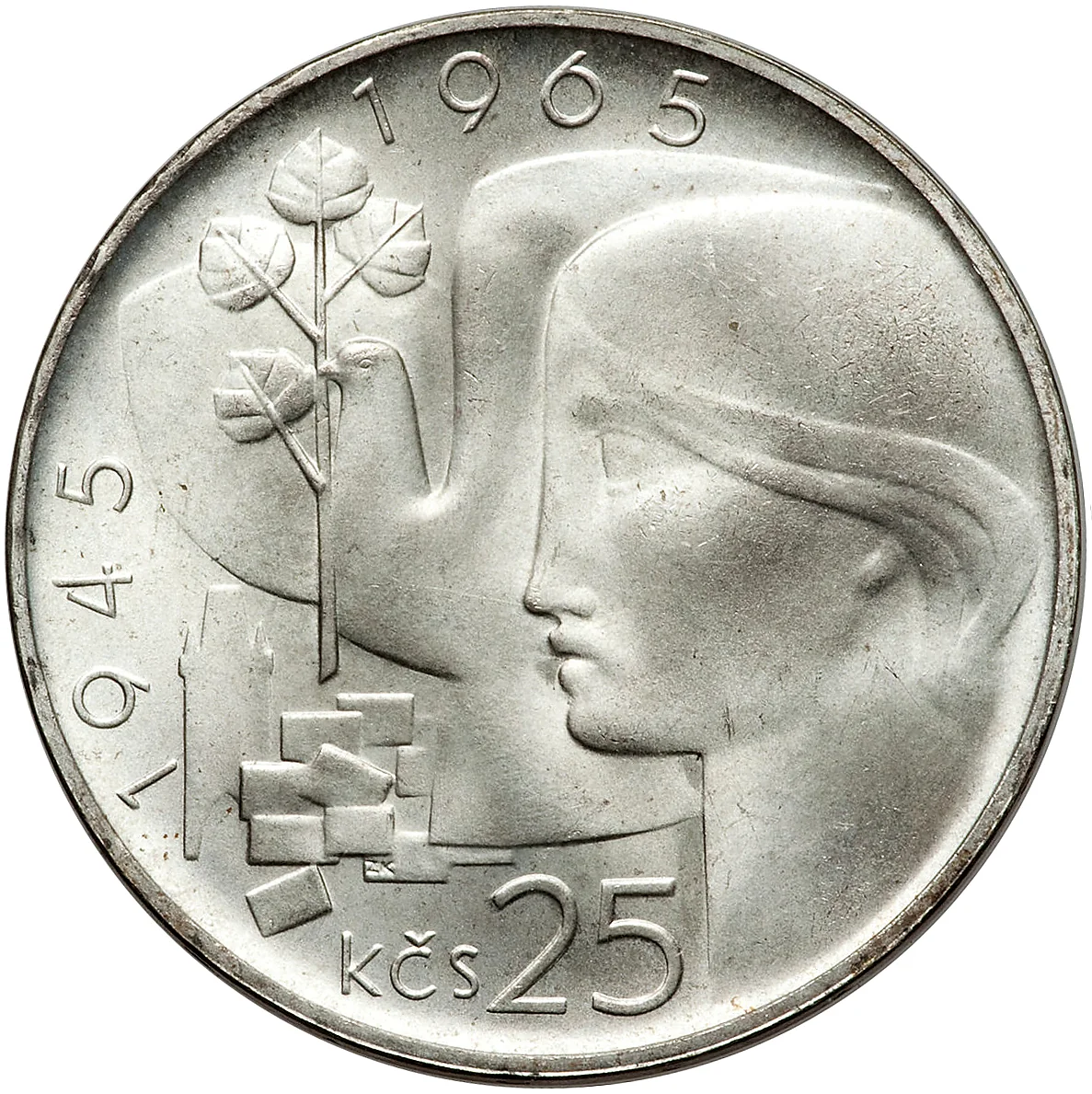
Description:
Left woman, dove, barricade at Charles Bridge Tower.
Inscription:
1945 1965
KČS 25
KČS 25
Translation:
Twenty-five Years of the Czechoslovak Socialist Republic
Script: Latin
Engraver: Zdeněk Kolářský
Edge
Smooth with inscription
Legend:
20 LET OSVOBOZENÍ ČSSR
Translation:
20 Years of the Liberation of the CSSR
Language: Czech
Mintings
| Year | Mint Mark | Mintage | Quality | Collection |
|---|---|---|---|---|
| 1965 | — | 150,000 | ||
| 1965 | — | 5,000 | Proof |
Historical background
By 1965, the currency situation in Czechoslovakia was characterized by a complex and problematic duality, a legacy of the Stalinist command economy. Officially, the Czechoslovak koruna (Kčs) had a fixed, overvalued exchange rate set by the state, which bore little relation to its actual purchasing power or economic reality. Internally, this system facilitated central planning but masked growing inefficiencies. Externally, it was part of the "transferable ruble" system within the Council for Mutual Economic Assistance (COMECON), which aimed to facilitate trade among Soviet-bloc nations but often resulted in cumbersome barter arrangements and did not reflect true market values.
This rigid official structure existed alongside a suppressed but telling parallel system. A special, more valuable "non-commercial" or "tourist" koruna rate was applied to foreign visitors, creating a tiered valuation. More significantly, a thriving black market for hard Western currencies (like US dollars and Deutsche Marks) operated outside state control. The black market rate revealed the stark gap between the official fiction and reality, with the koruna trading for a fraction of its official value. This undermined confidence in the currency and created distortions, as those with access to foreign exchange or special certificates could purchase goods in dedicated stores (Tuzex) that were unavailable to the general public.
The situation in 1965 was a clear symptom of the deeper economic stagnation that would culminate in the Prague Spring reforms of 1968. While the New Economic Model (introduced in the mid-1960s) tentatively aimed at decentralizing some economic controls, it did not fundamentally address the monetary system. The inherent contradictions of a non-convertible currency in a declining planned economy—chronic shortages of consumer goods, technological lag compared to the West, and inefficient foreign trade—were becoming increasingly apparent, setting the stage for the political and economic crises of the subsequent years.
This rigid official structure existed alongside a suppressed but telling parallel system. A special, more valuable "non-commercial" or "tourist" koruna rate was applied to foreign visitors, creating a tiered valuation. More significantly, a thriving black market for hard Western currencies (like US dollars and Deutsche Marks) operated outside state control. The black market rate revealed the stark gap between the official fiction and reality, with the koruna trading for a fraction of its official value. This undermined confidence in the currency and created distortions, as those with access to foreign exchange or special certificates could purchase goods in dedicated stores (Tuzex) that were unavailable to the general public.
The situation in 1965 was a clear symptom of the deeper economic stagnation that would culminate in the Prague Spring reforms of 1968. While the New Economic Model (introduced in the mid-1960s) tentatively aimed at decentralizing some economic controls, it did not fundamentally address the monetary system. The inherent contradictions of a non-convertible currency in a declining planned economy—chronic shortages of consumer goods, technological lag compared to the West, and inefficient foreign trade—were becoming increasingly apparent, setting the stage for the political and economic crises of the subsequent years.
🌱 Fairly Common