

10 korun (Great Moravia) – Czechoslovakia
Add to wishlist
Non-circulating coins
Commemoration: 1100th Anniversary of Great Moravia
Context
Year: 1966
Issuer: Czechoslovakia
Period:
(1960—1990)
Currency:
(1953—1992)
Demonetization: 30 September 2000
Total mintage: 120,000
Material
References
KM: #
Numista: #12626
Value
Exchange value: 10 CSK
Bullion value: $15.30
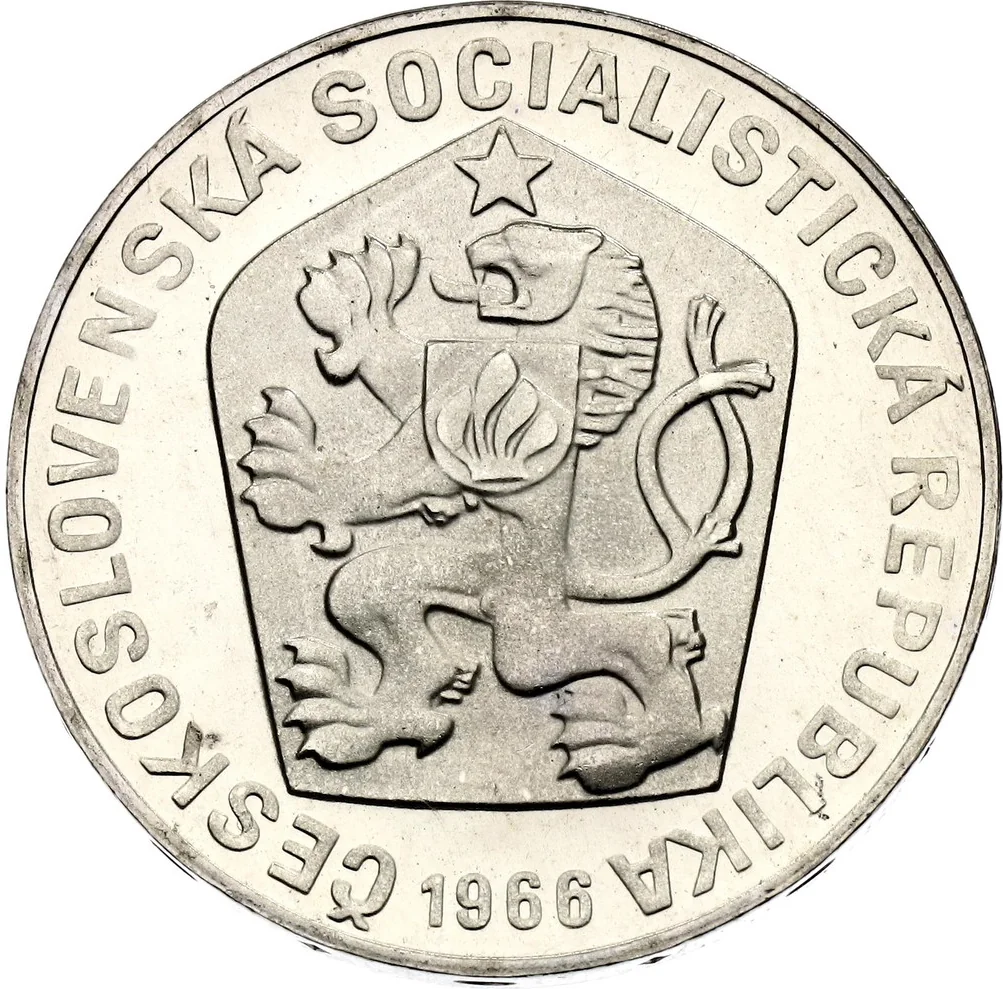
Obverse
Description:
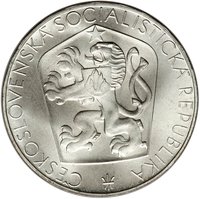
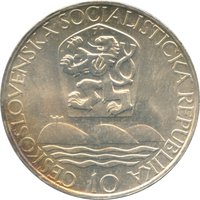
Czechoslovak Socialist emblem with encircling text.
Inscription:
ČESKOSLOVENSKÁ SOCIALISTICKÁ REPUBLIKA
1966
1966
Translation:
Czechoslovak Socialist Republic
1966
1966
Script: Latin
Engravers: Luboš Růžička, Jan Solpera
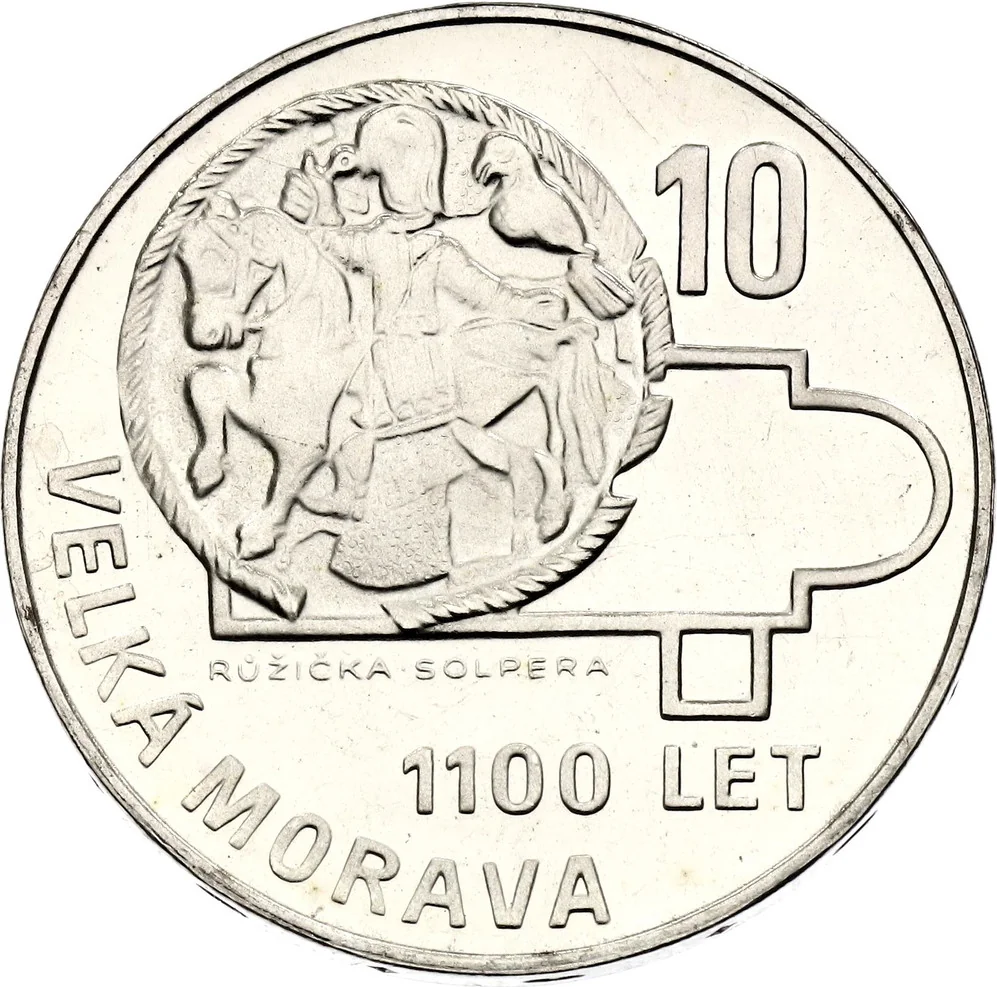
Reverse
Description:
Medieval seal on geometric pattern, legend beneath.
Inscription:
10
RŮŽIČKA-SOLPERA
1100 LET
VELKÁ MORAVA
RŮŽIČKA-SOLPERA
1100 LET
VELKÁ MORAVA
Translation:
RŮŽIČKA-SOLPERA
1100 YEARS
GREAT MORAVIA
1100 YEARS
GREAT MORAVIA
Script: Latin
Language: Czech
Engravers: Luboš Růžička, Jan Solpera
Edge
Plain with incuse symbols (diamonds and ovals)
Mintings
| Year | Mint Mark | Mintage | Quality | Collection |
|---|---|---|---|---|
| 1966 | — | 115,000 | ||
| 1966 | — | 5,000 | Proof |
Historical background
In 1966, Czechoslovakia operated under a strict, centrally planned economy with a non-convertible currency, the Czechoslovak koruna (Kčs). The official exchange rate was set arbitrarily by the state, bearing little relation to market forces or the currency's actual purchasing power. For citizens and domestic enterprises, access to foreign "hard" currencies like US dollars or Deutsche Marks was virtually impossible through official channels, creating a significant barrier to international trade and travel. This rigid system was a hallmark of the country's membership in the Soviet-led Council for Mutual Economic Assistance (COMECON), where trade was often conducted through bilateral barter agreements rather than convertible currency.
Beneath the surface of state control, however, a complex dual system existed. A separate, much more valuable "tourist" or "foreign exchange" koruna was used for visitors from the West, granting them access to special stores (Tuzex) with a selection of goods unavailable to the general public. Furthermore, a pervasive black market for hard currency thrived, where the real value of the koruna was a fraction of its official rate. This disparity highlighted the growing inefficiencies of the planned economy and the pent-up consumer demand that the state could not satisfy through domestic production.
The currency situation in 1966 existed within a period of cautious economic reform, known as the New Economic Model, which aimed to introduce limited market mechanisms and decentralize some planning. While these reforms did not directly tackle currency convertibility, they reflected a recognition within parts of the Communist Party that the economy was stagnating. The inflexible monetary system was a core problem, insulating Czechoslovak industry from global competition and technological progress, and contributing to the economic frustrations that would become part of the broader societal momentum leading to the Prague Spring of 1968.
Beneath the surface of state control, however, a complex dual system existed. A separate, much more valuable "tourist" or "foreign exchange" koruna was used for visitors from the West, granting them access to special stores (Tuzex) with a selection of goods unavailable to the general public. Furthermore, a pervasive black market for hard currency thrived, where the real value of the koruna was a fraction of its official rate. This disparity highlighted the growing inefficiencies of the planned economy and the pent-up consumer demand that the state could not satisfy through domestic production.
The currency situation in 1966 existed within a period of cautious economic reform, known as the New Economic Model, which aimed to introduce limited market mechanisms and decentralize some planning. While these reforms did not directly tackle currency convertibility, they reflected a recognition within parts of the Communist Party that the economy was stagnating. The inflexible monetary system was a core problem, insulating Czechoslovak industry from global competition and technological progress, and contributing to the economic frustrations that would become part of the broader societal momentum leading to the Prague Spring of 1968.
🌱 Fairly Common