

50 Cents – Australia
Circulating commemorative coins
Commemoration: Australian Capital Territory
Series: 100th Anniversary of Federation
Australia
Context

Material
Diameter: 31.51 mm
Weight: 15.55 g
Thickness: 3 mm
Shape: Dodecagonal
Standard: Silver half ounce
Technique: Milled
Alignment: Medal alignment

flip
References
KM: #Click to copy to clipboard553
Numista: #12597
Value
Exchange value: 0.50 AUD = $0.36
Inflation-adjusted value: 0.97 AUD
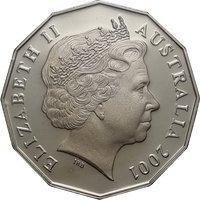
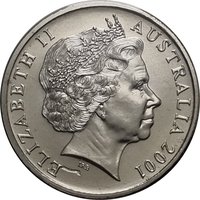
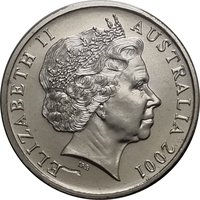
Obverse
Description:
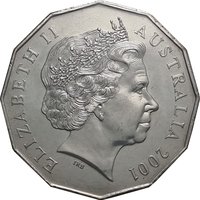
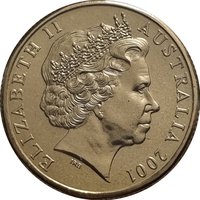
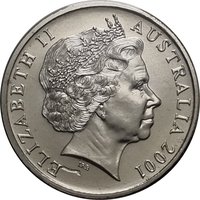
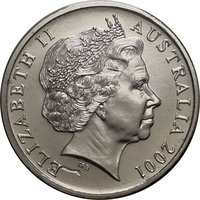
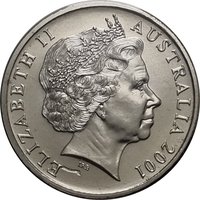
Queen Elizabeth IV, facing right, wearing the Girls of Great Britain and Ireland Tiara.
Inscription:
ELIZABETH II
AUSTRALIA
IRB
AUSTRALIA
IRB
Script: Latin
Designer: Ian Rank-Broadley
Reverse
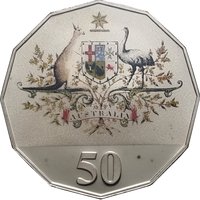
Description:
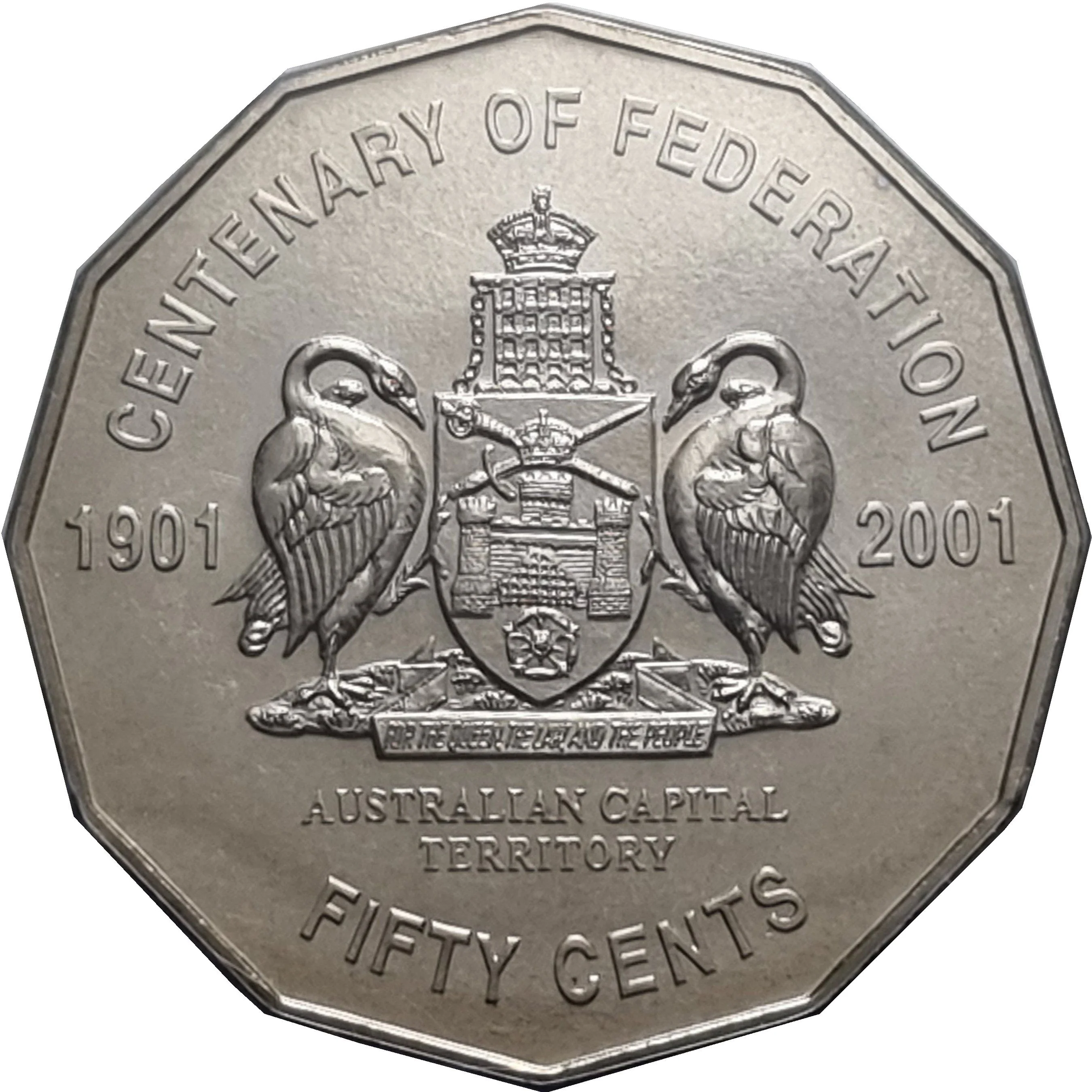
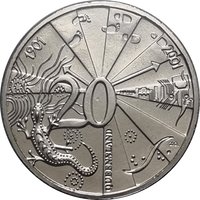
The coat of arms of the Australian Capital Territory features a shield with a castle, rose, sword, and sceptre under a crown, supported by black and mute swans, with a motto below.
Inscription:
CENTENARY OF FEDERATION
1901 2001
AUSTRALIAN CAPITAL
TERRITORY
FIFTY CENTS
1901 2001
AUSTRALIAN CAPITAL
TERRITORY
FIFTY CENTS
Script: Latin
Edge
12 Sided Smooth
Categories
| Symbols> Coat of Arms |
| Animal> Bird |
Mints
| Name | Mark |
|---|---|
| Royal Australian Mint | — |
Mintings
| Year | Mint Mark | Mintage | Quality | Collection |
|---|---|---|---|---|
| 2001 | — | 21,142 | BU | |
| 2001 | — | 2,000,000 | ||
| 2001 | — | 10,244 | Proof |
Historical background
In 2001, Australia's currency situation was dominated by the notable decline of the Australian dollar (AUD), which fell to historic lows against the US dollar (USD). The AUD, often seen as a commodity currency, was pressured by a combination of global and domestic factors. Internationally, the US dollar was strong, and a slowdown in major economies, particularly Japan and the United States, weakened demand for Australia's key exports. Domestically, the economy was perceived as underperforming relative to other developed nations, and the Reserve Bank of Australia (RBA) had maintained a relatively high-interest-rate differential that failed to attract sustained support. This confluence led the AUD to breach the psychologically significant level of US$0.50 in early April 2001, reaching a then-record low of approximately US$0.4775.
The currency's weakness became a significant political and economic issue, sparking public debate about national economic management and confidence. The Howard Government and the RBA generally adopted a stance of non-intervention, viewing the depreciation as a corrective adjustment that would bolster export competitiveness. However, the low dollar also raised concerns about imported inflation and increased the cost of servicing foreign debt. Public attention was captured by vocal commentary, including from then-Treasurer Peter Costello, who famously urged Australians to "have a cup of coffee" and not panic, framing the slide as part of a necessary global realignment rather than a crisis.
By the latter half of 2001, the AUD began a gradual recovery from its lows, a trend that would solidify in the following years. This turnaround was aided by an improving global economic outlook and, crucially, the onset of what would become a prolonged China-driven commodity boom. The events of 2001 ultimately proved to be the trough of the AUD's multi-year decline from its 1980s highs, setting the stage for a sustained period of strength in the subsequent decade as Australia's economic ties with Asia deepened and its terms of trade dramatically improved.
The currency's weakness became a significant political and economic issue, sparking public debate about national economic management and confidence. The Howard Government and the RBA generally adopted a stance of non-intervention, viewing the depreciation as a corrective adjustment that would bolster export competitiveness. However, the low dollar also raised concerns about imported inflation and increased the cost of servicing foreign debt. Public attention was captured by vocal commentary, including from then-Treasurer Peter Costello, who famously urged Australians to "have a cup of coffee" and not panic, framing the slide as part of a necessary global realignment rather than a crisis.
By the latter half of 2001, the AUD began a gradual recovery from its lows, a trend that would solidify in the following years. This turnaround was aided by an improving global economic outlook and, crucially, the onset of what would become a prolonged China-driven commodity boom. The events of 2001 ultimately proved to be the trough of the AUD's multi-year decline from its 1980s highs, setting the stage for a sustained period of strength in the subsequent decade as Australia's economic ties with Asia deepened and its terms of trade dramatically improved.
Series: 100th Anniversary of Federation

🌱 Common