

1 crown – Australia
Add to wishlist
Circulating commemorative coins
Commemoration: Coronation of King George VI
Australia
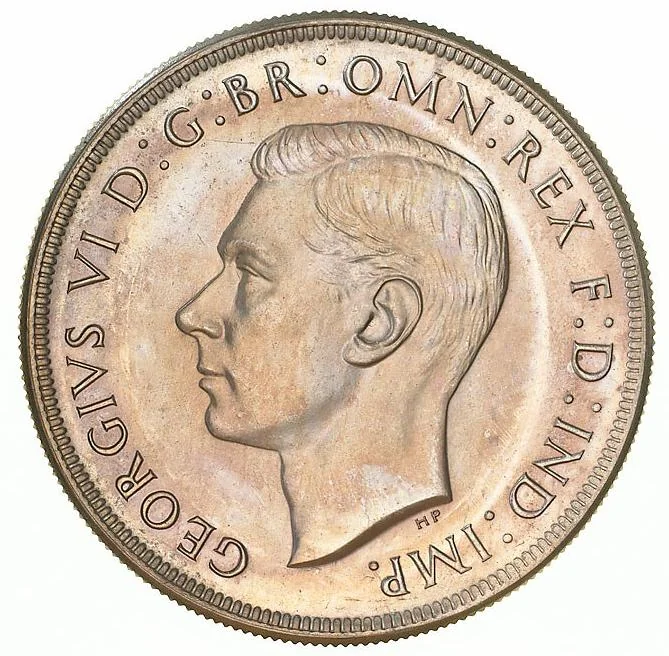
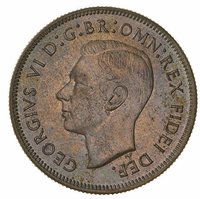
Obverse
Description:
King George VI, left-facing portrait.
Inscription:
GEORGIVS VI D:G:BR:OMN:REX F:D:IND:IMP.
HP
HP
Translation:
George VI by the Grace of God King of all the Britains Defender of the Faith Emperor of India.
Script: Latin
Language: Latin
Designer: Thomas Humphrey Paget
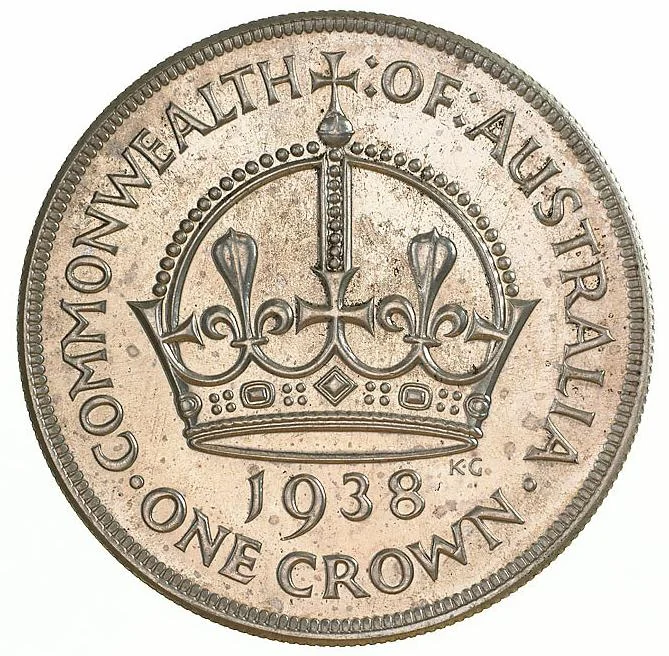
Reverse
Description:
Victoria’s Diamond Crown over date and value.
Inscription:
COMMONWEALTH:OF:AUSTRALIA
1937
• ONE CROWN •
1937
• ONE CROWN •
Script: Latin
Designer: George Kruger Gray
Edge
Reeded
Categories
| Event> Coronation |
Mints
| Name | Mark |
|---|---|
| Royal Mint | — |
Mintings
| Year | Mint Mark | Mintage | Quality | Collection |
|---|---|---|---|---|
| 1937 | — | 1,008,000 | ||
| 1937 | — | 100 | Proof | |
| 1938 | — | 101,600 | ||
| 1938 | — | 100 | Proof |
Historical background
In 1937, Australia's currency was firmly embedded within the Sterling Area, operating under the gold standard framework established by the Australian Pound (A£). The currency was pegged to British Pound Sterling at parity, meaning one A£ equalled one UK£. This link was maintained by the Commonwealth Bank of Australia (the nation's central bank until the Reserve Bank's establishment in 1960), which held its reserves primarily in gold and Sterling balances in London. The system ensured stable exchange rates with Britain, Australia's dominant trading partner and source of investment, but it also meant domestic monetary policy was largely subordinated to the economic conditions and decisions made in the United Kingdom.
The economy was emerging from the depths of the Great Depression, yet the recovery was uneven and the currency system faced underlying pressures. The primary export commodities of wool and wheat had seen price improvements from their early-1930s lows, boosting export income and Sterling reserves. However, this recovery was fragile and the economy remained heavily dependent on volatile primary product markets. Furthermore, the fixed exchange rate and adherence to the gold standard had previously forced severe deflationary policies during the Depression, a memory which fostered ongoing political and economic debate about the need for greater monetary independence to manage domestic conditions.
Consequently, 1937 stood at a crossroads between orthodox financial tradition and emerging change. While the formal gold standard parity was maintained, its practical operation had been subtly adjusted following Britain's own departure from the gold standard in 1931, with the Australian pound effectively shadowing Sterling's fluctuations. Discussions among economists and some policymakers increasingly questioned the rigidity of the system, advocating for mechanisms that would allow the currency to better absorb external shocks. Thus, the currency situation was one of surface stability underpinned by the Sterling link, but with growing intellectual and practical scrutiny that would eventually lead to a more independent monetary framework in the decades to follow.
The economy was emerging from the depths of the Great Depression, yet the recovery was uneven and the currency system faced underlying pressures. The primary export commodities of wool and wheat had seen price improvements from their early-1930s lows, boosting export income and Sterling reserves. However, this recovery was fragile and the economy remained heavily dependent on volatile primary product markets. Furthermore, the fixed exchange rate and adherence to the gold standard had previously forced severe deflationary policies during the Depression, a memory which fostered ongoing political and economic debate about the need for greater monetary independence to manage domestic conditions.
Consequently, 1937 stood at a crossroads between orthodox financial tradition and emerging change. While the formal gold standard parity was maintained, its practical operation had been subtly adjusted following Britain's own departure from the gold standard in 1931, with the Australian pound effectively shadowing Sterling's fluctuations. Discussions among economists and some policymakers increasingly questioned the rigidity of the system, advocating for mechanisms that would allow the currency to better absorb external shocks. Thus, the currency situation was one of surface stability underpinned by the Sterling link, but with growing intellectual and practical scrutiny that would eventually lead to a more independent monetary framework in the decades to follow.
🌱 Common