

Obverse
Description:
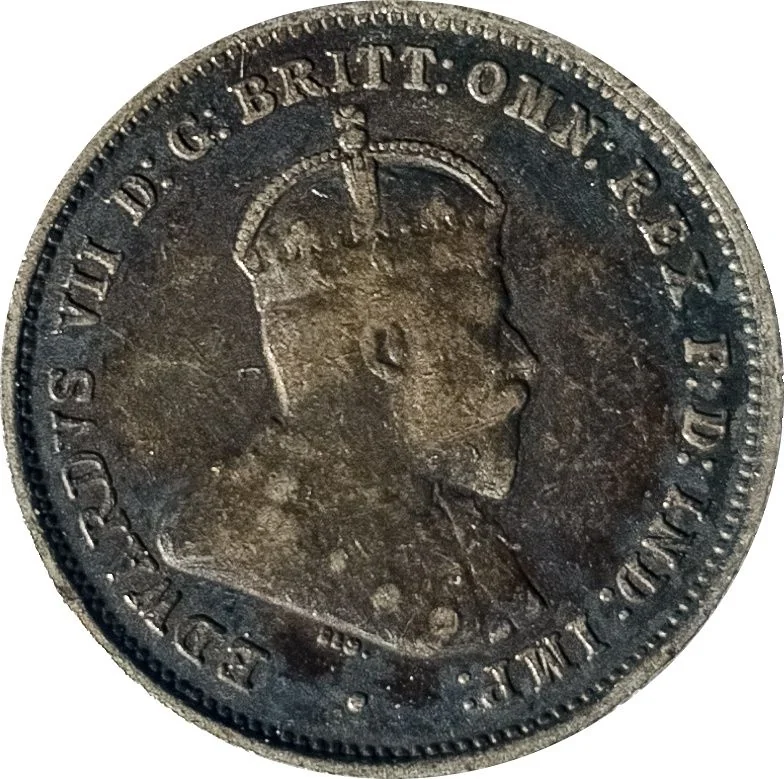
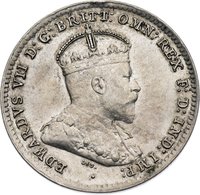
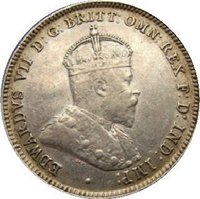
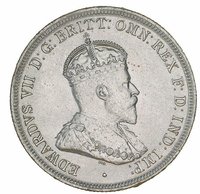
Edward VII crowned and robed, facing right. Legend: EDWARDVS VII D:G: BRITT: OMN: REX F: D: IND: IMP: Designer's initials DES below.
Inscription:
EDWARDVS VII D:G:BRITT:OMN:REX F:D:IND:IMP: ·
Translation:
Edward VII by the Grace of God King of all the Britains Defender of the Faith Emperor of India
Script: Latin
Language: Latin
Engraver: George William de Saulles
Reverse
Description:
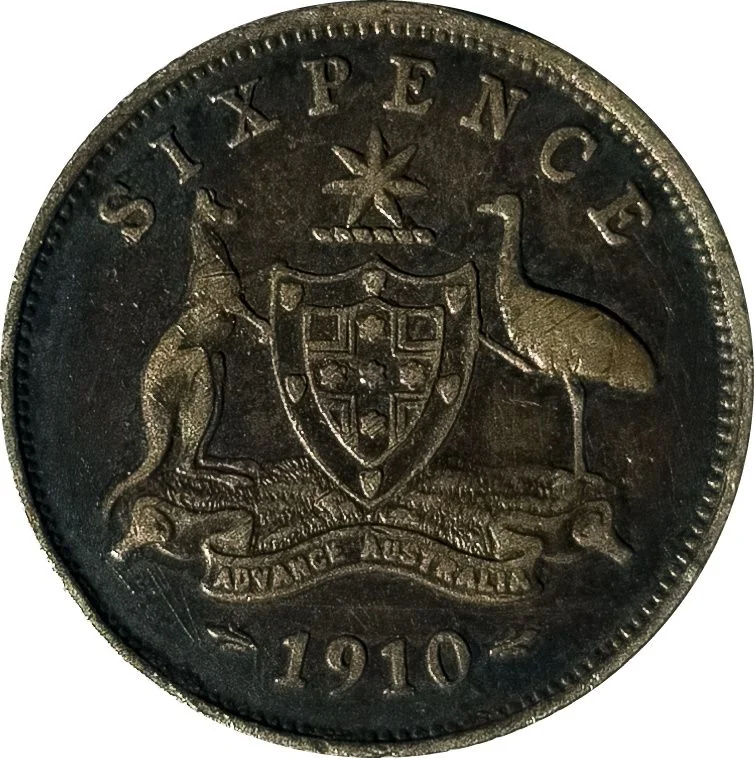
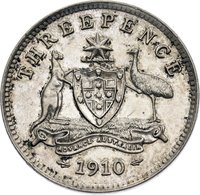
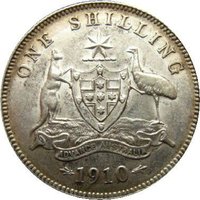
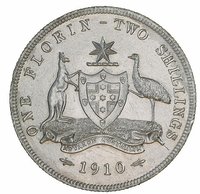
Australian Commonwealth Ensigns Armorial: a shield with a St. George's cross bearing five stars, surrounded by six small shields. Supported by a kangaroo and emu on a mound. Crest: a seven-pointed star on a wreath. Motto: ADVANCE AUSTRALIA. Inscription: SIXPENCE above, 1910 below.
Inscription:
SIXPENCE
ADVANCE AUSTRALIA
1910
ADVANCE AUSTRALIA
1910
Script: Latin
Engraver: William Henry James Blakemore
Edge
Milled
Mints
| Name | Mark |
|---|---|
| Royal Mint (Tower Hill) | — |
Mintings
| Year | Mint Mark | Mintage | Quality | Collection |
|---|---|---|---|---|
| 1910 | — | 3,046,000 | ||
| 1910 | — | — | Proof |
Historical background
In 1910, Australia stood at a pivotal moment in its monetary history, transitioning from a fragmented system to a unified national currency. Prior to Federation in 1901, the six colonies each issued their own pounds, alongside a vast array of British sovereigns, local banknotes, and private token coinage, creating a complex and inefficient financial landscape. The new Commonwealth government, empowered by the Constitution to legislate on currency, began the ambitious project of creating a single, distinct Australian monetary system to underpin national identity and economic cohesion.
The key legislative action of 1910 was the Australian Notes Act, which gave the Commonwealth Treasury the exclusive right to issue banknotes. This effectively began the process of phasing out the notes issued by private trading banks, bringing note issuance under federal control. Furthermore, the Coinage Act of 1909 came into practical effect, introducing Australia’s first distinct national coinage. From 1910, new silver and bronze coins—featuring the image of King Edward VII and iconic Australian motifs like the kangaroo and emu—began to circulate, replacing the British and colonial coinage that had been in use.
Thus, the currency situation in 1910 was one of active change and consolidation. While British gold sovereigns remained legal tender and the old private banknotes circulated alongside the new federal issues, the foundation for a modern, sovereign monetary system had been decisively laid. The year marked the beginning of the end for a colonial patchwork of money, setting the stage for the full introduction of the Australian pound in 1911 and establishing the principle of a uniform currency managed by the national government.
The key legislative action of 1910 was the Australian Notes Act, which gave the Commonwealth Treasury the exclusive right to issue banknotes. This effectively began the process of phasing out the notes issued by private trading banks, bringing note issuance under federal control. Furthermore, the Coinage Act of 1909 came into practical effect, introducing Australia’s first distinct national coinage. From 1910, new silver and bronze coins—featuring the image of King Edward VII and iconic Australian motifs like the kangaroo and emu—began to circulate, replacing the British and colonial coinage that had been in use.
Thus, the currency situation in 1910 was one of active change and consolidation. While British gold sovereigns remained legal tender and the old private banknotes circulated alongside the new federal issues, the foundation for a modern, sovereign monetary system had been decisively laid. The year marked the beginning of the end for a colonial patchwork of money, setting the stage for the full introduction of the Australian pound in 1911 and establishing the principle of a uniform currency managed by the national government.
🌱 Common