

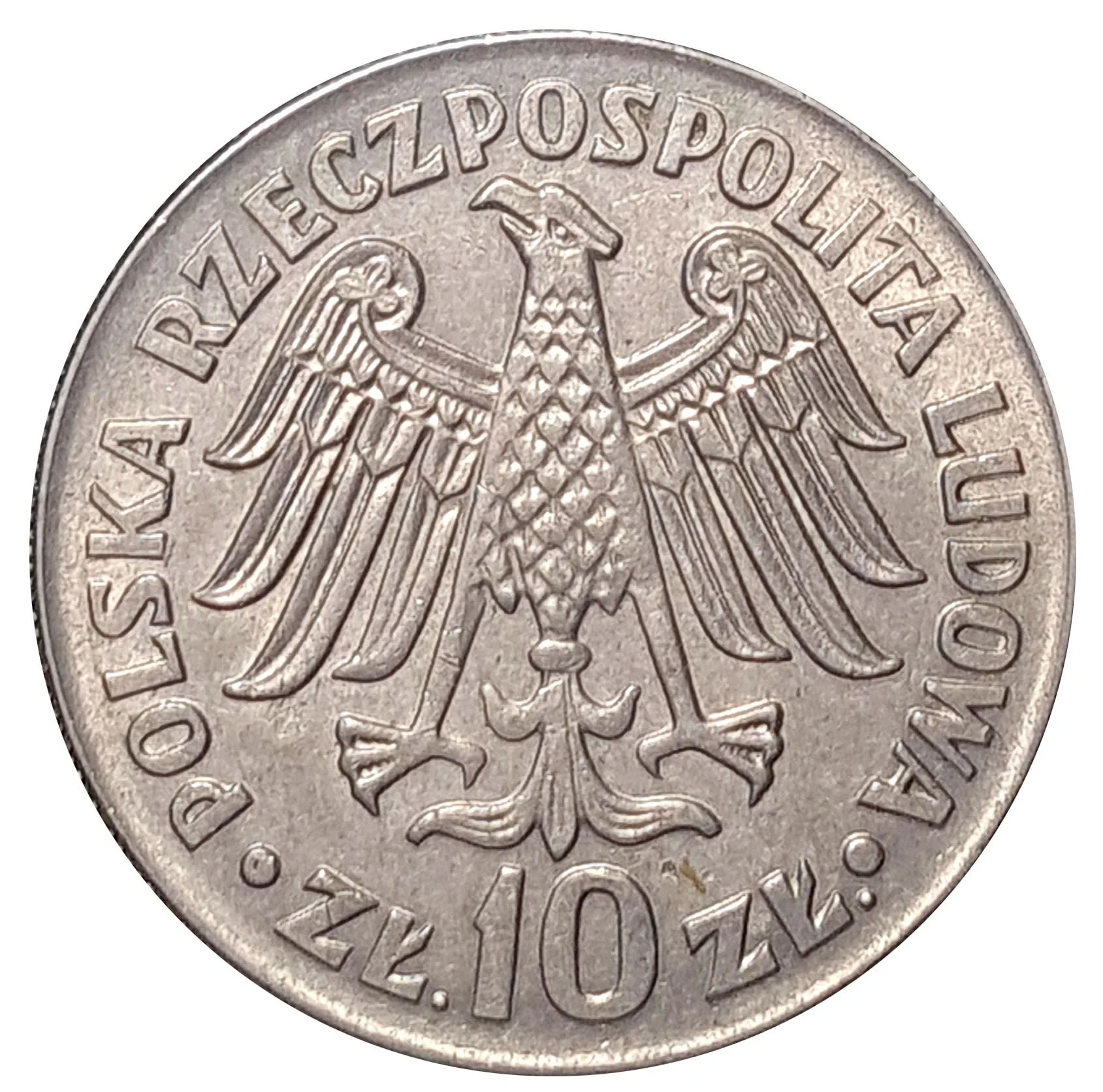
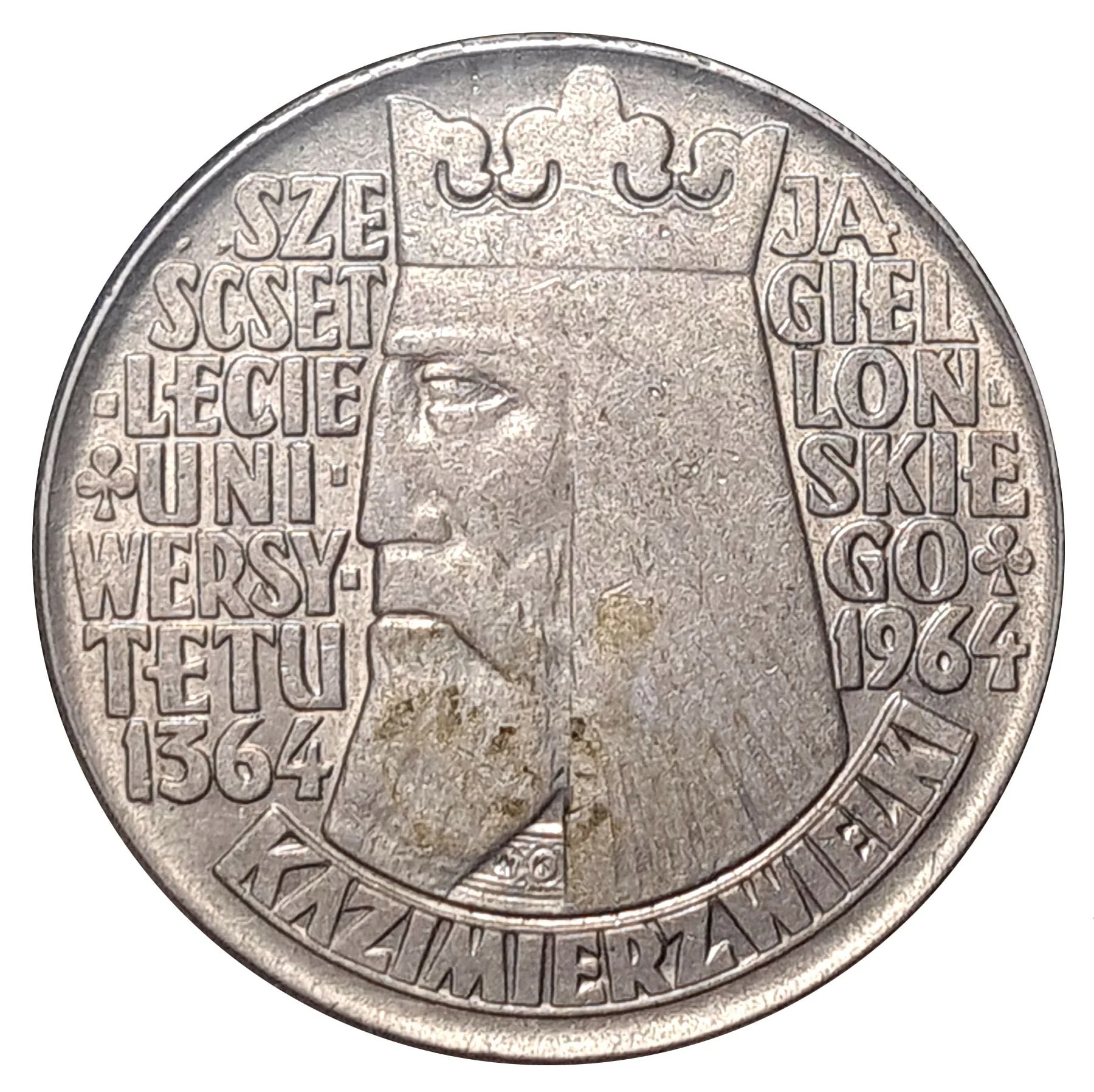
10 Zlotys (Jagiello University) – Poland
Circulating commemorative coins
Commemoration: 600th Anniversary of Jagiello University
Poland
Context
Year: 1964
Issuer: Poland 
Period:
(1952—1989)
Currency:
(1949—1994)
Demonetized: Yes
Total mintage: 2,610,100
Material
Diameter: 31 mm
Weight: 12.9 g
Thickness: 2.1 mm
Shape: Round
Composition: Copper-nickel
Technique: Milled
Alignment: Medal alignment
flip
References
Y: #Click to copy to clipboard52.1
Numista: #124886
Value
Exchange value: 10 PLZ
Obverse
Description:
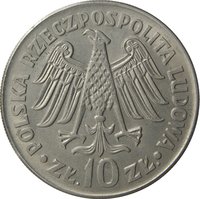
The Polish national coat of arms.
Inscription:
POLSKA RZECZPOSPOLITA LUDOWA
·ZŁ. 10 ZŁ.·
·ZŁ. 10 ZŁ.·
Translation:
PEOPLE'S REPUBLIC OF POLAND
·ZL. 10 ZL.·
·ZL. 10 ZL.·
Script: Latin
Language: Polish
Engraver: Wacław Kowalik
Reverse
Description:
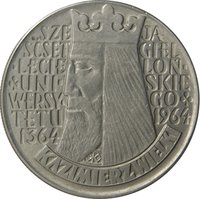
Crowned king, facing left.
Inscription:
SZEŚĆSET LECIE UNIWERSYTETU JAGIELOŃSKIEGO
1364 1964
KAZIMIERZWIELKI
1364 1964
KAZIMIERZWIELKI
Translation:
SIX HUNDREDTH ANNIVERSARY OF THE JAGIELLONIAN UNIVERSITY
1364 1964
CASIMIR THE GREAT
1364 1964
CASIMIR THE GREAT
Script: Latin
Language: Polish
Engraver: Wacław Kowalik
Edge
Reeded
Mintings
| Year | Mint Mark | Mintage | Quality | Collection |
|---|---|---|---|---|
| 1964 | — | 2,610,100 |
Historical background
In 1964, Poland's currency situation was defined by the complexities of a centrally planned economy under communist rule, operating within the broader framework of the Soviet-led Council for Mutual Economic Assistance (COMECON). The official currency was the złoty (PLZ), which was not freely convertible on international markets. Its exchange rate was set administratively by the state and bore little relation to market forces or its domestic purchasing power. Internally, the złoty functioned as the sole legal tender, but its value and utility were heavily managed through state price controls, subsidies on basic goods, and chronic shortages of desirable consumer items, leading to a significant disconnect between money in circulation and the availability of goods.
A critical feature of the monetary landscape was the existence of a pervasive black market and a special parallel currency system. For foreign tourists and for Poles receiving hard currency remittances from abroad, the state operated a network of Pewex and Baltona shops. These stores sold coveted Western imports and high-quality domestic goods exclusively for U.S. dollars, British pounds, or other convertible currencies. This created a two-tier economic reality where access to hard currency, often via the black market at a far more favorable rate than the official one, granted privileged access to a world of goods entirely separate from the constrained regular economy.
Overall, the 1964 currency system reflected the regime's attempt to maintain control over the economy and isolate it from Western influence, while simultaneously acknowledging the superior prestige and utility of hard currencies. The złoty was stable in an official sense, but its economic function was distorted by planning inefficiencies, leading to suppressed inflation, savings with limited spending options ("monetary overhang"), and a thriving informal economy. This unstable equilibrium would face mounting pressure in subsequent decades, culminating in the hyperinflation and radical reforms of the late 1980s and early 1990s.
A critical feature of the monetary landscape was the existence of a pervasive black market and a special parallel currency system. For foreign tourists and for Poles receiving hard currency remittances from abroad, the state operated a network of Pewex and Baltona shops. These stores sold coveted Western imports and high-quality domestic goods exclusively for U.S. dollars, British pounds, or other convertible currencies. This created a two-tier economic reality where access to hard currency, often via the black market at a far more favorable rate than the official one, granted privileged access to a world of goods entirely separate from the constrained regular economy.
Overall, the 1964 currency system reflected the regime's attempt to maintain control over the economy and isolate it from Western influence, while simultaneously acknowledging the superior prestige and utility of hard currencies. The złoty was stable in an official sense, but its economic function was distorted by planning inefficiencies, leading to suppressed inflation, savings with limited spending options ("monetary overhang"), and a thriving informal economy. This unstable equilibrium would face mounting pressure in subsequent decades, culminating in the hyperinflation and radical reforms of the late 1980s and early 1990s.
🌱 Common