

1000 tenge – Kazakhstan
Add to wishlist
Kazakhstan
Context
Material
References
Numista: #554899
Value
Exchange value: 1000 KZT
Bullion value: $73.16
Obverse
Description:
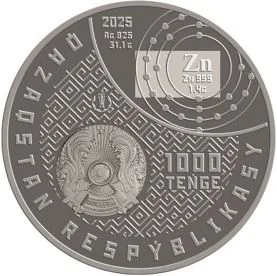
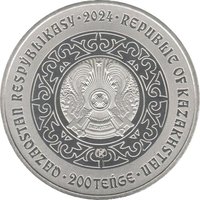
The coin features Kazakhstan's State Emblem with patterns, topped by the National Bank logo. The country name is on the left, and the denomination is on the right. The issue year is above the emblem, with metal details below. A stylized zinc atom inlay in the upper right corner indicates the specific metal, purity, and weight.
Inscription:
2025
AG 925
31.1 G
QAZAQSTAN RESPÝBLIKASY
Zn
ZN 999
1.4 G
1000 TEŃGE
AG 925
31.1 G
QAZAQSTAN RESPÝBLIKASY
Zn
ZN 999
1.4 G
1000 TEŃGE
Reverse
Description:
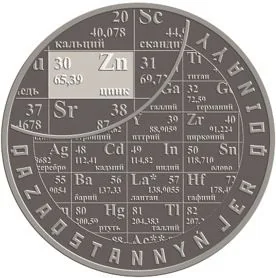
Periodic Table fragment highlighting Zinc (Zn, 30). Surrounding text: QAZAQSTANÝN JER QOINAÝY.
Inscription:
30 Zn
65.39
цинк
QAZAQSTANÝN JER QOINAÝY
65.39
цинк
QAZAQSTANÝN JER QOINAÝY
Edge
Mints
| Name | Mark |
|---|---|
| Kazakhstan Mint | (KMC) |
Mintings
| Year | Mint Mark | Mintage | Quality | Collection |
|---|---|---|---|---|
| 2025 | — | 2,000 | Proof |
Historical background
In 2025, Kazakhstan's currency, the tenge (KZT), operates within a managed float regime heavily influenced by the National Bank of the Republic of Kazakhstan (NBRK). The primary monetary policy focus remains on controlling inflation, which has seen moderate success but remains vulnerable to external shocks. The tenge's value continues to be predominantly dictated by the price of key export commodities, particularly oil and natural gas, as well as the economic dynamics of major trading partners like Russia and China. This dependency creates inherent volatility, with the NBRK intermittently intervening in the foreign exchange market to smooth out excessive fluctuations rather than targeting a specific exchange rate.
The broader financial landscape is characterized by ongoing efforts to deepen the domestic capital market and reduce dollarization, a persistent legacy of past devaluations. Initiatives to develop a more robust yield curve for tenge-denominated securities and to encourage lending in the local currency have seen incremental progress. However, geopolitical tensions and regional economic instability, coupled with the need to service external debt, continue to pressure foreign reserves and limit the central bank's policy flexibility. Digitalization is also a key theme, with the continued exploration of a digital tenge (CBDC) pilot aimed at improving payment efficiency and financial inclusion.
Looking ahead, the tenge's stability in 2025 hinges on a delicate balance. Sustained high global energy prices provide a fiscal buffer and support the currency, while diversification efforts away from raw material exports remain a long-term strategic goal. The NBRK's credibility in maintaining price stability is crucial for investor confidence. Ultimately, Kazakhstan's currency situation reflects an economy in transition, navigating the challenges of a resource-dependent model while cautiously building more resilient and sophisticated monetary and financial frameworks.
The broader financial landscape is characterized by ongoing efforts to deepen the domestic capital market and reduce dollarization, a persistent legacy of past devaluations. Initiatives to develop a more robust yield curve for tenge-denominated securities and to encourage lending in the local currency have seen incremental progress. However, geopolitical tensions and regional economic instability, coupled with the need to service external debt, continue to pressure foreign reserves and limit the central bank's policy flexibility. Digitalization is also a key theme, with the continued exploration of a digital tenge (CBDC) pilot aimed at improving payment efficiency and financial inclusion.
Looking ahead, the tenge's stability in 2025 hinges on a delicate balance. Sustained high global energy prices provide a fiscal buffer and support the currency, while diversification efforts away from raw material exports remain a long-term strategic goal. The NBRK's credibility in maintaining price stability is crucial for investor confidence. Ultimately, Kazakhstan's currency situation reflects an economy in transition, navigating the challenges of a resource-dependent model while cautiously building more resilient and sophisticated monetary and financial frameworks.
Series: Kazakhstan's subsoil


✨ Legendary