

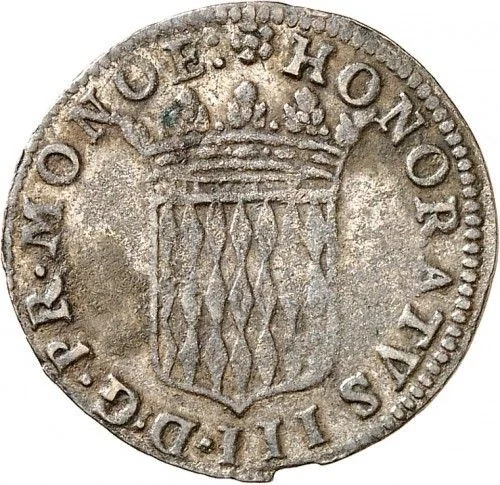
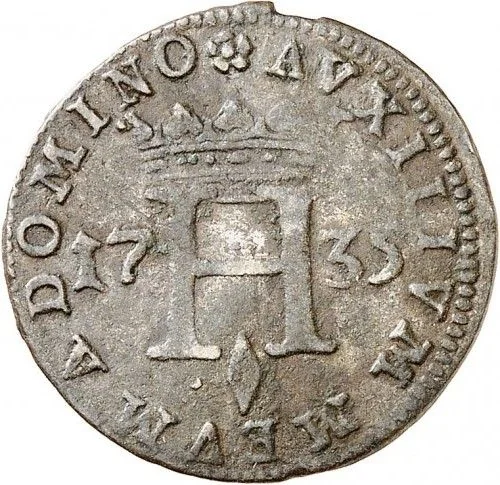
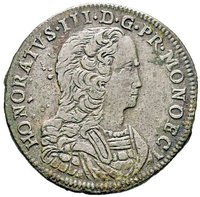
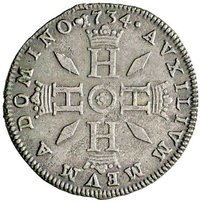
½ Pezzetta – Monaco
Monaco

Obverse
Reverse
Edge
Mints
| Name | Mark |
|---|---|
| Monaco | — |
Mintings
| Year | Mint Mark | Mintage | Quality | Collection |
|---|---|---|---|---|
| 1735 | — | — |
Historical background
In 1735, Monaco's currency situation was a direct reflection of its political and economic dependency on France. Since the 1641 Treaty of Péronne, Monaco had been a French protectorate, and its monetary system was effectively integrated with that of its powerful neighbour. The official legal tender was the French livre tournois, and the Monegasque economy, reliant on trade, agriculture, and the limited taxation of its subjects, operated within the broader French monetary zone. The Princes of Grimaldi minted their own coinage only sporadically, and these issues were primarily symbolic, intended to assert sovereignty rather than circulate independently.
The circulation of physical money in the principality was a complex mixture. Alongside French royal coins, older Monegasque issues, Spanish pistoles, Genoese scudi, and other foreign currencies from Mediterranean trade all passed through the hands of merchants and residents. This proliferation required constant calculation of exchange rates and inherent uncertainty in daily transactions. The value of the French livre itself was not entirely stable, being subject to the monetary manipulations and debasements that characterized the ancien régime finance, indirectly affecting price stability in Monaco.
Therefore, Monaco in 1735 lacked an autonomous monetary policy. The Grimaldi court's finances were deeply intertwined with French patronage and the revenues from their feudal lands in France. Any significant currency decision would have required Paris's tacit approval. The situation was one of pragmatic subordination: the benefits of stability and access to a large economic area came at the cost of ceding control over a fundamental pillar of sovereignty, a trade-off that defined Monaco's precarious existence as a small state nestled within the sphere of a great power.
The circulation of physical money in the principality was a complex mixture. Alongside French royal coins, older Monegasque issues, Spanish pistoles, Genoese scudi, and other foreign currencies from Mediterranean trade all passed through the hands of merchants and residents. This proliferation required constant calculation of exchange rates and inherent uncertainty in daily transactions. The value of the French livre itself was not entirely stable, being subject to the monetary manipulations and debasements that characterized the ancien régime finance, indirectly affecting price stability in Monaco.
Therefore, Monaco in 1735 lacked an autonomous monetary policy. The Grimaldi court's finances were deeply intertwined with French patronage and the revenues from their feudal lands in France. Any significant currency decision would have required Paris's tacit approval. The situation was one of pragmatic subordination: the benefits of stability and access to a large economic area came at the cost of ceding control over a fundamental pillar of sovereignty, a trade-off that defined Monaco's precarious existence as a small state nestled within the sphere of a great power.
✨ Legendary