

½ mohur – Mughal Empire
Add to wishlist
Circulating commemorative coins
Commemoration: Nisar Issue
India
Context
Year: 1638
Islamic (Hijri) Year:: 1048
Country: India
Issuer: Mughal Empire
Ruler: Shah Jahan
Currency:
(1540—1842)
Demonetized: Yes
Material
Diameter: 17 mm
Weight: 5.55 g
Gold Weight:: 5.55 g
Shape: Irregular round
Composition: Gold
Magnetic: No
Technique: Hammered
Alignment: Medal alignment
flip
References
KM: #
Numista: #552178
Value
Bullion value: $864.06
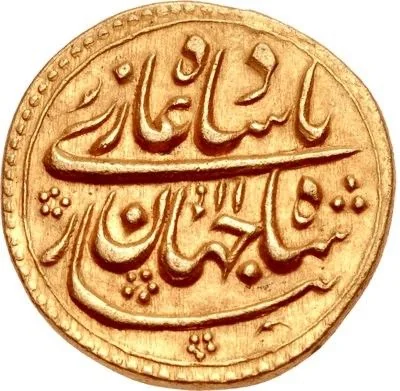
Obverse
Description:
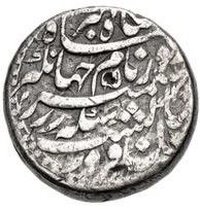
Shah Jahan quoted in a Persian couplet.
Script: Persian
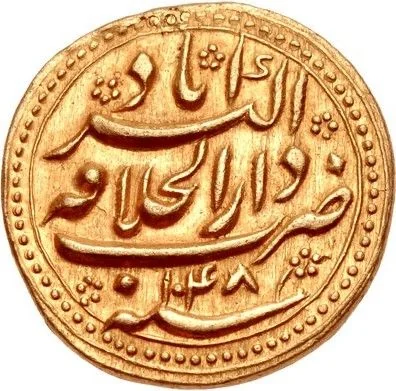
Reverse
Description:
Mint date formula:
1. Extract year.
2. Extract month.
3. Concatenate results.
1. Extract year.
2. Extract month.
3. Concatenate results.
Script: Persian
Edge
Mints
| Name | Mark |
|---|---|
| Agra | — |
Mintings
| Year | Mint Mark | Mintage | Quality | Collection |
|---|---|---|---|---|
| 1638 | — | — |
Historical background
In 1638, the Mughal Empire's currency system under Emperor Shah Jahan was a sophisticated and highly regulated bimetallic standard, centered on the silver rupee and the gold mohur. The primary unit, the rupee, was a remarkably pure coin, minted to a strict standard of nearly 97% fineness (Jahangiri standard). Its widespread acceptance and consistent quality made it the engine of the empire's vast economy, facilitating both monumental state projects like the construction of the Taj Mahal and everyday trade across a subcontinent-spanning market.
The minting process was a tightly controlled imperial monopoly. Coins were struck in numerous mints (dar al-zarb) across the empire, with major centers in Lahore, Ahmedabad, and Surat. Each coin bore inscriptions of the emperor's name, the mint of origin, and the regnal year, ensuring traceability and accountability. The system was managed by a complex bureaucracy, with officials like the Master of the Mint (Darogha-i-Dar al-Zarb) and the Treasure-Master (Khazanadar) overseeing production and preventing debasement. This centralization was crucial for maintaining public trust in the currency's value.
However, the empire's monetary health was intrinsically linked to the influx of precious metals. A significant portion of silver, vital for the rupee coinage, was imported from the New World via European trading companies, which exchanged it for Indian textiles and spices. Any disruption to this flow could cause economic strain. Furthermore, while the system was advanced, regional variations and the continued use of older coins and copper dam for smaller transactions created a complex multi-denominational monetary environment beneath the official bimetallic order.
The minting process was a tightly controlled imperial monopoly. Coins were struck in numerous mints (dar al-zarb) across the empire, with major centers in Lahore, Ahmedabad, and Surat. Each coin bore inscriptions of the emperor's name, the mint of origin, and the regnal year, ensuring traceability and accountability. The system was managed by a complex bureaucracy, with officials like the Master of the Mint (Darogha-i-Dar al-Zarb) and the Treasure-Master (Khazanadar) overseeing production and preventing debasement. This centralization was crucial for maintaining public trust in the currency's value.
However, the empire's monetary health was intrinsically linked to the influx of precious metals. A significant portion of silver, vital for the rupee coinage, was imported from the New World via European trading companies, which exchanged it for Indian textiles and spices. Any disruption to this flow could cause economic strain. Furthermore, while the system was advanced, regional variations and the continued use of older coins and copper dam for smaller transactions created a complex multi-denominational monetary environment beneath the official bimetallic order.
✨ Legendary