

5 Centimos – Spain
Spain
Context
Years: 1877–1879
Issuer: Spain 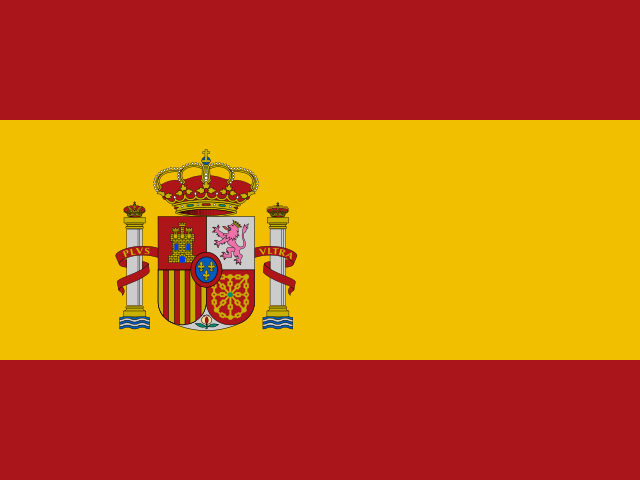
Ruler: Alfonso XII
Currency:
(1868—2001)
Demonetization: 29 October 1941
Total mintage: 157,324,000
Material
References
KM: #Click to copy to clipboard674
Numista: #1246
Value
Exchange value: 0.05 ESP
Obverse
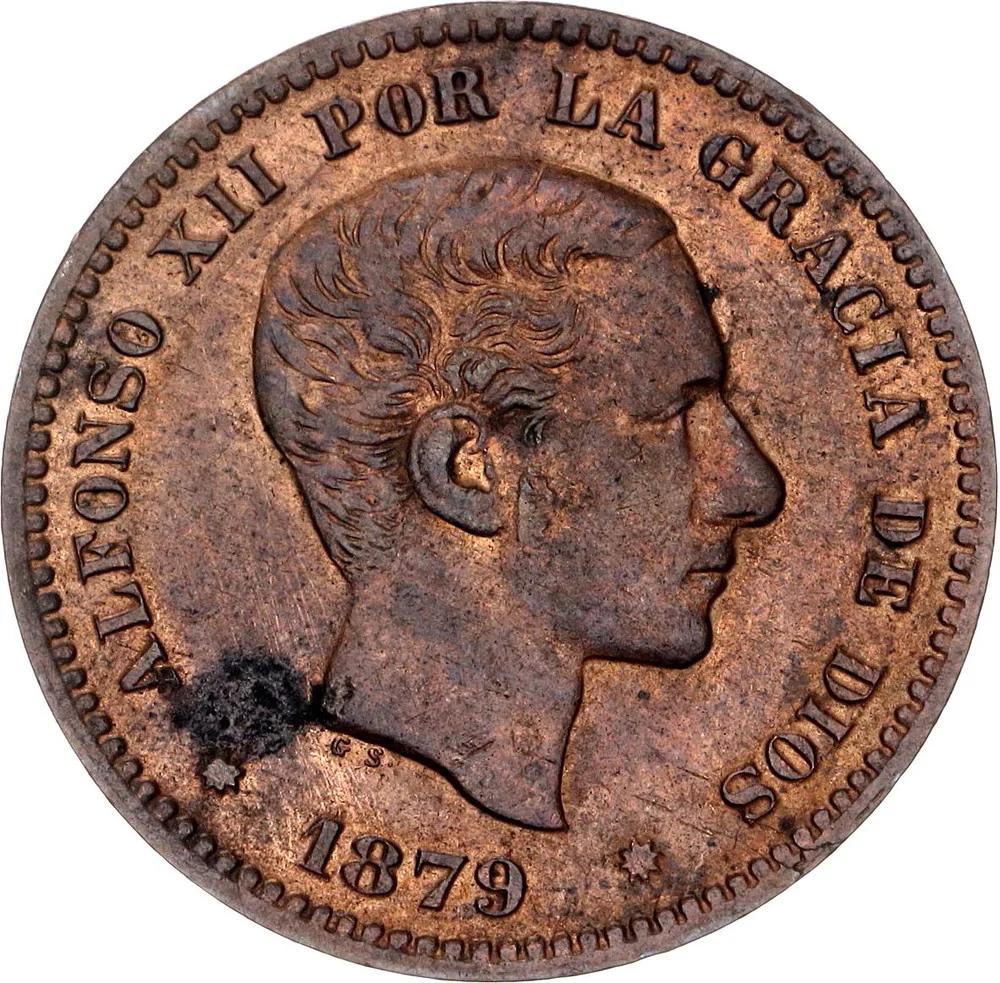
Description:
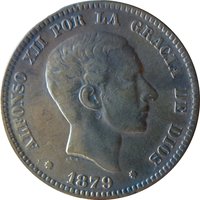
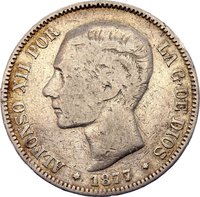
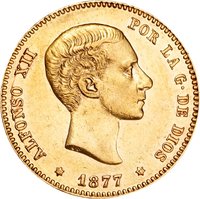
King Alfonso XII facing right.
Inscription:
ALFONSO XII POR LA GRACIA DE DIOS
G. S.
* 1877 *
G. S.
* 1877 *
Translation:
ALFONSO XII BY THE GRACE OF GOD
G. S.
* 1877 *
G. S.
* 1877 *
Script: Latin
Language: Spanish
Engraver: Gregorio Sellán y González
Reverse
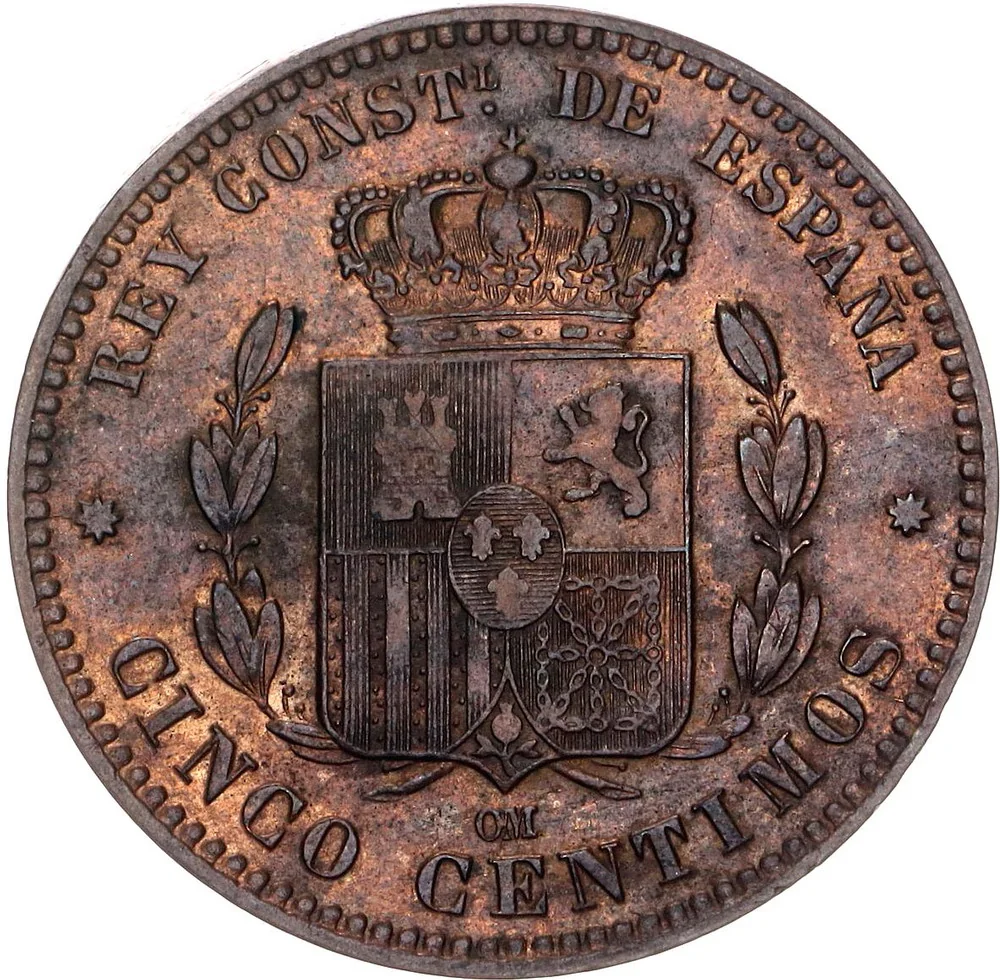
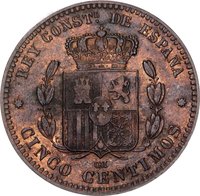
Description:
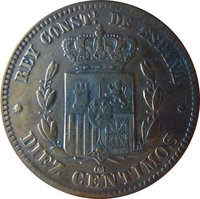
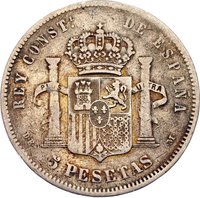
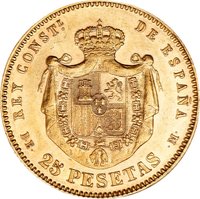
Spanish coat of arms crowned and wreathed.
Inscription:
REY CONSTL. DE ESPAÑA
OM
CINCO CENTIMOS
OM
CINCO CENTIMOS
Translation:
King Constitutional of Spain
Five Cents
Five Cents
Script: Latin
Language: Spanish
Engraver: Gregorio Sellán y González
Edge
Plain
Categories
| Person> Monarch |
| Symbols> Coat of Arms |
Mints
| Name | Mark |
|---|---|
| Barcelona Mint / La Seca | — |
Mintings
| Year | Mint Mark | Mintage | Quality | Collection |
|---|---|---|---|---|
| 1877 | — | — | ||
| 1877 | OM | 34,376,000 | ||
| 1878 | OM | 67,954,000 | ||
| 1879 | OM | 54,994,000 |
Historical background
In 1877, Spain was navigating the complex aftermath of the Glorious Revolution of 1868 and the subsequent establishment of the First Spanish Republic (1873-1874), which had recently collapsed with the Bourbon Restoration in 1874. The monetary system was in a state of disarray and transition. The revolutionary government had decimalized the currency in 1868, introducing the peseta as the sole national currency to replace the old, chaotic system of reales, escudos, and duros. However, by 1877, the peseta was still consolidating its position, facing public skepticism and competition from older, familiar coins that remained in circulation.
Economically, the country was grappling with significant inflation and a large public debt, exacerbated by the recent Carlist Wars (1872-1876) and colonial conflicts. The Bank of Spain (Banco de España), which had been granted the sole right to issue banknotes in 1874, was working to establish a stable national banking system and manage the money supply. The currency was on a bimetallic standard (gold and silver), but like much of Europe, Spain faced the practical challenges of bimetallism, where the fluctuating market values of the metals could cause one to drive the other out of circulation.
Therefore, the currency situation in 1877 was one of fragile stabilization under the new monarchy of Alfonso XII. The government, led by Antonio Cánovas del Castillo, was prioritizing political and economic orden (order), which included legitimizing the peseta and managing the debt. While the foundational laws for a modern monetary system were in place, full public confidence and uniform circulation were still works in progress, set against a backdrop of a society recovering from profound political instability.
Economically, the country was grappling with significant inflation and a large public debt, exacerbated by the recent Carlist Wars (1872-1876) and colonial conflicts. The Bank of Spain (Banco de España), which had been granted the sole right to issue banknotes in 1874, was working to establish a stable national banking system and manage the money supply. The currency was on a bimetallic standard (gold and silver), but like much of Europe, Spain faced the practical challenges of bimetallism, where the fluctuating market values of the metals could cause one to drive the other out of circulation.
Therefore, the currency situation in 1877 was one of fragile stabilization under the new monarchy of Alfonso XII. The government, led by Antonio Cánovas del Castillo, was prioritizing political and economic orden (order), which included legitimizing the peseta and managing the debt. While the foundational laws for a modern monetary system were in place, full public confidence and uniform circulation were still works in progress, set against a backdrop of a society recovering from profound political instability.
🌱 Very Common