


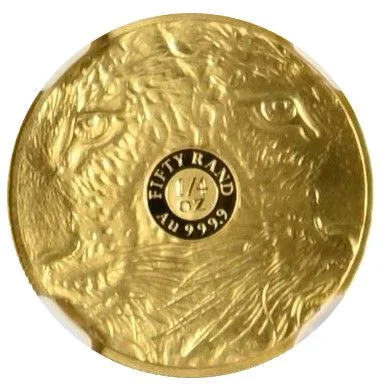
50 rand – South Africa
Add to wishlist
South Africa
Context
Material
Diameter: 22 mm
Weight: 7.78 g
Gold Weight:: 7.78 g
Shape: Round
Composition: 99.99% Gold
Standard: Silver quarter ounce
Magnetic: No
Technique: Milled
Alignment: Medal alignment

flip

References
KM: #
Numista: #548034
Value
Exchange value: 50 ZAR
Bullion value: $1186.91
Inflation-adjusted value: 56.13 ZAR
Obverse
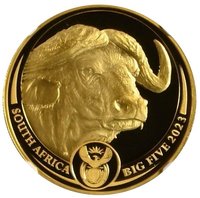
Description:
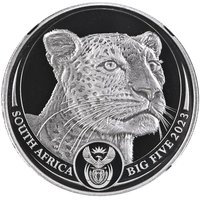
Close-up of a leopard's face.
Inscription:
SOUTH AFRICA BIG FIVE 2023
Script: Latin
Engraver: Paul Botes
Designer: Richard Stone
Reverse
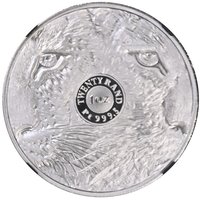
Description:
Leopard face split in half.
Inscription:
FIFTY RAND
1/4
oz
Au 999.9
1/4
oz
Au 999.9
Script: Latin
Engraver: Paul Botes
Designer: Richard Stone
Edge
Reeded
Mintings
| Year | Mint Mark | Mintage | Quality | Collection |
|---|---|---|---|---|
| 2023 | — | 2,000 | Proof |
Historical background
In 2023, the South African Rand (ZAR) faced a year of significant volatility and pressure, largely trading within a wide band of R17 to R19 against the US Dollar. The currency's trajectory was dominated by a persistent and challenging domestic environment. Chronic issues including severe load-shedding (planned power blackouts), logistical bottlenecks at Transnet's ports and rails, and a stagnant economy with high unemployment created a backdrop of low investor confidence and constrained growth. These structural weaknesses, often termed "South Africa-specific risks," were the fundamental drivers of the Rand's weakness, as they directly impacted the country's productive capacity and fiscal outlook.
The currency was also highly reactive to both global and local financial developments. Internationally, the Rand weakened during periods of heightened global risk aversion and as the US Federal Reserve continued its aggressive interest rate hiking cycle, which strengthened the Dollar globally. Domestically, monetary policy from the South African Reserve Bank (SARB), which raised rates to combat persistent inflation, provided only intermittent support. Major spikes in volatility occurred around key events, most notably the diplomatic crisis in May surrounding the US allegation that a Russian vessel had collected arms in South Africa. This incident triggered a sharp sell-off, bringing the Rand perilously close to the R20/$ mark and highlighting its sensitivity to geopolitical shocks.
By the close of 2023, the Rand remained vulnerable, ending the year as one of the emerging market currencies most heavily impacted by domestic challenges. While it avoided a complete collapse, it consistently underperformed its peers. The year underscored that without meaningful progress in resolving the country's electricity, logistics, and fiscal crises, the currency would remain susceptible to both internal deterioration and external shocks, with its fortunes inextricably linked to the implementation of long-promised structural reforms.
The currency was also highly reactive to both global and local financial developments. Internationally, the Rand weakened during periods of heightened global risk aversion and as the US Federal Reserve continued its aggressive interest rate hiking cycle, which strengthened the Dollar globally. Domestically, monetary policy from the South African Reserve Bank (SARB), which raised rates to combat persistent inflation, provided only intermittent support. Major spikes in volatility occurred around key events, most notably the diplomatic crisis in May surrounding the US allegation that a Russian vessel had collected arms in South Africa. This incident triggered a sharp sell-off, bringing the Rand perilously close to the R20/$ mark and highlighting its sensitivity to geopolitical shocks.
By the close of 2023, the Rand remained vulnerable, ending the year as one of the emerging market currencies most heavily impacted by domestic challenges. While it avoided a complete collapse, it consistently underperformed its peers. The year underscored that without meaningful progress in resolving the country's electricity, logistics, and fiscal crises, the currency would remain susceptible to both internal deterioration and external shocks, with its fortunes inextricably linked to the implementation of long-promised structural reforms.
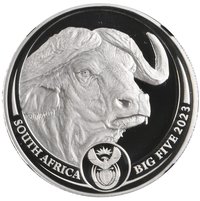
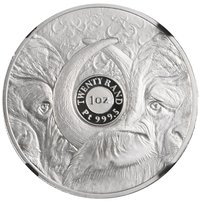
Series: The Big Five II







✨ Legendary