

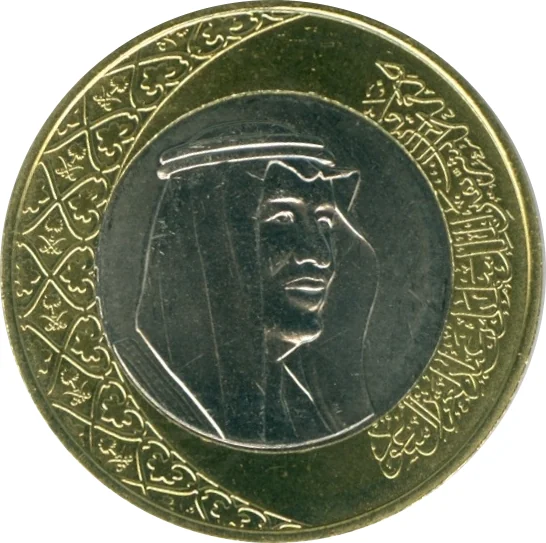
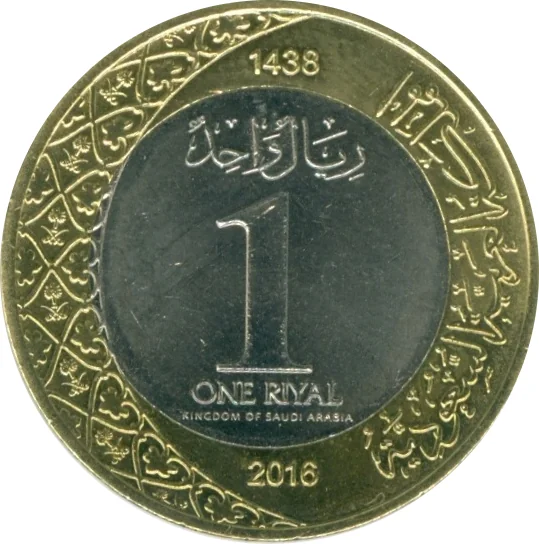
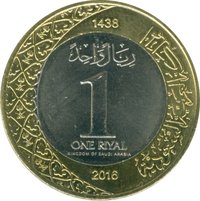
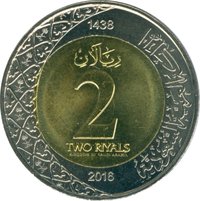
1 Riyal – Saudi Arabia
Saudi Arabia
Context
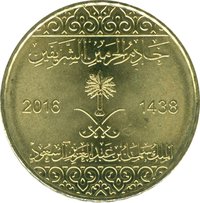
Year: 2016
Islamic (Hijri) Year: 1438
Issuer: Saudi Arabia 
Ruler: Salman bin Abdulaziz
Currency:
(since 1960)
Material
References
KM: #Click to copy to clipboard78
Numista: #101225
Value
Exchange value: 1 SAR
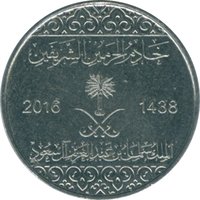
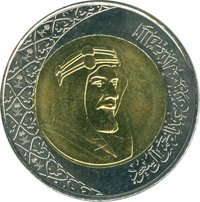
Obverse
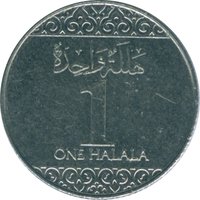
Reverse
Edge
Plain
Categories
| Person> Monarch |
| Mustache/Beard |
| Symbols> Coat of Arms |
Mints
| Name | Mark |
|---|---|
| Monnaie de Paris | — |
Mintings
| Year | Mint Mark | Mintage | Quality | Collection |
|---|---|---|---|---|
| 2016 | — | — |
Historical background
In 2016, Saudi Arabia faced a significant currency situation driven by the sustained low price of oil, the kingdom's primary revenue source. The fiscal deficit ballooned to nearly 15% of GDP in 2015, depleting foreign reserves and increasing pressure on the Saudi Riyal (SAR), which has been pegged to the U.S. dollar at a rate of 3.75 since 1986. Speculation in forward markets intensified throughout the year, with the 12-month forward rate for the SAR weakening to its lowest level in decades, reflecting growing investor doubt about the government's ability to maintain the peg without drastic economic reforms.
The government's response was twofold: fiscal consolidation and a strategic shift in economic policy. It implemented severe austerity measures, including cutting fuel and utility subsidies, reducing ministerial budgets, and delaying payments to contractors. More fundamentally, the year saw the launch of Vision 2030, an ambitious blueprint championed by Crown Prince Mohammed bin Salman to diversify the economy away from oil dependence. This long-term plan, however, did not immediately alleviate the short-term currency pressures, as the kingdom continued to draw down its foreign assets, which fell from a peak of over $730 billion in 2014 to approximately $555 billion by year's end.
Ultimately, the peg held firm in 2016, backed by the Saudi Arabian Monetary Authority's (SAMA) substantial, though declining, reserves and a strong political commitment to the dollar linkage as a pillar of economic stability. The situation underscored a critical juncture: the market was testing the kingdom's resolve as it transitioned from a period of immense petroleum wealth to a new era of fiscal constraint. The events of 2016 set the stage for the subsequent introduction of a Value-Added Tax (VAT) and the pursuit of external borrowing, including an international bond sale, to help finance the deficit and support the currency regime.
The government's response was twofold: fiscal consolidation and a strategic shift in economic policy. It implemented severe austerity measures, including cutting fuel and utility subsidies, reducing ministerial budgets, and delaying payments to contractors. More fundamentally, the year saw the launch of Vision 2030, an ambitious blueprint championed by Crown Prince Mohammed bin Salman to diversify the economy away from oil dependence. This long-term plan, however, did not immediately alleviate the short-term currency pressures, as the kingdom continued to draw down its foreign assets, which fell from a peak of over $730 billion in 2014 to approximately $555 billion by year's end.
Ultimately, the peg held firm in 2016, backed by the Saudi Arabian Monetary Authority's (SAMA) substantial, though declining, reserves and a strong political commitment to the dollar linkage as a pillar of economic stability. The situation underscored a critical juncture: the market was testing the kingdom's resolve as it transitioned from a period of immense petroleum wealth to a new era of fiscal constraint. The events of 2016 set the stage for the subsequent introduction of a Value-Added Tax (VAT) and the pursuit of external borrowing, including an international bond sale, to help finance the deficit and support the currency regime.
🌱 Very Common