

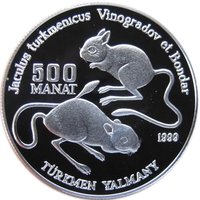
500 Manat – Turkmenistan
Turkmenistan
Context
Year: 1999
Issuer: Turkmenistan 
Period:
(since 1991)
Currency:
(1993—2009)
Demonetized: Yes
Total mintage: 100
Material

References
KM: #Click to copy to clipboard15a
Numista: #101223
Value
Exchange value: 500 TMM
Bullion value: $7906.53
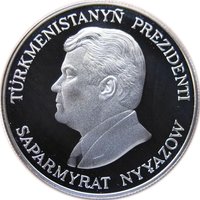
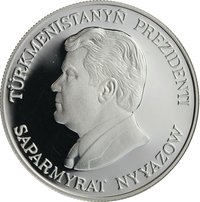
Obverse
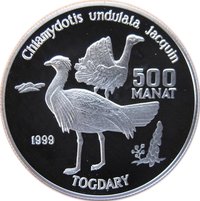
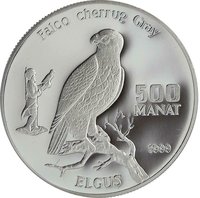
Reverse
Description:
The Houbara bustard.
Inscription:
Chlamydotis undulata Jacquin
500
MANAT
1999
TOGDARY
500
MANAT
1999
TOGDARY
Script: Latin
Edge
Reeded
Categories
| Animal> Bird |
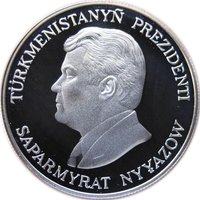
| Person> Politician |
Mints
| Name | Mark |
|---|---|
| Royal Mint | — |
Mintings
| Year | Mint Mark | Mintage | Quality | Collection |
|---|---|---|---|---|
| 1999 | — | 100 |
Historical background
In 1999, Turkmenistan's currency situation was characterized by a stark and growing divergence between the official and unofficial exchange rates, a direct consequence of the country's rigid economic isolation and state-controlled economy. The government, under President Saparmurat Niyazov, maintained a fixed official exchange rate for the manat that was vastly overvalued, set at approximately 5,200 manat to the US dollar. This rate was accessible only for a narrow range of state-sanctioned imports and transactions, creating a privileged channel for the elite while bearing little relation to economic reality.
For the general population and most businesses, the real value of the manat was determined by a thriving black market, where the currency traded at a fraction of its official worth. By 1999, the unofficial rate had deteriorated to roughly 17,000-23,000 manat per dollar, reflecting chronic inflation, a scarcity of hard currency, and a struggling economy heavily dependent on natural gas exports. This dual-system created severe economic distortions, encouraging corruption, stifling legitimate foreign investment, and causing shortages of imported goods as formal channels were ineffective.
The root cause was a combination of poor economic management, the aftermath of the 1998 Russian financial crisis which impacted export revenues, and the government's insistence on maintaining strict control and subsidization. The situation led to a highly dollarized economy for savings and large transactions, while salaries and domestic prices remained in the rapidly depreciating manat, eroding the purchasing power of ordinary citizens. This unsustainable monetary environment set the stage for the eventual currency reform of 2009, when a new manat was introduced at a rate of 5,000 old manat to 1 new manat, effectively devaluing the currency to more closely align with market realities.
For the general population and most businesses, the real value of the manat was determined by a thriving black market, where the currency traded at a fraction of its official worth. By 1999, the unofficial rate had deteriorated to roughly 17,000-23,000 manat per dollar, reflecting chronic inflation, a scarcity of hard currency, and a struggling economy heavily dependent on natural gas exports. This dual-system created severe economic distortions, encouraging corruption, stifling legitimate foreign investment, and causing shortages of imported goods as formal channels were ineffective.
The root cause was a combination of poor economic management, the aftermath of the 1998 Russian financial crisis which impacted export revenues, and the government's insistence on maintaining strict control and subsidization. The situation led to a highly dollarized economy for savings and large transactions, while salaries and domestic prices remained in the rapidly depreciating manat, eroding the purchasing power of ordinary citizens. This unsustainable monetary environment set the stage for the eventual currency reform of 2009, when a new manat was introduced at a rate of 5,000 old manat to 1 new manat, effectively devaluing the currency to more closely align with market realities.
Series: Wildlife

✨ Legendary