

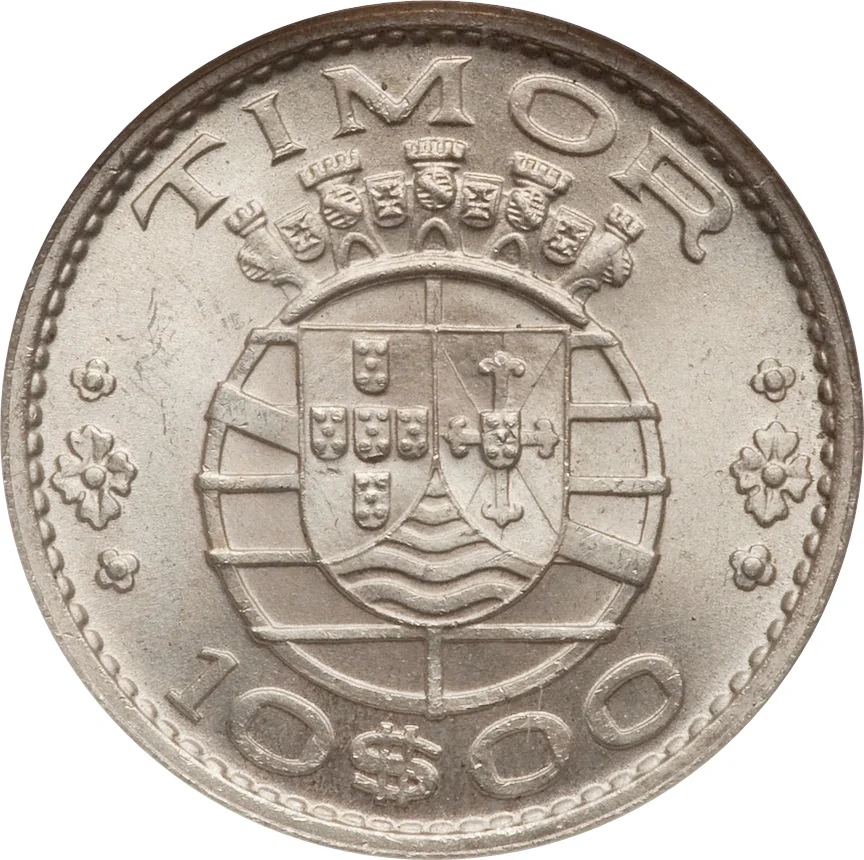
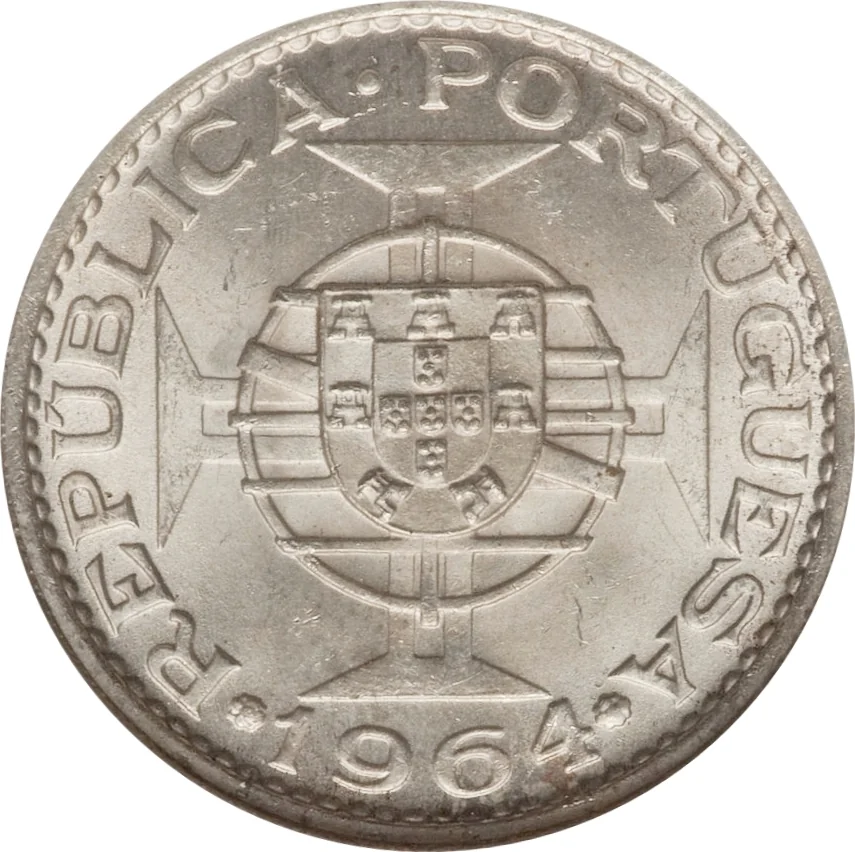
10 escudos – Portuguese Timor
Add to wishlist
Timor-Leste
Context
Year: 1964
Country: Timor-Leste
Issuer: Portuguese Timor
Period:
(1951—1974)
Currency:
(1958—1976)
Demonetization: 6 May 1964
Total mintage: 600,000
Material
References
KM: #
Numista: #20322
Value
Exchange value: 10 TPE
Bullion value: $11.16
Obverse
Reverse
Description:
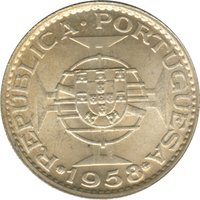
Portugal's coat of arms on the Cross of Christ.
Inscription:
REPUBLICA.PORTUGUESA.
1964
1964
Script: Latin
Edge
Reeded
Categories
| Symbols> Coat of Arms |
Mints
| Name | Mark |
|---|---|
| Imprensa Nacional - Casa da Moeda | — |
Mintings
| Year | Mint Mark | Mintage | Quality | Collection |
|---|---|---|---|---|
| 1964 | — | 600,000 |
Historical background
In 1964, Portuguese Timor (present-day Timor-Leste) operated under a unique and complex currency situation, a legacy of its colonial status and geographic position. As an overseas province of Portugal, its official currency was the Portuguese Timor Escudo, which was pegged at par with the Portuguese Metropolitan Escudo. This system was managed by the Banco Nacional Ultramarino (BNU), which held the exclusive right of issue for the territory. However, in practice, the escudo circulated alongside, and was often overshadowed by, other more stable and trusted currencies, reflecting the colony's economic integration with its Asian neighbours rather than with distant Lisbon.
The dominant medium of exchange in daily life was not the escudo but the Indonesian Rupiah and, to a lesser extent, the Australian Pound. This was due to Timor's extensive border trade with Indonesian West Timor and its economic links to Australia, making these currencies more practical and desirable for commerce. The Portuguese authorities, while unable to stop this de facto dollarization, officially tolerated the circulation of these foreign currencies. They periodically issued decrees attempting to reinforce the use of the escudo, but with limited success, as the local population had little confidence in Lisbon's currency, especially given Portugal's own economic struggles and political instability under the Estado Novo regime.
This multi-currency environment highlighted the territory's economic vulnerability and administrative challenges. The reliance on foreign currencies meant Portuguese Timor had little monetary autonomy, and its economy was susceptible to fluctuations in the Indonesian and Australian economies. The situation in 1964 thus presented a picture of a colonial administration with nominal monetary control, while the reality on the ground was a pragmatic, market-driven acceptance of stronger regional currencies—a monetary duality that would persist until the end of Portuguese rule a decade later.
The dominant medium of exchange in daily life was not the escudo but the Indonesian Rupiah and, to a lesser extent, the Australian Pound. This was due to Timor's extensive border trade with Indonesian West Timor and its economic links to Australia, making these currencies more practical and desirable for commerce. The Portuguese authorities, while unable to stop this de facto dollarization, officially tolerated the circulation of these foreign currencies. They periodically issued decrees attempting to reinforce the use of the escudo, but with limited success, as the local population had little confidence in Lisbon's currency, especially given Portugal's own economic struggles and political instability under the Estado Novo regime.
This multi-currency environment highlighted the territory's economic vulnerability and administrative challenges. The reliance on foreign currencies meant Portuguese Timor had little monetary autonomy, and its economy was susceptible to fluctuations in the Indonesian and Australian economies. The situation in 1964 thus presented a picture of a colonial administration with nominal monetary control, while the reality on the ground was a pragmatic, market-driven acceptance of stronger regional currencies—a monetary duality that would persist until the end of Portuguese rule a decade later.
🌱 Fairly Common