

Obverse
Description:
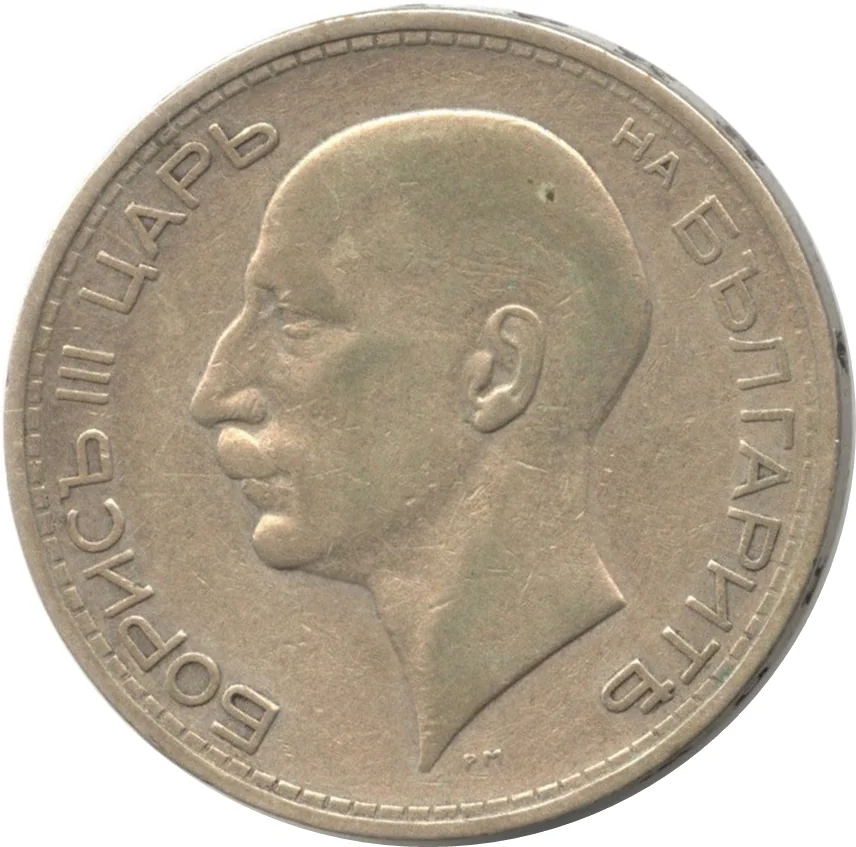
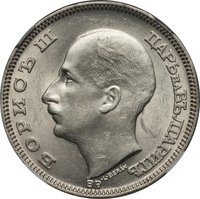
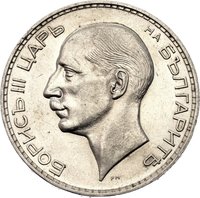
Boris III (1894–1943), Tsar of Bulgaria, facing left.
Inscription:
БОРИСЪ III ЦАРЬ
на БЪЛГАРИТѢ
PM
на БЪЛГАРИТѢ
PM
Translation:
BORIS III TSAR
OF BULGARIA
PM
OF BULGARIA
PM
Script: Cyrillic
Language: Bulgarian
Engraver: Percy Metcalfe
Reverse
Description:
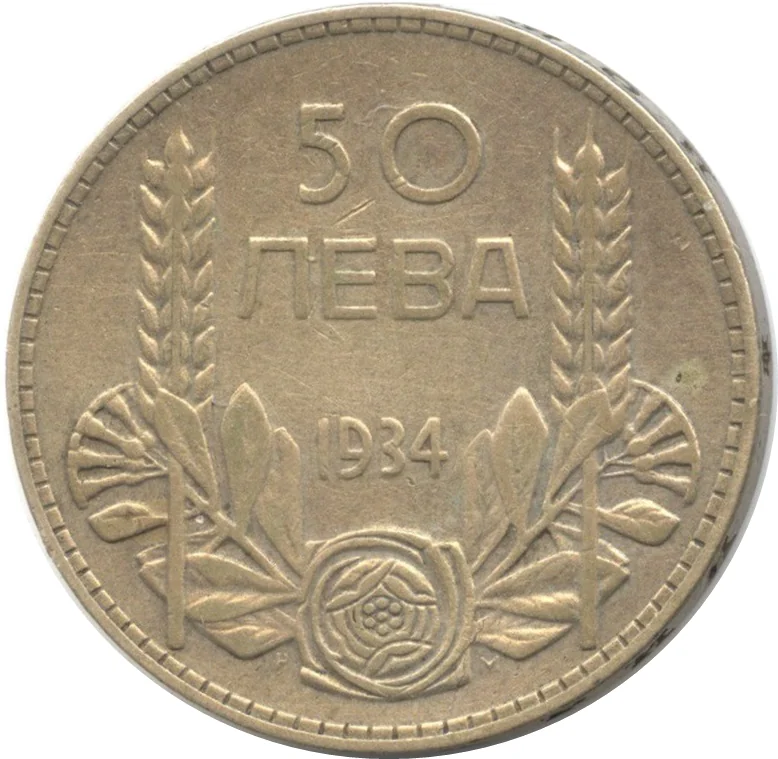
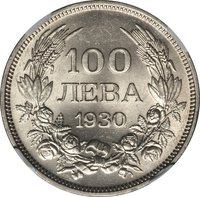
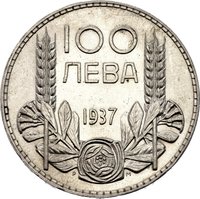
Denomination above date, rose with flanking grain sprigs below.
Inscription:
50
ЛЕВА
1934
ЛЕВА
1934
Translation:
Fifty Leva
1934
1934
Script: Cyrillic
Language: Bulgarian
Engraver: Percy Metcalfe
Edge
Smooth with inscription
Legend:
БОЖЕ ПАЗИ БЪЛГАРИЯ
Translation:
God Save Bulgaria
Language: Bulgarian
Mints
| Name | Mark |
|---|---|
| Belgrade | — |
| Royal Mint (Tower Hill) | — |
Mintings
| Year | Mint Mark | Mintage | Quality | Collection |
|---|---|---|---|---|
| 1934 | — | 3,000,958 | ||
| 1934 | — | — | Proof |
Historical background
In 1934, Bulgaria's currency situation was one of relative stability but underlying fragility, anchored by its membership in the Gold Bloc. The national currency, the lev, was officially pegged to gold, a regime maintained by the Bulgarian National Bank (BNB) since 1928. This peg provided a shield against the hyperinflation that had devastated the country in the early 1920s and offered a semblance of monetary order during the global Great Depression. However, this stability was largely administrative and reliant on strict exchange controls, rather than being buoyed by strong economic fundamentals.
The stability was precarious because Bulgaria's economy was severely depressed, heavily agrarian, and burdened by foreign debt. The global collapse in agricultural prices drastically reduced export earnings, creating a chronic balance of payments deficit. To defend the gold peg, the BNB enforced rigorous capital controls and restricted imports, which stifled economic activity and access to essential goods. Consequently, while the official exchange rate held, the economy operated under a regime of scarcity and limited convertibility, with the government and central bank prioritizing external debt servicing to maintain international creditworthiness.
Politically, this rigid monetary environment existed under the authoritarian regime of the "May 19" coup government, which had taken power in 1934. The regime supported the conservative gold standard policy as a matter of financial orthodoxy and political prestige, aligning with other European Gold Bloc nations. However, the policy came at a significant social cost, deepening economic hardship for the population. By the end of 1934, the system was increasingly untenable, and Bulgaria would be forced to devalue the lev and effectively abandon the gold standard in 1935, following the lead of other nations that had already exited the bloc.
The stability was precarious because Bulgaria's economy was severely depressed, heavily agrarian, and burdened by foreign debt. The global collapse in agricultural prices drastically reduced export earnings, creating a chronic balance of payments deficit. To defend the gold peg, the BNB enforced rigorous capital controls and restricted imports, which stifled economic activity and access to essential goods. Consequently, while the official exchange rate held, the economy operated under a regime of scarcity and limited convertibility, with the government and central bank prioritizing external debt servicing to maintain international creditworthiness.
Politically, this rigid monetary environment existed under the authoritarian regime of the "May 19" coup government, which had taken power in 1934. The regime supported the conservative gold standard policy as a matter of financial orthodoxy and political prestige, aligning with other European Gold Bloc nations. However, the policy came at a significant social cost, deepening economic hardship for the population. By the end of 1934, the system was increasingly untenable, and Bulgaria would be forced to devalue the lev and effectively abandon the gold standard in 1935, following the lead of other nations that had already exited the bloc.
🌱 Common