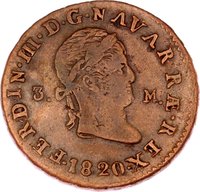
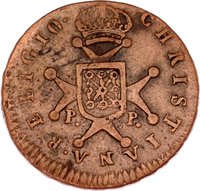
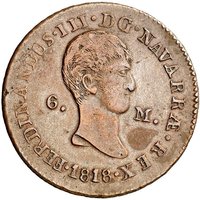
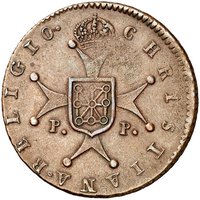
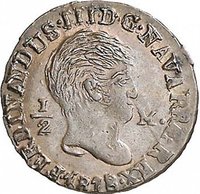
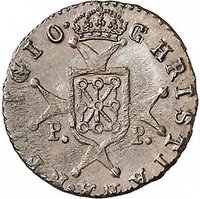
In 1818, the Kingdom of Navarre, a historic territory straddling the Pyrenees, was in a state of monetary disarray and transition, a direct consequence of the Napoleonic Wars and subsequent political upheaval. The region was divided, with
Upper Navarre (south of the Pyrenees) under the restored Spanish Bourbon monarchy of Ferdinand VII, while
Lower Navarre (north of the Pyrenees) was incorporated into the French department of the Basses-Pyrénées. This political split created a fractured economic zone where multiple currencies circulated, complicating trade and daily life.
In Spanish Navarre, the official currency was the
Spanish real, with the peso (or dollar of eight reales) as a key unit. However, the economy was still recovering from the Peninsular War, which had drained resources and seen various occupation currencies, including French francs and Joseph Bonaparte's
afrancesado coinage, flood the market. While these were being phased out, their remnants caused confusion. Simultaneously, in French Navarre, the
French franc, decimalized and standardized under Napoleon, was the sole legal tender, firmly integrating that territory into the French national economy.
The result was a borderland economy where merchants and farmers had to navigate a complex system of exchange. Cross-border trade, a traditional lifeline for the region, required constant calculation of exchange rates between the franc and the Spanish real. Furthermore, older, pre-revolutionary Spanish and French coins, along with even foreign coins like the Mexican peso (a widely trusted silver piece), might still be accepted based on their precious metal content. Thus, in 1818, Navarre lacked a unified monetary identity, operating instead as a pragmatic and somewhat chaotic zone of competing currencies, reflecting its divided political status in post-Napoleonic Europe.