

6 Doppie – Bozzolo
Italy
Context
Year: 1640
Country: Italy 
Issuer: Bozzolo
Ruler: Scipione Gonzaga
Currency:
(1497—1670)
Demonetized: Yes
Material
Diameter: 43 mm
Weight: 39.36 g
Gold weight: 39.36 g
Shape: Irregular round
Composition: Gold
Magnetic: No
Alignment: Coin alignment

flip
References
KM: #Click to copy to clipboard61
Numista: #536726
Value
Bullion value: $6575.80
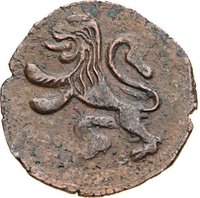
Obverse
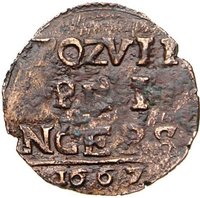
Reverse
Edge
Mints
| Name | Mark |
|---|---|
| Bozzolo | — |
Mintings
| Year | Mint Mark | Mintage | Quality | Collection |
|---|---|---|---|---|
| 1640 | — | — |
Historical background
In 1640, the small northern Italian Duchy of Bozzolo, ruled by the Gonzaga family, operated within a complex and fragmented monetary landscape typical of the Italian peninsula. The duchy did not possess its own minting authority and therefore relied heavily on the circulation of foreign coinage. The most prominent of these were the large silver scudi from neighbouring powerful states like the Duchy of Milan (under Spanish Habsburg rule) and the Republic of Venice, alongside a plethora of smaller fractional coins from various Italian and European mints. This created a daily reality of monetary confusion, where merchants and citizens had to constantly assess the weight, purity, and exchange rate of coins from different origins.
The local economy, primarily agrarian with some textile trade, was further strained by the period's "Price Revolution," a Europe-wide phenomenon of gradual inflation driven by inflows of precious metals from the Americas. For Bozzolo, this meant the real value of existing coins was slowly eroding, causing subtle economic stress. Furthermore, the duchy's political subordination—first to the Spanish crown and later increasingly influenced by the French—meant its monetary fate was tied to the fiscal policies and debasement practices of these greater powers. Debasement, where ruling states reduced the precious metal content in their coinage to raise short-term revenue, directly impacted the value of the foreign coins circulating in Bozzolo’s markets.
Consequently, the "currency situation" was one of passive dependency and practical inconvenience. Transactions required money-changers and careful negotiation, as the values of coins were not fixed by a local standard but by their metallic content and the volatile international exchange rates. This system was inefficient and prone to exploitation, hindering commerce and complicating tax collection for the ducal treasury. Ultimately, Bozzolo’s monetary reality in 1640 reflected its broader political reality: a minor state buffeted by the economic forces and decisions of much larger neighbours, with little autonomy to shape its own financial stability.
The local economy, primarily agrarian with some textile trade, was further strained by the period's "Price Revolution," a Europe-wide phenomenon of gradual inflation driven by inflows of precious metals from the Americas. For Bozzolo, this meant the real value of existing coins was slowly eroding, causing subtle economic stress. Furthermore, the duchy's political subordination—first to the Spanish crown and later increasingly influenced by the French—meant its monetary fate was tied to the fiscal policies and debasement practices of these greater powers. Debasement, where ruling states reduced the precious metal content in their coinage to raise short-term revenue, directly impacted the value of the foreign coins circulating in Bozzolo’s markets.
Consequently, the "currency situation" was one of passive dependency and practical inconvenience. Transactions required money-changers and careful negotiation, as the values of coins were not fixed by a local standard but by their metallic content and the volatile international exchange rates. This system was inefficient and prone to exploitation, hindering commerce and complicating tax collection for the ducal treasury. Ultimately, Bozzolo’s monetary reality in 1640 reflected its broader political reality: a minor state buffeted by the economic forces and decisions of much larger neighbours, with little autonomy to shape its own financial stability.

✨ Legendary