

4 Doppie – Bozzolo
Italy
Context
Year: 1639
Country: Italy 
Issuer: Bozzolo
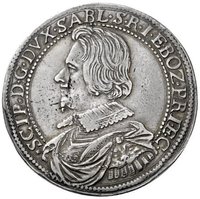
Ruler: Scipione Gonzaga
Currency:
(1497—1670)
Demonetized: Yes
Material
Diameter: 43 mm
Weight: 26.07 g
Gold weight: 26.07 g
Shape: Irregular round
Composition: Gold
Magnetic: No
Alignment: Coin alignment

flip
References
KM: #Click to copy to clipboard59
Numista: #536596
Value
Bullion value: $4355.46
Obverse
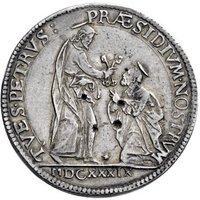
Reverse
Description:
Christ giving the keys to Peter.
Inscription:
TVES PETRVS PRÆSIDIVM NOSTRVM
MDCXXXIX
MDCXXXIX
Script: Latin
Edge
Mints
| Name | Mark |
|---|---|
| Bozzolo | — |
Mintings
| Year | Mint Mark | Mintage | Quality | Collection |
|---|---|---|---|---|
| 1639 | — | — |
Historical background
In 1639, the small northern Italian Duchy of Bozzolo, ruled by the Gonzaga family, operated within a complex and fragmented monetary system typical of the Italian peninsula. The state itself had limited minting rights, and its local currency, the scudo and its subdivisions, competed with a plethora of foreign coins circulating freely within its borders. Spanish silver reales, Venetian ducats, and Milanese scudi were all commonly used in commerce, their values fluctuating based on their precious metal content and the credibility of the issuing authority. This created a constant challenge for merchants and the ducal treasury, requiring frequent official tavole di cambio (exchange rate bulletins) to establish equivalence between coins.
The period was one of significant economic strain, exacerbated by the Thirty Years' War (1618-1648), which disrupted trade routes and placed heavy fiscal demands on even minor states like Bozzolo. Duke Gianfrancesco II Gonzaga faced the dual pressure of maintaining his court and fulfilling obligations to larger imperial powers, leading to potential debasement—reducing the silver content in local coinage to stretch precious metal reserves. This practice, while providing short-term liquidity, risked driving good foreign money out of circulation (Gresham's Law) and fueling inflation, further eroding economic stability.
Thus, the currency situation in Bozzolo in 1639 was characterized by monetary plurality, external dependency, and underlying vulnerability. The ducal administration’s primary financial concerns were less about controlling a unified currency and more about managing this chaotic system: assuring the value of payments into the treasury, settling debts with foreign creditors, and attempting to maintain confidence in the local coinage amidst regional warfare and economic uncertainty. The stability of money was directly tied to the political fortunes and fiscal health of the Gonzaga court itself.
The period was one of significant economic strain, exacerbated by the Thirty Years' War (1618-1648), which disrupted trade routes and placed heavy fiscal demands on even minor states like Bozzolo. Duke Gianfrancesco II Gonzaga faced the dual pressure of maintaining his court and fulfilling obligations to larger imperial powers, leading to potential debasement—reducing the silver content in local coinage to stretch precious metal reserves. This practice, while providing short-term liquidity, risked driving good foreign money out of circulation (Gresham's Law) and fueling inflation, further eroding economic stability.
Thus, the currency situation in Bozzolo in 1639 was characterized by monetary plurality, external dependency, and underlying vulnerability. The ducal administration’s primary financial concerns were less about controlling a unified currency and more about managing this chaotic system: assuring the value of payments into the treasury, settling debts with foreign creditors, and attempting to maintain confidence in the local coinage amidst regional warfare and economic uncertainty. The stability of money was directly tied to the political fortunes and fiscal health of the Gonzaga court itself.

✨ Legendary