

2 Doppie – Monaco
Monaco

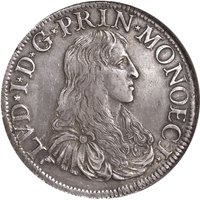
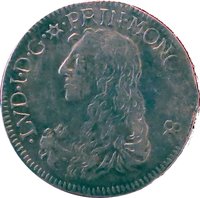
Obverse
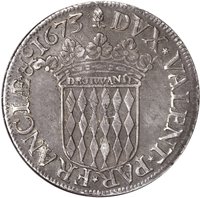
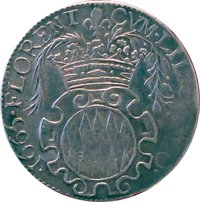
Reverse
Description:
Monogram crowned in branches.
Inscription:
DEO IVVANTE ET S PROTEGENTE 1663
Script: Latin
Edge
Mints
| Name | Mark |
|---|---|
| Monaco | — |
Mintings
| Year | Mint Mark | Mintage | Quality | Collection |
|---|---|---|---|---|
| 1663 | — | — | ||
| 1664 | — | — |
Historical background
In 1663, Monaco’s currency situation was a complex tapestry of foreign coinage and local token issues, reflecting its small size and political dependence. The Principality, under the sovereignty of the Grimaldi family, lacked the sovereign right to mint its own official metallic currency. Consequently, the daily economic life of the port and market was conducted using a mixture of foreign coins, primarily French livres, sous, and deniers, but also Spanish reales and Italian lire and scudi from neighboring Genoa and Savoy. This multiplicity created constant challenges of exchange rates and valuation, complicating trade and taxation.
To address the chronic shortage of small change for everyday transactions, the Lords of Monaco, Honoré II and later his grandson Louis I, periodically issued low-denomination token coinage. These monégasque coins, such as the liard and double sol, were made of billon (a base silver alloy) or copper and were intended for local use only. Their value was not intrinsic but was set by princely decree (cours forcé), requiring the population to accept them at face value. However, their circulation was often limited and they struggled to compete with the perceived reliability of French royal coinage.
The broader monetary context was one of French hegemony. Having placed itself under French protection in 1641, Monaco was increasingly within the orbit of France's monetary system. King Louis XIV's government was actively working to standardize coinage across the kingdom, a policy that inevitably influenced the Principality. Thus, while local tokens filled a practical gap, the monetary trajectory of Monaco in 1663 was one of gradual but steady alignment with the French economy, a prelude to the later formal adoption of the French franc.
To address the chronic shortage of small change for everyday transactions, the Lords of Monaco, Honoré II and later his grandson Louis I, periodically issued low-denomination token coinage. These monégasque coins, such as the liard and double sol, were made of billon (a base silver alloy) or copper and were intended for local use only. Their value was not intrinsic but was set by princely decree (cours forcé), requiring the population to accept them at face value. However, their circulation was often limited and they struggled to compete with the perceived reliability of French royal coinage.
The broader monetary context was one of French hegemony. Having placed itself under French protection in 1641, Monaco was increasingly within the orbit of France's monetary system. King Louis XIV's government was actively working to standardize coinage across the kingdom, a policy that inevitably influenced the Principality. Thus, while local tokens filled a practical gap, the monetary trajectory of Monaco in 1663 was one of gradual but steady alignment with the French economy, a prelude to the later formal adoption of the French franc.
✨ Legendary