

1 Liard – Prince-bishopric of Liege
Belgium
Context
Year: 1606
Country: Belgium 
Issuer: Prince-bishopric of Liege
Ruler: Ernest of Bavaria
Currency:
(1545—1650)
Subdivision: 1 Liard = 1 Aidant
Demonetized: Yes
Material
References
KM: #Click to copy to clipboard11
Numista: #533431
Obverse
Description:
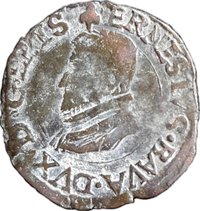
Ernest left, short-bearded, wearing electoral cap.
Inscription:
LEODIENSIS DVX BVLL CO LOS
Script: Latin
Reverse
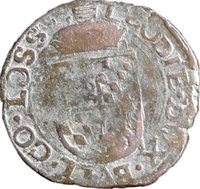
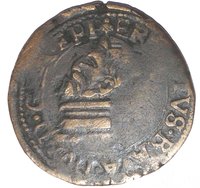
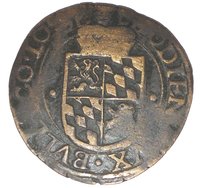
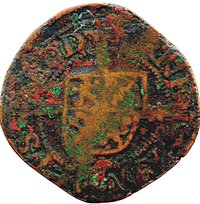
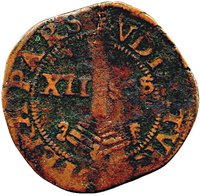
Description:
Crowned, quartered arms of Bavaria-Palatinate within a circle. Legend divided near 6:00 by the Liège perron.
Inscription:
ERNESTVS BAVA DVX D G EPIS
Script: Latin
Edge
Mints
| Name | Mark |
|---|---|
| Liège | — |
Mintings
| Year | Mint Mark | Mintage | Quality | Collection |
|---|---|---|---|---|
| 1606 | — | — |
Historical background
In 1606, the Prince-Bishopric of Liège was navigating a complex and challenging monetary landscape, typical of the fragmented Holy Roman Empire. The region did not possess a strong, unified currency of its own, leading to a circulation dominated by foreign coins. Spanish patagons and Dutch leeuwendaalders (lion dollars) were particularly prevalent due to Liège's strategic location between the Spanish Netherlands and the Dutch Republic. This reliance on external coinage made the local economy highly vulnerable to the monetary policies and debasements of its powerful neighbours, causing instability in trade and daily transactions.
The situation was exacerbated by the ongoing Eighty Years' War (1568-1648) raging on its borders, which flooded the markets with coins of varying weight and purity as warring states manipulated their currency for fiscal advantage. Counterfeiting was also a rampant problem. While the Prince-Bishops had minting rights, their own silver patards and liards were often of inferior quality and played a secondary role in commerce. The year 1606 fell within the reign of Prince-Bishop Ernest of Bavaria, whose administration was likely preoccupied with these persistent monetary disorders, though no major reform is specifically recorded for that single year.
Consequently, merchants and citizens in Liège faced constant uncertainty regarding the real value of the coins in their hands. Exchange rates fluctuated, and simple transactions required expert knowledge to assess a coin's origin, metal content, and acceptable discount. This chaotic environment acted as a drag on economic development, prompting local authorities to periodically issue ordinances attempting to fix rates for the multitude of circulating coins, but with limited long-term success against powerful regional economic forces.
The situation was exacerbated by the ongoing Eighty Years' War (1568-1648) raging on its borders, which flooded the markets with coins of varying weight and purity as warring states manipulated their currency for fiscal advantage. Counterfeiting was also a rampant problem. While the Prince-Bishops had minting rights, their own silver patards and liards were often of inferior quality and played a secondary role in commerce. The year 1606 fell within the reign of Prince-Bishop Ernest of Bavaria, whose administration was likely preoccupied with these persistent monetary disorders, though no major reform is specifically recorded for that single year.
Consequently, merchants and citizens in Liège faced constant uncertainty regarding the real value of the coins in their hands. Exchange rates fluctuated, and simple transactions required expert knowledge to assess a coin's origin, metal content, and acceptable discount. This chaotic environment acted as a drag on economic development, prompting local authorities to periodically issue ordinances attempting to fix rates for the multitude of circulating coins, but with limited long-term success against powerful regional economic forces.

✨ Legendary