

10 Sen – Brunei
Brunei
Context

Material
Diameter: 19.41 mm
Weight: 2.83 g
Shape: Round
Composition: Copper-nickel
Magnetic: Yes
Technique: Milled
Alignment: Medal alignment

flip
References
Numista: #526154
Value
Exchange value: 0.10 BND
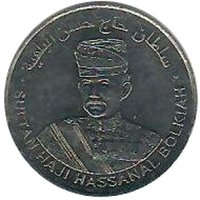
Obverse
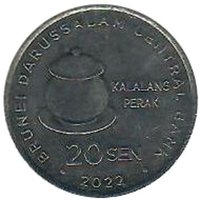
Reverse
Description:
Rose vase.
Inscription:
BRUNEI DARUSSALAM CENTRAL BANK
10
SEN
TARIAN
KERAJAAN
∙ 2022 ∙
10
SEN
TARIAN
KERAJAAN
∙ 2022 ∙
Script: Latin
Edge
Reeded
Mintings
| Year | Mint Mark | Mintage | Quality | Collection |
|---|---|---|---|---|
| 2022 | — | — |
Historical background
In 2022, Brunei Darussalam’s currency situation remained anchored by its long-standing Currency Interchangeability Agreement with Singapore, established in 1967. Under this arrangement, the Brunei dollar (BND) is pegged at par to the Singapore dollar (SGD), and both currencies are legal tender in each other's countries. This symbiotic relationship provides Brunei with significant monetary stability, anchoring inflation and facilitating seamless trade and financial flows with its major economic partner. The arrangement effectively outsources much of Brunei's monetary policy to the Monetary Authority of Singapore (MAS), which is known for its credible and stable management, thereby bolstering investor confidence in the small sultanate's economy.
The year saw the Brunei dollar, and by extension its linked policy, face indirect pressures from global macroeconomic developments. As the U.S. Federal Reserve aggressively raised interest rates to combat inflation, the MAS also tightened its monetary policy, allowing the Singapore dollar (and thus the Brunei dollar) to appreciate against a strengthening U.S. dollar. This helped mitigate imported inflation for Brunei, a nation that relies heavily on foreign goods. However, the broader economic context for Brunei in 2022 was one of post-pandemic recovery and fiscal consolidation, heavily dependent on volatile oil and gas revenues. The currency peg provided a crucial buffer against external volatility, even as the nation worked to diversify its economy away from hydrocarbon dependence.
Overall, the currency situation in 2022 was characterized by stability and predictability, a deliberate outcome of the peg. There were no indications or policy shifts suggesting any reconsideration of this foundational agreement. The system continued to serve Brunei's key interests: ensuring price stability, maintaining international credibility, and supporting financial integration within a key regional market. The primary challenges for the nation remained fiscal and economic in nature—related to energy prices and diversification efforts—rather than monetary, thanks to the secure and well-established currency framework.
The year saw the Brunei dollar, and by extension its linked policy, face indirect pressures from global macroeconomic developments. As the U.S. Federal Reserve aggressively raised interest rates to combat inflation, the MAS also tightened its monetary policy, allowing the Singapore dollar (and thus the Brunei dollar) to appreciate against a strengthening U.S. dollar. This helped mitigate imported inflation for Brunei, a nation that relies heavily on foreign goods. However, the broader economic context for Brunei in 2022 was one of post-pandemic recovery and fiscal consolidation, heavily dependent on volatile oil and gas revenues. The currency peg provided a crucial buffer against external volatility, even as the nation worked to diversify its economy away from hydrocarbon dependence.
Overall, the currency situation in 2022 was characterized by stability and predictability, a deliberate outcome of the peg. There were no indications or policy shifts suggesting any reconsideration of this foundational agreement. The system continued to serve Brunei's key interests: ensuring price stability, maintaining international credibility, and supporting financial integration within a key regional market. The primary challenges for the nation remained fiscal and economic in nature—related to energy prices and diversification efforts—rather than monetary, thanks to the secure and well-established currency framework.

💎 Extremely Rare