

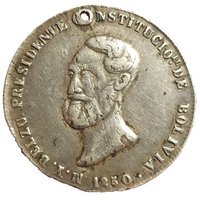
Obverse
Description:
General Velasco bust on pedestal, encircled by flagpoles. Circular legend.
Inscription:
POTOSI AL REJENERADOR DE BOLIVIA
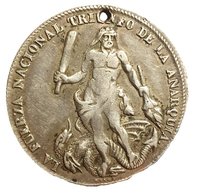
Reverse
Description:
Justice allegory with encircling legend.
Inscription:
PRESIDENTE CONSTITUCIONAL EN 1840
Edge
Mints
| Name | Mark |
|---|---|
| Potosi | — |
Mintings
| Year | Mint Mark | Mintage | Quality | Collection |
|---|---|---|---|---|
| 1840 | — | — |
Historical background
In 1840, Bolivia’s currency situation was chaotic and emblematic of the severe economic and political instability that had plagued the young republic since its independence in 1825. The nation’s formal monetary system was based on the peso boliviano, but its value and circulation were undercut by a chronic shortage of minted coinage, especially silver. This scarcity was exacerbated by the decline of the Potosí silver mines, which had historically been the region's economic engine but were now producing far less due to depleted veins, lack of investment, and political turmoil. Consequently, foreign coins, primarily Peruvian and Argentine pesos, circulated widely alongside the limited domestic coinage, creating a confusing and unreliable monetary environment.
The fundamental problem was a deep fiscal crisis. The state treasury was virtually empty due to costly wars, particularly the disastrous conflict with the Peru-Bolivia Confederation (1836-1839), which had just ended in defeat. With minimal tax revenue and massive debts, the government under General José Miguel de Velasco (in his first presidency) lacked the bullion reserves to mint sufficient currency. This led to widespread use of moneda feble (weak money), often crudely cut or debased coins, and even primitive credit instruments and barter in remote areas. The lack of a strong, unified national currency stifled internal trade and complicated all commercial transactions, as the value of coins depended heavily on their origin, metal content, and physical condition.
This monetary disarray was both a cause and a symptom of Bolivia's broader struggles. It reflected the failure of successive caudillo governments to establish stable institutions and foster economic recovery. The unreliable currency discouraged foreign investment and hindered the state's ability to collect taxes or pay its soldiers and officials, perpetuating a cycle of instability. Thus, in 1840, Bolivia's currency was not merely an economic issue but a profound symbol of a fractured nation-state still struggling to forge a functional and sovereign economic system nearly two decades after its founding.
The fundamental problem was a deep fiscal crisis. The state treasury was virtually empty due to costly wars, particularly the disastrous conflict with the Peru-Bolivia Confederation (1836-1839), which had just ended in defeat. With minimal tax revenue and massive debts, the government under General José Miguel de Velasco (in his first presidency) lacked the bullion reserves to mint sufficient currency. This led to widespread use of moneda feble (weak money), often crudely cut or debased coins, and even primitive credit instruments and barter in remote areas. The lack of a strong, unified national currency stifled internal trade and complicated all commercial transactions, as the value of coins depended heavily on their origin, metal content, and physical condition.
This monetary disarray was both a cause and a symptom of Bolivia's broader struggles. It reflected the failure of successive caudillo governments to establish stable institutions and foster economic recovery. The unreliable currency discouraged foreign investment and hindered the state's ability to collect taxes or pay its soldiers and officials, perpetuating a cycle of instability. Thus, in 1840, Bolivia's currency was not merely an economic issue but a profound symbol of a fractured nation-state still struggling to forge a functional and sovereign economic system nearly two decades after its founding.
✨ Legendary