

20 zlotys – Poland
Add to wishlist
Poland
Context
Year: 2025
Issuer: Poland
Issuing organization: Narodowy Bank Polski
Period:
(since 1989)
Currency:
(since 1995)
Total mintage: 10,000
Material
References
Y: #
Numista: #520867
Value
Exchange value: 20 PLN
Bullion value: $66.84
Obverse
Description:
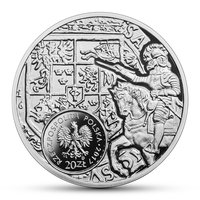
Top: A fragment of the 1812 3-grosz coin reverse with "3 / GROSZE / 1812 / I.B."
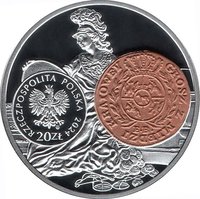
Center: The Polish Eagle state emblem, with the Mint mark "m/w" below.
Background: A fragment of the Duchy of Warsaw Provisional Supreme Council seal.
Surrounding inscriptions: "RZECZPOSPOLITA POLSKA 2025" and "20 ZŁ."
Center: The Polish Eagle state emblem, with the Mint mark "m/w" below.
Background: A fragment of the Duchy of Warsaw Provisional Supreme Council seal.
Surrounding inscriptions: "RZECZPOSPOLITA POLSKA 2025" and "20 ZŁ."
Inscription:
3
GROSZE
1812
I.B.
RZECZPOSPOLITA POLSKA 2025
20 ZŁ
GROSZE
1812
I.B.
RZECZPOSPOLITA POLSKA 2025
20 ZŁ
Script: Latin
Designer: Dominika Karpińska-Kopiec
Reverse
Description:
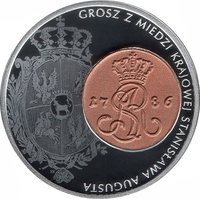
The obverse of the 1812 3-grosz coin shows the crowned coat of arms of the Duchy of Warsaw flanked by twigs, with the inscription "3 GROSZE KSIĘSTWA WARSZAWSKIEGO" above. The background features part of the Duchy's Constitution cover.
Inscription:
3 GROSZE KSIĘSTWA WARSZAWSKIEGO
Script: Latin
Designer: Dominika Karpińska-Kopiec
Edge
Plain
Categories
| Currency> Coin depiction |
| Symbols> Coat of Arms |
Mints
| Name | Mark |
|---|---|
| Mint of Poland | (MW) |
Mintings
| Year | Mint Mark | Mintage | Quality | Collection |
|---|---|---|---|---|
| 2025 | MW | 10,000 | Proof |
Historical background
In 2025, Poland's currency, the złoty (PLN), operates within a complex economic landscape defined by cautious stability and underlying pressures. Having navigated the post-pandemic recovery and the initial shock of the war in Ukraine, the National Bank of Poland (NBP) maintains a primary focus on steering inflation back to its target band. While the extreme peaks of 2022-2023 have subsided, inflation remains a key concern, keeping monetary policy relatively tight. The złoty's exchange rate against the euro and dollar is thus influenced less by crisis and more by traditional fundamentals: interest rate differentials, growth prospects, and regional risk sentiment.
The currency's strength is notably supported by Poland's resilient economy, which continues to attract significant foreign direct investment, particularly in manufacturing and green energy sectors. Furthermore, the continued inflow of EU recovery and cohesion funds provides a steady source of foreign currency, bolstering the złoty's position. However, these positives are balanced by persistent challenges, including a tight labor market fueling wage growth, uncertainties regarding the full absorption of EU funds due to rule-of-law disputes, and the broader geopolitical risks stemming from Poland's frontline position.
Looking ahead, the key determinant for the złoty in 2025 is the timing and pace of monetary easing by the NBP compared to the European Central Bank and the Federal Reserve. Market participants closely watch for signals that inflation is sustainably tamed, which would allow for rate cuts without triggering capital outflows and currency depreciation. Consequently, the PLN in 2025 is expected to exhibit moderate volatility, trading within established ranges but sensitive to any shifts in domestic inflation data or changes in the global risk environment.
The currency's strength is notably supported by Poland's resilient economy, which continues to attract significant foreign direct investment, particularly in manufacturing and green energy sectors. Furthermore, the continued inflow of EU recovery and cohesion funds provides a steady source of foreign currency, bolstering the złoty's position. However, these positives are balanced by persistent challenges, including a tight labor market fueling wage growth, uncertainties regarding the full absorption of EU funds due to rule-of-law disputes, and the broader geopolitical risks stemming from Poland's frontline position.
Looking ahead, the key determinant for the złoty in 2025 is the timing and pace of monetary easing by the NBP compared to the European Central Bank and the Federal Reserve. Market participants closely watch for signals that inflation is sustainably tamed, which would allow for rate cuts without triggering capital outflows and currency depreciation. Consequently, the PLN in 2025 is expected to exhibit moderate volatility, trading within established ranges but sensitive to any shifts in domestic inflation data or changes in the global risk environment.
Series: History of Polish Coin

✨ Legendary