

1 Thaler – Brunswick-Lüneburg-Calenberg-Hannover
Germany
Context

Material
References
KM: #Click to copy to clipboard353
Numista: #266568
Value
Bullion value: $83.23
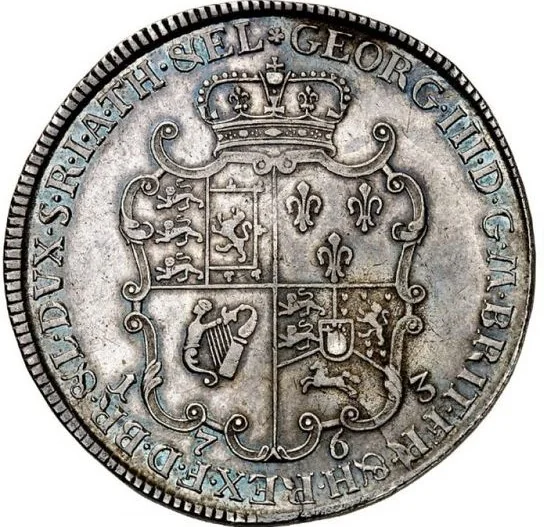
Obverse
Description:
Quartered arms on an ornate shield.
Inscription:
GEORG • III • D • G • M • BRIT • FR • & H • REX • F • D • BR • & L • DVX • S • R • I • A • TH • & EL *
1763
1763
Script: Latin
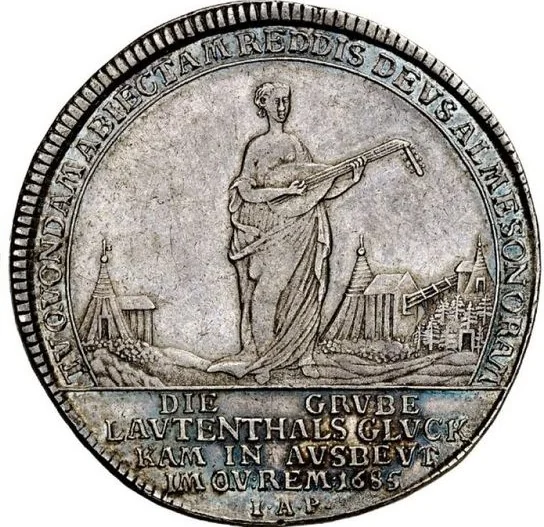
Reverse
Description:
Lute player at the mines.
Inscription:
TV QVONDAM ABIECTAM REDDIS DEVS ALME SONORAM
DIE GRVBE
LAVTENTHALS GLVCK
KAM IN AVSBEVT
IM QV: REM: 1685
I.A.P.
DIE GRVBE
LAVTENTHALS GLVCK
KAM IN AVSBEVT
IM QV: REM: 1685
I.A.P.
Script: Latin
Edge
Mints
| Name | Mark |
|---|---|
| Zellerfeld | — |
Mintings
| Year | Mint Mark | Mintage | Quality | Collection |
|---|---|---|---|---|
| 1763 | — | — |
Historical background
In 1763, the currency situation in the Duchy of Brunswick-Lüneburg, specifically the Principality of Calenberg (with its capital in Hanover), was one of profound crisis and instability, emerging directly from the devastation of the Seven Years' War (1756-1763). The conflict had seen the Hanoverian territories repeatedly occupied and fought over, leading to massive war expenditures, plundering, and economic disruption. To finance the war, the government, like others in the Holy Roman Empire, had resorted to debasing its coinage, issuing excessive quantities of low-quality Scheidemünzen (small change coins) with a high face value but low intrinsic metal content. This resulted in a severe loss of public trust, rampant inflation, and a chaotic monetary system where multiple, fluctuating currencies circulated simultaneously.
The situation reached a critical point with the "Kipper- und Wipperzeit" of the early 1760s, a period of speculative coinage and monetary manipulation. The sheer volume of debated coins drove good, full-weight silver Reichsthaler out of circulation, as they were hoarded or melted down (Gresham's Law in action). This created a dual crisis: a crippling shortage of reliable specie for commerce and state finance, alongside a flood of nearly worthless small change that creditors and merchants refused to accept at face value. The economic foundation of the principality was severely damaged, threatening both recovery from the war and the state's ability to service its substantial debts.
In direct response to this turmoil, 1763 became a landmark year for monetary reform. Under the guidance of the Hanoverian government, a comprehensive currency edict was promulgated to restore stability. This reform demonetized the discredited Scheidemünzen, mandated their withdrawal from circulation, and re-established the Conventionsmünze standard, pegging the Hanoverian Thaler to a fixed silver content. This decisive action, part of a broader wave of post-war monetary reforms across Germany, successfully ended the inflationary crisis and laid a stable monetary foundation for Hanover's economic recovery and future development in the latter part of the 18th century.
The situation reached a critical point with the "Kipper- und Wipperzeit" of the early 1760s, a period of speculative coinage and monetary manipulation. The sheer volume of debated coins drove good, full-weight silver Reichsthaler out of circulation, as they were hoarded or melted down (Gresham's Law in action). This created a dual crisis: a crippling shortage of reliable specie for commerce and state finance, alongside a flood of nearly worthless small change that creditors and merchants refused to accept at face value. The economic foundation of the principality was severely damaged, threatening both recovery from the war and the state's ability to service its substantial debts.
In direct response to this turmoil, 1763 became a landmark year for monetary reform. Under the guidance of the Hanoverian government, a comprehensive currency edict was promulgated to restore stability. This reform demonetized the discredited Scheidemünzen, mandated their withdrawal from circulation, and re-established the Conventionsmünze standard, pegging the Hanoverian Thaler to a fixed silver content. This decisive action, part of a broader wave of post-war monetary reforms across Germany, successfully ended the inflationary crisis and laid a stable monetary foundation for Hanover's economic recovery and future development in the latter part of the 18th century.

✨ Legendary