


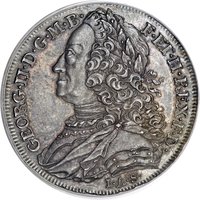
Obverse
Description:
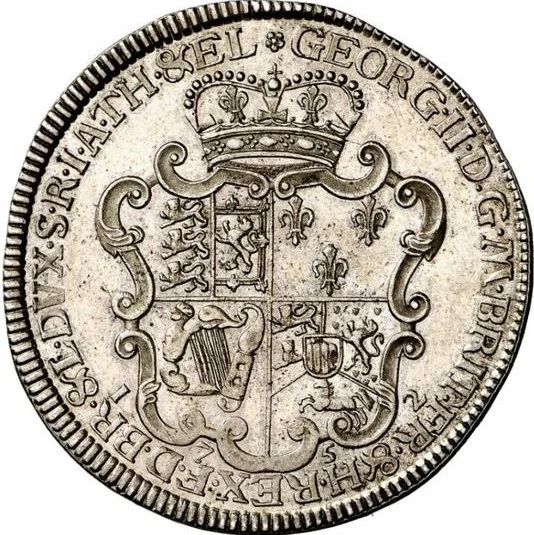
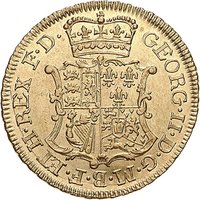
Quartered arms on an ornate shield.
Inscription:
GEORG • II • D • G • M • BRIT • FR • & H • REX • F • D • BR • & L • DVX • S • R • I • A • TH • EL • *
1752
1752
Script: Latin
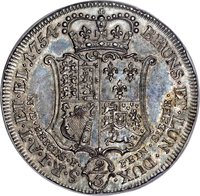
Reverse
Description:
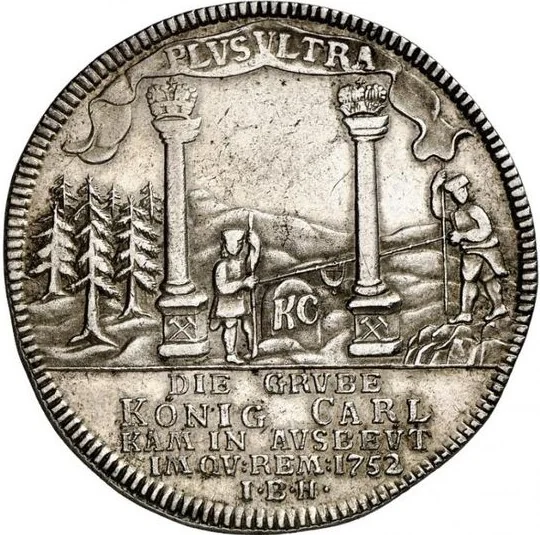
Mine interior
Inscription:
PLVS VLTRA
KC
DIE GRVBE
KÖNIG CARL
KAM IN AVSBEVT
IM QV REM 1752
I.B.H.
KC
DIE GRVBE
KÖNIG CARL
KAM IN AVSBEVT
IM QV REM 1752
I.B.H.
Script: Latin
Edge
Mints
| Name | Mark |
|---|---|
| Zellerfeld | — |
Mintings
| Year | Mint Mark | Mintage | Quality | Collection |
|---|---|---|---|---|
| 1752 | — | — |
Historical background
In 1752, the currency situation in the Duchy of Brunswick-Lüneburg, specifically the Principality of Calenberg (often referred to as Hanover after its capital), was characterized by significant complexity and ongoing reform. The region operated within the fragmented monetary system of the Holy Roman Empire, where numerous states issued their own coinage. Hanover itself used the Reichsthaler as a standard accounting unit, but daily commerce was conducted in a confusing array of physical coins, including various Thalers, Gute Groschen, and Mariengroschen, each with fluctuating values based on silver content and regional acceptance. This proliferation of currencies, combined with the widespread circulation of debased coins from neighboring states, created chronic instability for trade and public finance.
Recognizing these problems, the Hanoverian government, under the rule of the British King George II (as Elector of Hanover), was actively pursuing standardization. The year 1752 fell within a period of monetary consolidation following the major Münzedikt (coin edict) of 1750, which aimed to align the Duchy's currency with the Reichsthaler standard of the Leipziger Fuß (Leipzig monetary standard). This reform sought to stabilize the relationship between the accounting Reichsthaler and the smaller subsidiary coins, thereby reducing arbitrage and fraud. The state was systematically recalling old, debased coinage and minting new, full-value coins to establish a uniform and reliable monetary system across its territories.
The impetus for this reform was both economic and political. A stable currency was essential for managing state debt, paying troops, and facilitating the growing trade of the Hanoverian territories. Furthermore, as a dynastic state linked to Great Britain, Hanover required sound finances to support its geopolitical interests within the Empire. Thus, the currency situation in 1752 was one of transition—caught between the legacy of a chaotic, multi-currency past and a concerted, state-driven effort to impose order, trust, and uniformity on the monetary system, a process crucial for the principality's modern administrative development.
Recognizing these problems, the Hanoverian government, under the rule of the British King George II (as Elector of Hanover), was actively pursuing standardization. The year 1752 fell within a period of monetary consolidation following the major Münzedikt (coin edict) of 1750, which aimed to align the Duchy's currency with the Reichsthaler standard of the Leipziger Fuß (Leipzig monetary standard). This reform sought to stabilize the relationship between the accounting Reichsthaler and the smaller subsidiary coins, thereby reducing arbitrage and fraud. The state was systematically recalling old, debased coinage and minting new, full-value coins to establish a uniform and reliable monetary system across its territories.
The impetus for this reform was both economic and political. A stable currency was essential for managing state debt, paying troops, and facilitating the growing trade of the Hanoverian territories. Furthermore, as a dynastic state linked to Great Britain, Hanover required sound finances to support its geopolitical interests within the Empire. Thus, the currency situation in 1752 was one of transition—caught between the legacy of a chaotic, multi-currency past and a concerted, state-driven effort to impose order, trust, and uniformity on the monetary system, a process crucial for the principality's modern administrative development.
✨ Legendary