

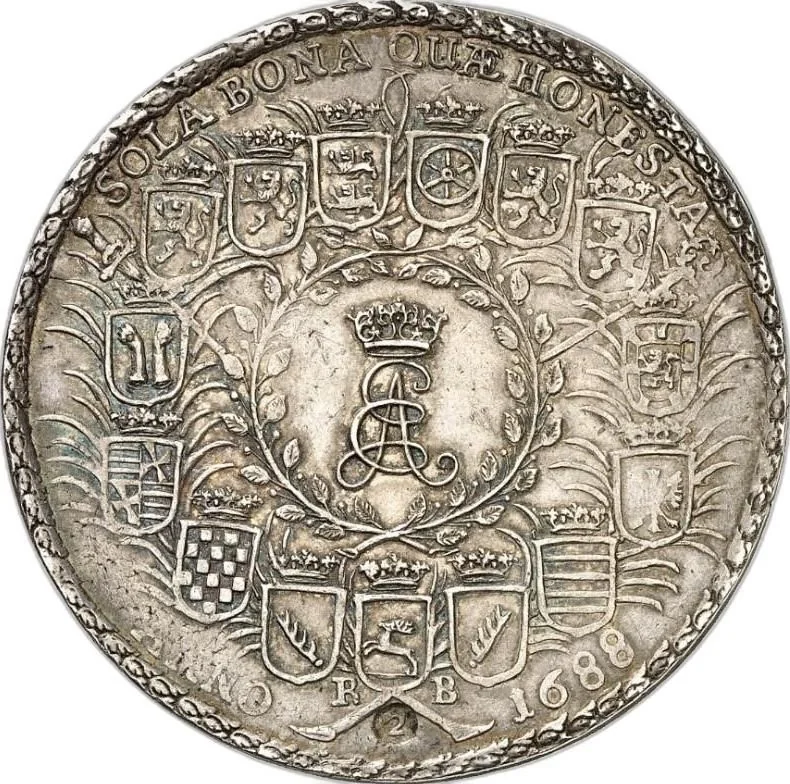
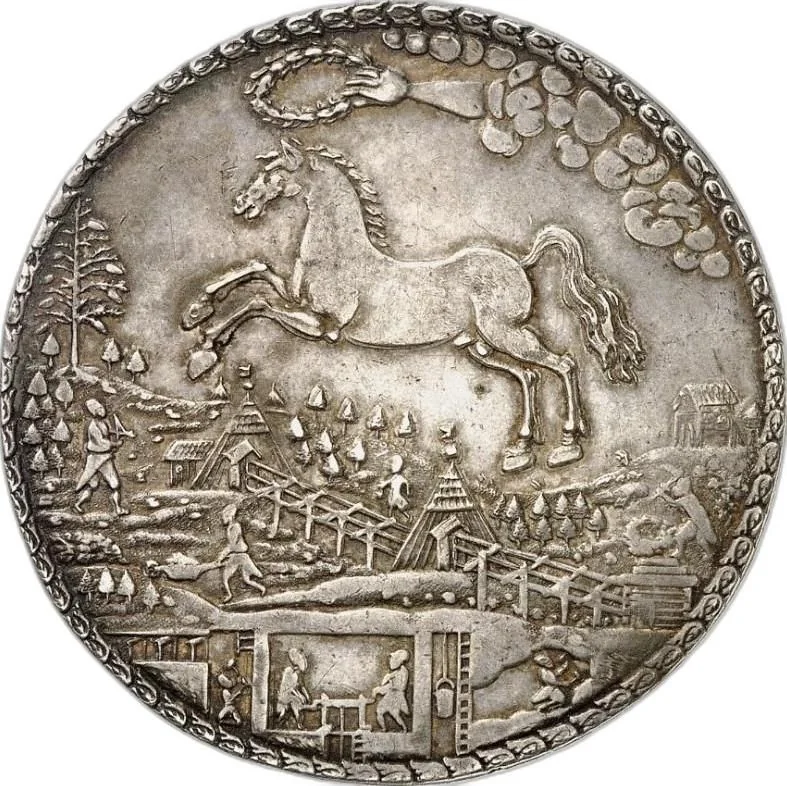
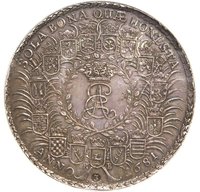
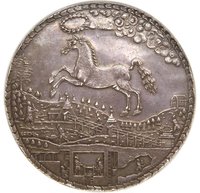
2 Thalers – Brunswick-Lüneburg-Calenberg
Germany
Context
Years: 1681–1688
Country: Germany 
Issuer: Brunswick-Lüneburg-Calenberg
Ruler: Ernest Augustus
Currency:
Demonetized: Yes
Material
References
KM: #Click to copy to clipboard282
Numista: #266509
Value
Bullion value: $160.55
Mints
| Name | Mark |
|---|---|
| Zellerfeld | — |
Mintings
| Year | Mint Mark | Mintage | Quality | Collection |
|---|---|---|---|---|
| 1681 | — | — | ||
| 1688 | — | — |
Historical background
In 1681, the Duchy of Brunswick-Lüneburg, specifically the Principality of Calenberg under Duke Ernst August, was grappling with the severe and chronic monetary instability common across the Holy Roman Empire. The primary issue was the widespread circulation of debased coinage, particularly the ubiquitous Kipper- und Wipperzeit coins from earlier in the century, which had lower intrinsic silver content than their face value. This situation was exacerbated by the fragmentation of minting rights; numerous imperial cities and petty princes operated mints, competitively issuing inferior coins to profit from seigniorage, leading to a confusing mix of currencies of varying worth that undermined trade and public trust.
Duke Ernst August’s administration recognized that this monetary chaos hindered economic development and state revenue. While a definitive, unified reform for all Brunswick-Lüneburg territories was still years away, the groundwork was being laid in Calenberg. The focus in this period was likely on administrative and preparatory measures, such as gathering information on the scale of the problem, negotiating with other territorial lords, and attempting to control the circulation of the very worst debased coins within his own domains. The goal was to assert greater princely control over the monetary system as a key step toward both economic stability and the consolidation of absolutist power.
Therefore, the currency situation in 1681 was one of disorderly transition. It was characterized by the lingering aftermath of past debasements and active planning for future reform. The significant monetary consolidation, the Münzprobationstag of 1682 and the subsequent Zinnaische Münzfuß convention of 1683, which Calenberg would join, were imminent. These agreements aimed to standardize coin weights and fineness across several northern German territories, setting the stage for the more stable Leipziger Münzfuß of 1690. Thus, 1681 represents the tense prelude to a concerted, regional effort to impose order on the chaotic currency system.
Duke Ernst August’s administration recognized that this monetary chaos hindered economic development and state revenue. While a definitive, unified reform for all Brunswick-Lüneburg territories was still years away, the groundwork was being laid in Calenberg. The focus in this period was likely on administrative and preparatory measures, such as gathering information on the scale of the problem, negotiating with other territorial lords, and attempting to control the circulation of the very worst debased coins within his own domains. The goal was to assert greater princely control over the monetary system as a key step toward both economic stability and the consolidation of absolutist power.
Therefore, the currency situation in 1681 was one of disorderly transition. It was characterized by the lingering aftermath of past debasements and active planning for future reform. The significant monetary consolidation, the Münzprobationstag of 1682 and the subsequent Zinnaische Münzfuß convention of 1683, which Calenberg would join, were imminent. These agreements aimed to standardize coin weights and fineness across several northern German territories, setting the stage for the more stable Leipziger Münzfuß of 1690. Thus, 1681 represents the tense prelude to a concerted, regional effort to impose order on the chaotic currency system.
✨ Legendary