Logo Title
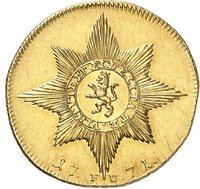
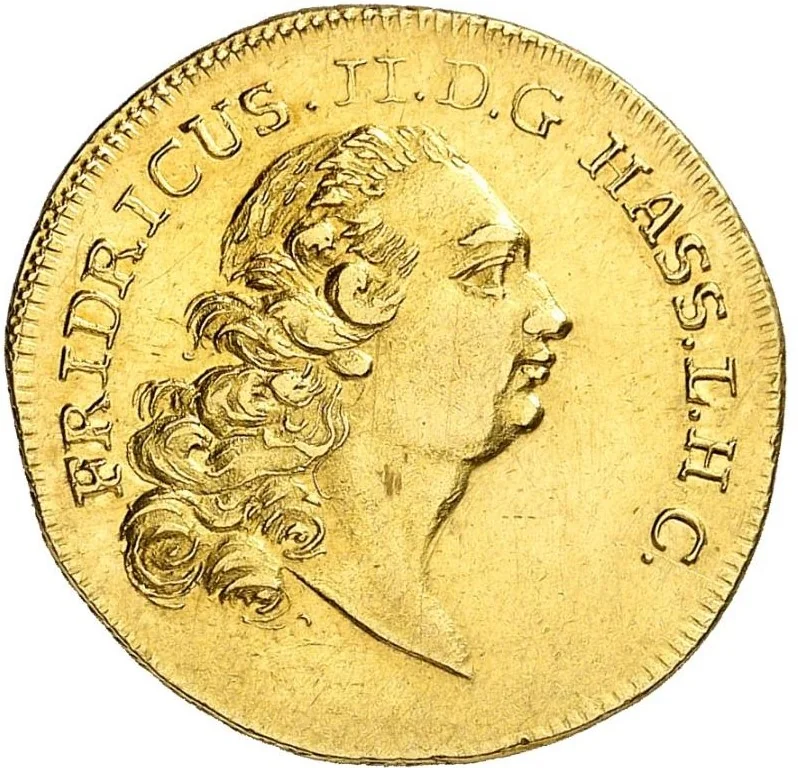
obverse
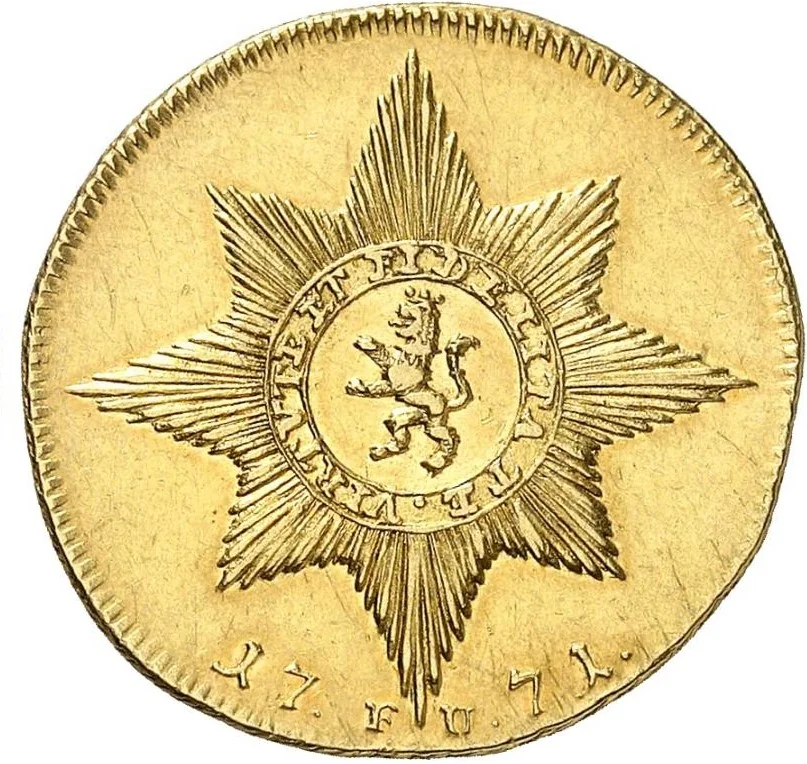
reverse
Fritz Rudolf Künker GmbH & Co. KG, Osnabrück and Lübke & Wiedemann KG, Leonberg

1 Friedrichs d'Or – Landgraviate of Hesse-Cassel

Context
Years: 1771–1778
Currency:
Subdivision: 1 Friedrichs d'Or = 5 Thalers
Demonetized: Yes
Material
Diameter: 24 mm
Weight: 6.65 g
Gold weight: 5.99 g
Shape: Round
Composition: 90% Gold
Magnetic: No
Alignment: Medal alignment
Obverse
OBVERSE ↑
flip
Reverse
REVERSE ↑
References
KM: #Click to copy to clipboard496
Numista: #266288
Value
Bullion value: $996.28

Obverse

Description:
Right bust
Inscription:
FRIDRICUS II D G HASS L H C
Script: Latin

Reverse

Description:
Lion arms inside star, date beneath.
Inscription:
VIRTVTE ET DIDELITA ET

1771

F U
Script: Latin

Edge

Mints

NameMark
Kassel

Mintings

YearMint MarkMintageQualityCollection
1771
1777
1778

Historical background

In 1771, the Landgraviate of Hesse-Cassel was navigating a complex and challenging currency situation, typical of the Holy Roman Empire's fragmented monetary landscape. The territory did not have a single, unified currency but operated within a system where multiple coinages circulated simultaneously. These included locally minted Taler and Gulden, but also a plethora of foreign coins from neighboring German states and trade partners. The critical problem was the fluctuating and often debased value of these coins, which created confusion in commerce, hampered state finances, and made tax collection inefficient.

Landgrave Frederick II, who ruled from 1760 to 1785, was acutely aware that this monetary disorder was an obstacle to his state's economic and administrative modernization. His reign was marked by a drive for fiscal rationalization, heavily influenced by the period's cameralist principles, which emphasized strong state management of the economy. A primary goal was to establish a stable and reliable currency to facilitate trade, ensure predictable state revenue, and project sovereign authority. The situation in 1771 represented a point of ongoing struggle and reform, as the Landgrave's government worked to assert greater control over the monetary chaos.

Therefore, the currency situation of 1771 was one of transition. While full standardization was still a work in progress, the year fell within a period of active state intervention aimed at monetary consolidation. Frederick II's efforts would later include attempts to regulate exchange rates and suppress the circulation of inferior foreign coins, laying groundwork for more stable finances. This stability, ironically funded in part by the Landgrave's notorious practice of leasing Hessian soldiers to Great Britain during the American Revolutionary War, would eventually make Hesse-Cassel one of the most fiscally sound states in Germany by the early 19th century.
Legendary