

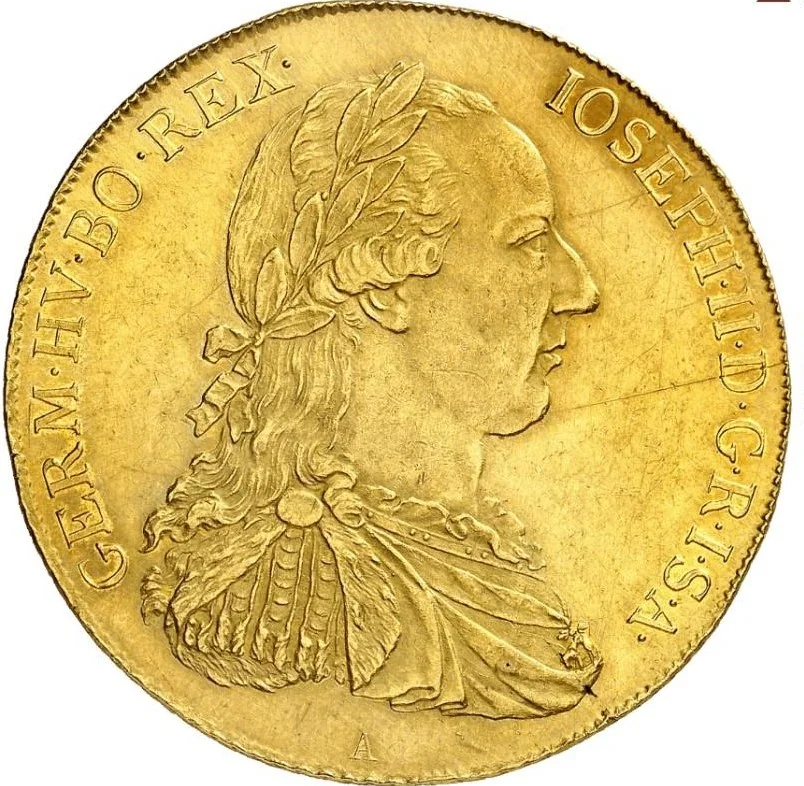
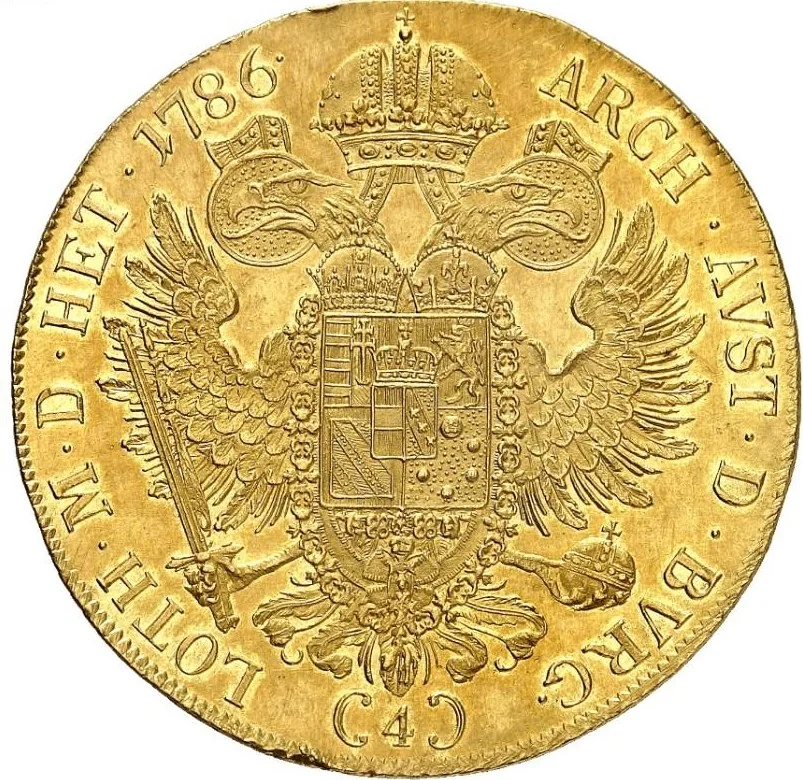
4 Ducats – Austrian Empire
Austria
Context
Year: 1786
Country: Austria 
Issuer: Austrian Empire
Ruler: Joseph II
Currency:
(1754—1857)
Demonetized: Yes
Material
References
KM: #Click to copy to clipboard1881
Numista: #266173
Value
Bullion value: $2288.14
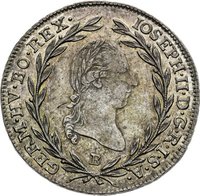
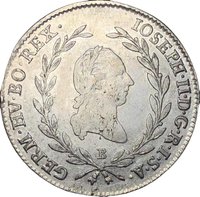
Obverse
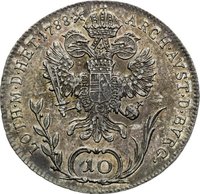
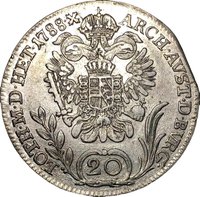
Reverse
Description:
Imperial two-headed eagle.
Inscription:
ARCH AVST D BVRG LOTH M D HET 1786
Script: Latin
Edge
Mints
| Name | Mark |
|---|---|
| Münze Österreich | A |
Mintings
| Year | Mint Mark | Mintage | Quality | Collection |
|---|---|---|---|---|
| 1786 | A | — |
Historical background
In 1786, the currency system of the Habsburg Monarchy, often referred to as the Austrian Empire, was a complex and fragile patchwork inherited from earlier conflicts. The state's finances were still recovering from the immense costs of the War of the Austrian Succession and the Seven Years' War, leading to a history of debasement. The primary unit was the Conventionsthaler (or Conventionstaler), established in 1754, which was supposed to be a stable silver coin containing a defined amount of fine silver. However, in practice, the monetary landscape was cluttered with a confusing variety of older, debased coins from different regions, alongside paper money, all circulating at fluctuating values.
The most significant pressure came from the paper banknotes issued by the state-backed Wiener Stadtbanco (Vienna City Bank). Originally intended as credit notes, these Bancozettel had been issued in large quantities to finance the wars, leading to a worrying over-supply. By 1786, although not yet in a state of catastrophic collapse, the volume of these notes was growing and they had begun to trade at a discount against silver Conventionsthaler. This marked the early stages of the inflation that would later spiral out of control during the Napoleonic Wars.
Emperor Joseph II, ruling as co-regent with his mother Maria Theresa until 1780 and thereafter alone, continued an era of energetic reform but also costly military engagements and state spending. His ambitious domestic programs and foreign policy, including a costly war with the Ottoman Empire, further strained the treasury. Consequently, the year 1786 falls within a period of underlying monetary instability, where the state relied on the increasingly suspect credit of the Bancozettel to fund its operations, setting the stage for the severe currency crisis that would engulf the empire in the following decade.
The most significant pressure came from the paper banknotes issued by the state-backed Wiener Stadtbanco (Vienna City Bank). Originally intended as credit notes, these Bancozettel had been issued in large quantities to finance the wars, leading to a worrying over-supply. By 1786, although not yet in a state of catastrophic collapse, the volume of these notes was growing and they had begun to trade at a discount against silver Conventionsthaler. This marked the early stages of the inflation that would later spiral out of control during the Napoleonic Wars.
Emperor Joseph II, ruling as co-regent with his mother Maria Theresa until 1780 and thereafter alone, continued an era of energetic reform but also costly military engagements and state spending. His ambitious domestic programs and foreign policy, including a costly war with the Ottoman Empire, further strained the treasury. Consequently, the year 1786 falls within a period of underlying monetary instability, where the state relied on the increasingly suspect credit of the Bancozettel to fund its operations, setting the stage for the severe currency crisis that would engulf the empire in the following decade.
✨ Legendary