

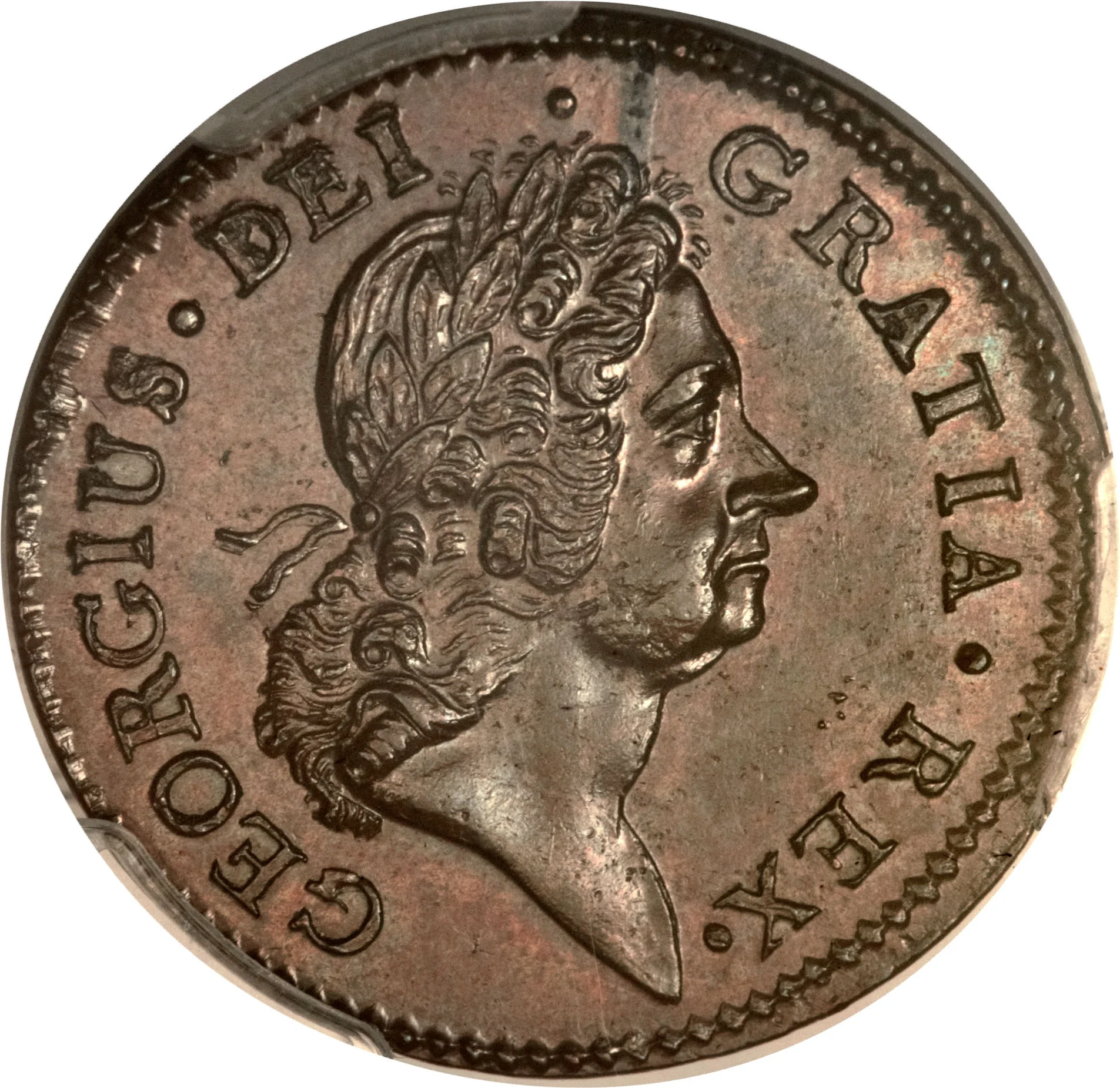
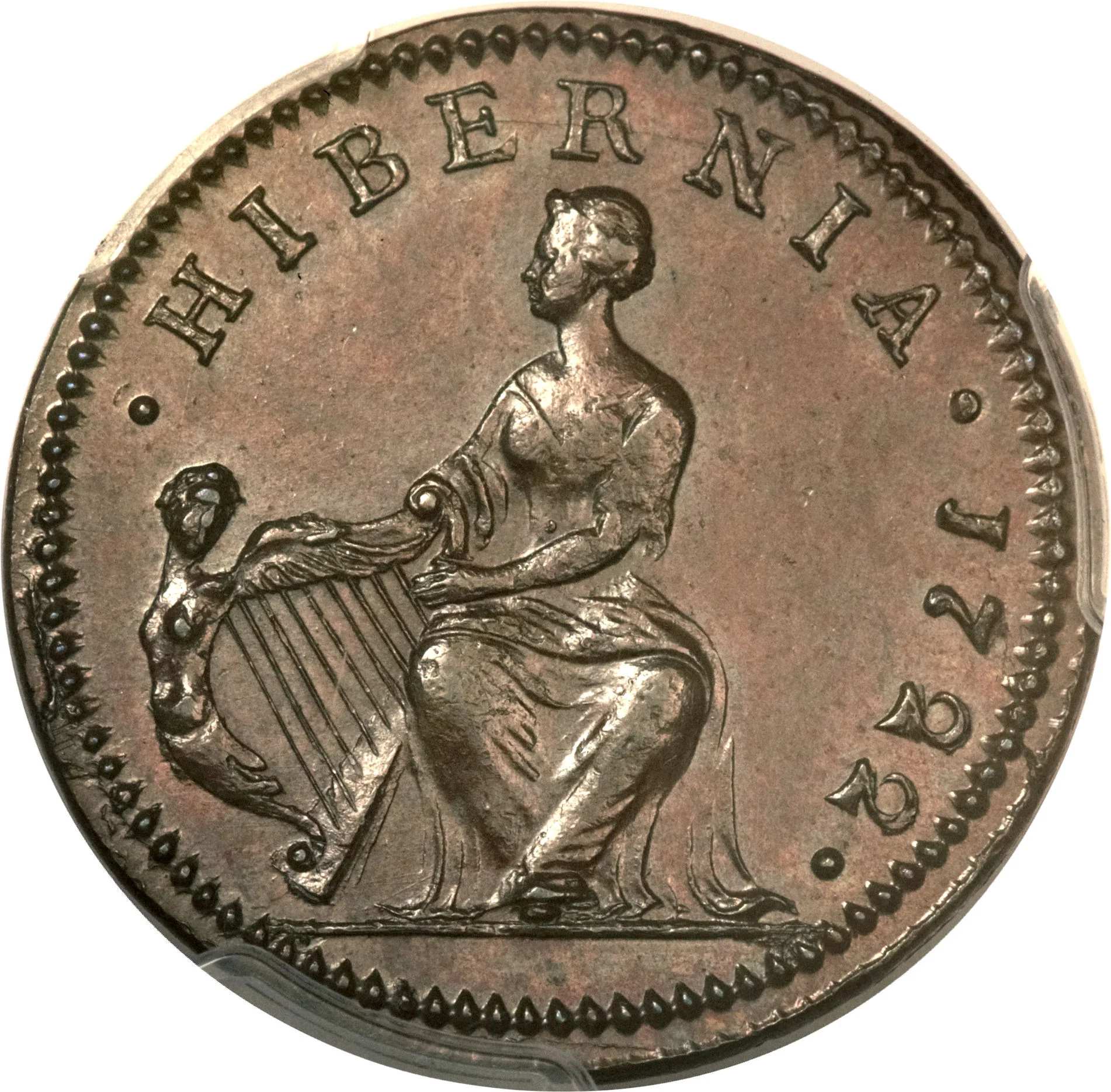

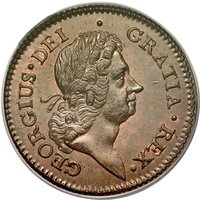
Obverse
Description:
King George bust, right profile.
Inscription:
GEORGIUS. DEI. GRATIA. REX.
Script: Latin
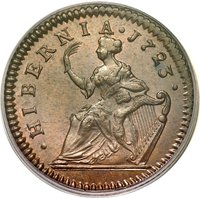
Reverse
Edge
Mintings
| Year | Mint Mark | Mintage | Quality | Collection |
|---|---|---|---|---|
| 1722 | — | — | ||
| 1722 | — | — | Proof |
Historical background
In 1722, Ireland operated under a complex and strained currency system, a direct legacy of the Williamite War and subsequent English economic policies. The official currency was based on sterling, but the reality was a severe shortage of gold and silver coinage in circulation. This scarcity was exacerbated by the fact that Ireland, as a dependent kingdom, was economically subservient to England; trade surpluses were routinely settled by the export of precious metals to London, draining the island of hard currency. The result was a reliance on a patchwork of foreign coins, banknotes from private "bankers" (often mere paper promises), and a widespread use of debased coins, leading to confusion and frequent disputes over real value.
The situation was further complicated by the issue of "Wood's Halfpence." In 1722, an English ironmaster, William Wood, had secured a patent to mint new copper coinage for Ireland. While intended to address the coin shortage, the patent was granted without consultation with the Irish Parliament and was widely perceived as a corrupt scheme that would flood Ireland with inferior coin, further destabilizing the economy and symbolizing English contempt for Irish legislative autonomy. The coins had not yet entered circulation in 1722, but the controversy was simmering, with Irish writers and politicians beginning to voice strenuous opposition.
Consequently, the monetary environment in 1722 was one of profound instability and political tension. Trade and daily commerce were hampered by the unreliable medium of exchange, creating a drag on economic activity. More significantly, the currency crisis became a focal point for broader grievances about Irish constitutional rights and economic independence from Britain. The looming battle over Wood's Halfpence, which would erupt into public fury with Swift's Drapier's Letters in 1724, was already taking shape, making currency not just an economic issue, but a potent symbol of colonial oppression.
The situation was further complicated by the issue of "Wood's Halfpence." In 1722, an English ironmaster, William Wood, had secured a patent to mint new copper coinage for Ireland. While intended to address the coin shortage, the patent was granted without consultation with the Irish Parliament and was widely perceived as a corrupt scheme that would flood Ireland with inferior coin, further destabilizing the economy and symbolizing English contempt for Irish legislative autonomy. The coins had not yet entered circulation in 1722, but the controversy was simmering, with Irish writers and politicians beginning to voice strenuous opposition.
Consequently, the monetary environment in 1722 was one of profound instability and political tension. Trade and daily commerce were hampered by the unreliable medium of exchange, creating a drag on economic activity. More significantly, the currency crisis became a focal point for broader grievances about Irish constitutional rights and economic independence from Britain. The looming battle over Wood's Halfpence, which would erupt into public fury with Swift's Drapier's Letters in 1724, was already taking shape, making currency not just an economic issue, but a potent symbol of colonial oppression.
💎 Extremely Rare