

1 ducat – Denmark
Add to wishlist
Denmark
Context
Material
References
KM: #
Numista: #265064
Value
Bullion value: $527.37
Obverse
Description:
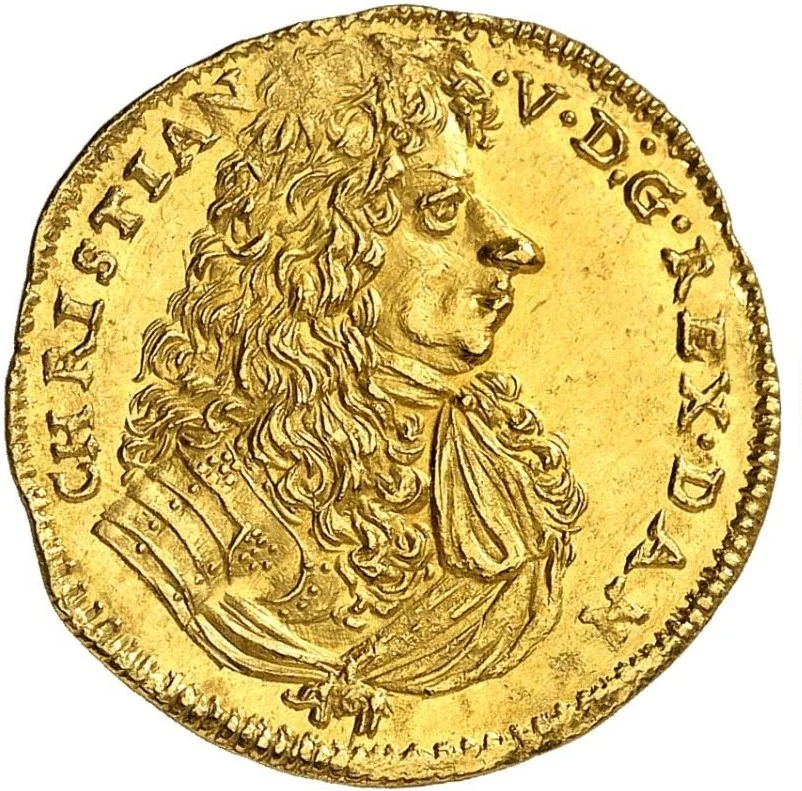
Bust of King Christian V in armor, facing right with long hair, a scarf, and the Order of the Elephant pendant.
Inscription:
CHRISTIAN | · V · D : G · REX · DAN
Script: Latin
Reverse
Description:
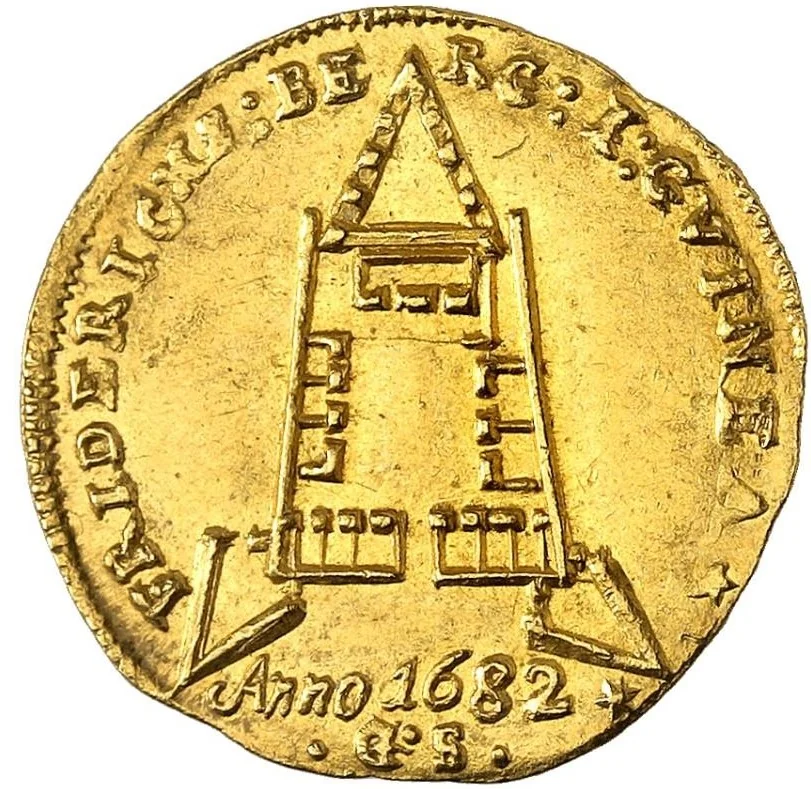
Plan of Frederiksborg Fortress, Guinea (Ghana). Legend encircling the rim. Date and Mint Master initials below.
Inscription:
FRIDERICHS : BE | RG : I : GVINEA ★
Anno 1682 ★
• G • S •
Anno 1682 ★
• G • S •
Script: Latin
Edge
Categories
| Building> Castle or fortification |
Mints
| Name | Mark |
|---|---|
| Copenhagen | — |
Mintings
| Year | Mint Mark | Mintage | Quality | Collection |
|---|---|---|---|---|
| 1682 | — | — |
Historical background
In 1682, Denmark was operating under a monetary system that was both complex and unstable, a legacy of the costly wars and economic policies of the mid-17th century. The primary currency was the silver rigsdaler, but its value and purity were under constant pressure. Decades of coinage debasement—reducing the silver content in coins to fund state expenditures—had led to a severe loss of public confidence. This resulted in a chaotic circulation of both old, high-value coins (which were hoarded or melted down) and new, inferior coins, alongside a multitude of foreign currencies, creating a confusing and inefficient marketplace.
Recognizing the crisis, King Christian V’s government was in the midst of a significant monetary reform, culminating in the Currency Regulation of 1683. The situation in 1682 was therefore one of transition and preparation. The state aimed to standardize the currency by introducing a new, stable rigsdaler tied explicitly to a fixed silver standard and to streamline the subsidiary coinage. This required a major recall and re-minting of the old, debased coins, a massive logistical and financial undertaking that was being planned and set in motion.
The economic backdrop was one of a deeply agrarian society with a growing absolutist state seeking to centralize control and increase revenue. The currency instability directly hampered trade, taxation, and economic planning. Thus, the situation in 1682 was defined by the tangible consequences of past fiscal mismanagement and the active, top-down efforts of the absolute monarchy to impose order, stability, and royal authority onto the very medium of economic exchange, setting the stage for a more unified national currency system.
Recognizing the crisis, King Christian V’s government was in the midst of a significant monetary reform, culminating in the Currency Regulation of 1683. The situation in 1682 was therefore one of transition and preparation. The state aimed to standardize the currency by introducing a new, stable rigsdaler tied explicitly to a fixed silver standard and to streamline the subsidiary coinage. This required a major recall and re-minting of the old, debased coins, a massive logistical and financial undertaking that was being planned and set in motion.
The economic backdrop was one of a deeply agrarian society with a growing absolutist state seeking to centralize control and increase revenue. The currency instability directly hampered trade, taxation, and economic planning. Thus, the situation in 1682 was defined by the tangible consequences of past fiscal mismanagement and the active, top-down efforts of the absolute monarchy to impose order, stability, and royal authority onto the very medium of economic exchange, setting the stage for a more unified national currency system.
✨ Legendary