

½ Crown – England
United Kingdom
Context
Years: 1630–1632
Country: United Kingdom 
Issuer: England 
Ruler: Charles I
Currency:
(1158—1970)
Demonetized: Yes
Material
Diameter: 35 mm
Weight: 14.75 g
Silver weight: 14.75 g
Thickness: 1.7 mm
Shape: Irregular round
Composition: Silver
Magnetic: No
References
KM: #Click to copy to clipboard116.1
Numista: #264756
Value
Bullion value: $41.52
Obverse
Description:
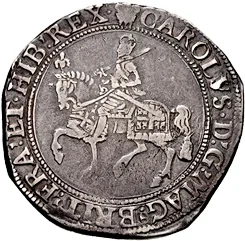
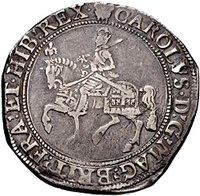
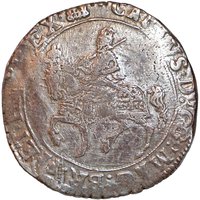
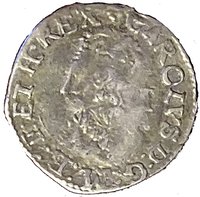
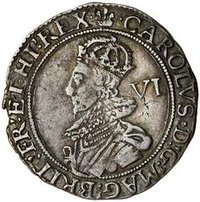
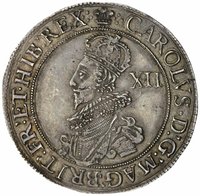
King Charles I on horseback, sword raised; second horseman, legend around, mintmark at 12 o'clock. Smaller horse, cross on flank cloth.
Inscription:
[mm] CAROLVS·D;G;MAG;BRIT;FRA;ET·HIB;REX·
Script: Latin
Reverse
Description:
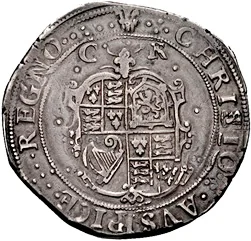
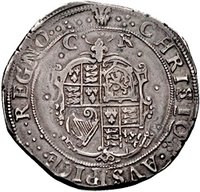
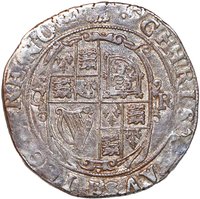
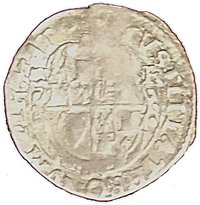
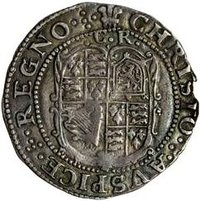
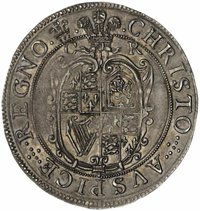
Oval shield quartered, C R above, legend around, mintmark at 12. Note: C R divided by rose (very rare), lis over rose (rare), or lis.
Inscription:
[mm] ·:· CHRISTO ·:· AVSPICE ·:· REGNO ·:·
Script: Latin
Edge
Mints
| Name | Mark |
|---|---|
| Royal Mint (Tower of London) | — |
Mintings
| Year | Mint Mark | Mintage | Quality | Collection |
|---|---|---|---|---|
| — | — | — |
Historical background
In 1630, England operated under a bimetallic monetary system, with the pound sterling (£) defined as a unit of account equivalent to one pound weight of sterling silver. The primary coins in circulation were the silver shilling (12 pence) and gold sovereigns. However, the kingdom faced significant monetary instability due to the widespread practice of "clipping" (shaving metal from coin edges) and counterfeiting, which degraded the currency's intrinsic value. Furthermore, a disparity between the official mint ratio of gold to silver and European market rates caused the newer, full-weight coins—especially silver—to be hoarded or exported, leaving the economy with a circulation of poor-quality, lightweight coins. This phenomenon, known as Gresham's Law ("bad money drives out good"), hampered trade and created price inflation.
The situation was exacerbated by the policies of the Crown. King Charles I, ruling without Parliament since 1629, was perpetually in need of revenue. In 1630, he continued the controversial practice of seizing bullion held at the Tower of London mint by merchants for coining, forcing them to loan the equivalent value to the Crown. This "Tower seizure" and other fiscal expedients, like the enforcement of archaic forest laws and the distraint of knighthood fines, undermined confidence in the monetary system and the Crown's role as its guarantor. The government's inability to reform the coinage or secure sound finances through parliamentary taxation created a deep economic unease.
Consequently, the currency problems of 1630 were symptomatic of a wider constitutional and fiscal crisis. The degraded coinage disrupted everyday transactions, harmed commercial credibility, and contributed to social discontent. This monetary weakness, intertwined with the Crown's arbitrary financial measures, eroded trust in royal governance. These tensions would accumulate over the following decade, becoming one of the underlying economic grievances that contributed to the outbreak of the English Civil Wars in 1642.
The situation was exacerbated by the policies of the Crown. King Charles I, ruling without Parliament since 1629, was perpetually in need of revenue. In 1630, he continued the controversial practice of seizing bullion held at the Tower of London mint by merchants for coining, forcing them to loan the equivalent value to the Crown. This "Tower seizure" and other fiscal expedients, like the enforcement of archaic forest laws and the distraint of knighthood fines, undermined confidence in the monetary system and the Crown's role as its guarantor. The government's inability to reform the coinage or secure sound finances through parliamentary taxation created a deep economic unease.
Consequently, the currency problems of 1630 were symptomatic of a wider constitutional and fiscal crisis. The degraded coinage disrupted everyday transactions, harmed commercial credibility, and contributed to social discontent. This monetary weakness, intertwined with the Crown's arbitrary financial measures, eroded trust in royal governance. These tensions would accumulate over the following decade, becoming one of the underlying economic grievances that contributed to the outbreak of the English Civil Wars in 1642.
Series: 1630 England circulation coins
✨ Legendary