

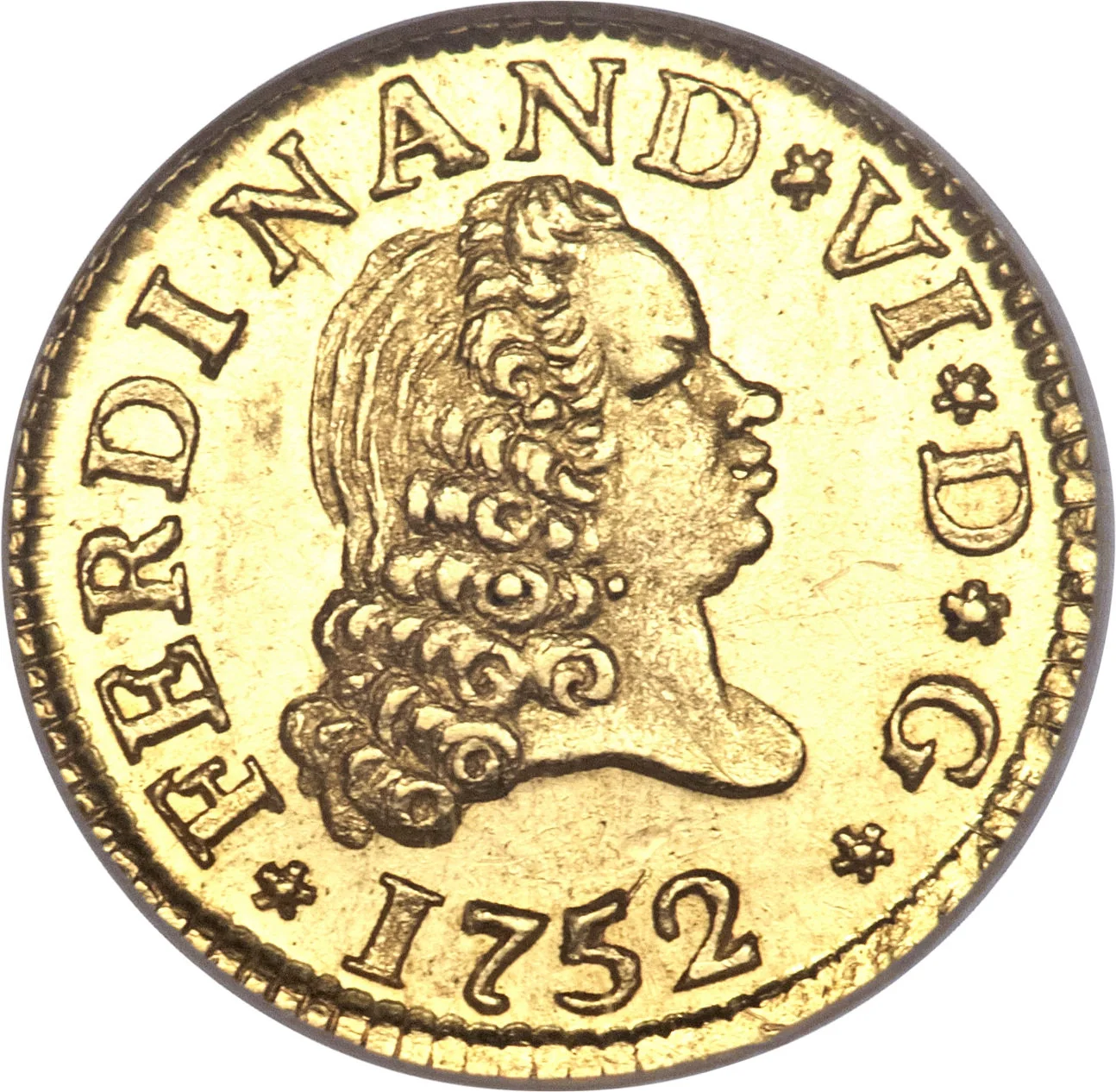
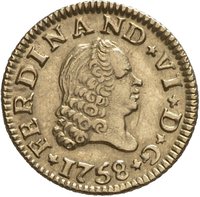
Obverse
Description:
King Ferdinand VI facing right.
Inscription:
FERDINAND · VI · D · G
· 1752 ·
· 1752 ·
Script: Latin
Engraver: Tomás Francisco Prieto Martin
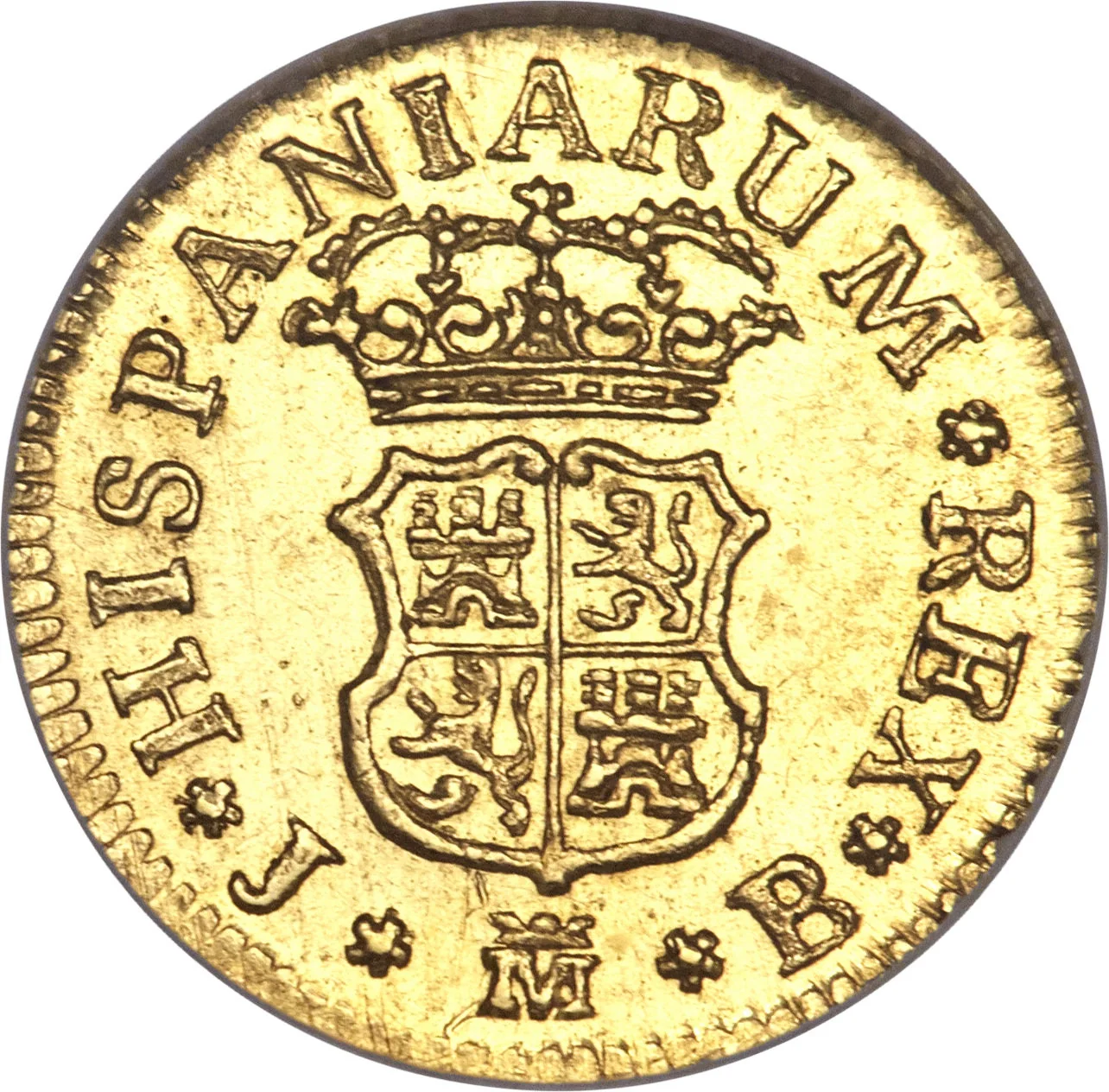
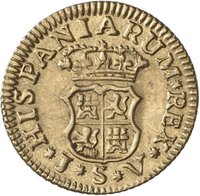
Reverse
Description:
Royal arms of Spain.
Inscription:
HISPANIARUM · REX
J M B
J M B
Script: Latin
Engraver: Tomás Francisco Prieto Martin
Edge
Categories
| Symbols> Coat of Arms |
Mints
| Name | Mark |
|---|---|
| Royal Mint of Madrid | (M) |
Mintings
| Year | Mint Mark | Mintage | Quality | Collection |
|---|---|---|---|---|
| 1748 | MJB | — | ||
| 1749 | MJB | — | ||
| 1750 | MJB | — | ||
| 1751 | MJB | — | ||
| 1752 | MJB | — | ||
| 1753 | MJB | — | ||
| 1754 | MJB | — | ||
| 1755 | MJB | — | ||
| 1756 | MJB | — | ||
| 1757 | MJB | — | ||
| 1758 | MJB | — | ||
| 1759 | MJ | — | ||
| 1759 | MJB | — |
Historical background
In 1748, Spain's currency situation was a complex and troubled legacy of the early Bourbon monarchs, particularly Philip V (r. 1700-1746). The War of the Spanish Succession and subsequent conflicts, including the ongoing War of the Austrian Succession (which would conclude with the Treaty of Aix-la-Chapelle that same year), had drained the royal treasury. To finance these wars, the crown had repeatedly resorted to debasing the coinage, notably through the widespread minting of vellón (a copper-based coinage) and reducing the silver content in higher-denomination coins. This created a severe imbalance, where an overabundance of low-value copper currency flooded the market, while precious silver and gold coins were hoarded or exported, leading to price inflation and public mistrust in the monetary system.
The situation was further complicated by a fragmented system with no uniform national currency. Different regions, such as Catalonia, Aragon, and Castile, operated with varying monetary units, exchange rates, and valuations. The most common unit of account was the real, but the actual physical coins in circulation were a chaotic mix of domestic and foreign issues, including Spanish reales, escudos, and pesos, as well as Portuguese, French, and Spanish-American coins. This lack of standardization hampered domestic trade and state finance, as constant conversion and valuation disputes were common.
By 1748, under the rule of Ferdinand VI, Spain was in a period of post-war recovery and relative peace. The new king and his ministers, most notably the Marquis of Ensenada, recognized that monetary reform was essential for economic stability and increased tax revenue. While comprehensive reform would not be enacted until later (notably with the 1772 Pragmática under Charles III), the year 1748 marked a turning point where the urgent need for a uniform, stable coinage based on reliable precious metal content became a central focus of the crown's efforts to centralize administrative and economic power. The immediate goal was to restore confidence, curb inflation, and lay the groundwork for a more modern fiscal state.
The situation was further complicated by a fragmented system with no uniform national currency. Different regions, such as Catalonia, Aragon, and Castile, operated with varying monetary units, exchange rates, and valuations. The most common unit of account was the real, but the actual physical coins in circulation were a chaotic mix of domestic and foreign issues, including Spanish reales, escudos, and pesos, as well as Portuguese, French, and Spanish-American coins. This lack of standardization hampered domestic trade and state finance, as constant conversion and valuation disputes were common.
By 1748, under the rule of Ferdinand VI, Spain was in a period of post-war recovery and relative peace. The new king and his ministers, most notably the Marquis of Ensenada, recognized that monetary reform was essential for economic stability and increased tax revenue. While comprehensive reform would not be enacted until later (notably with the 1772 Pragmática under Charles III), the year 1748 marked a turning point where the urgent need for a uniform, stable coinage based on reliable precious metal content became a central focus of the crown's efforts to centralize administrative and economic power. The immediate goal was to restore confidence, curb inflation, and lay the groundwork for a more modern fiscal state.
⭐ Rare