

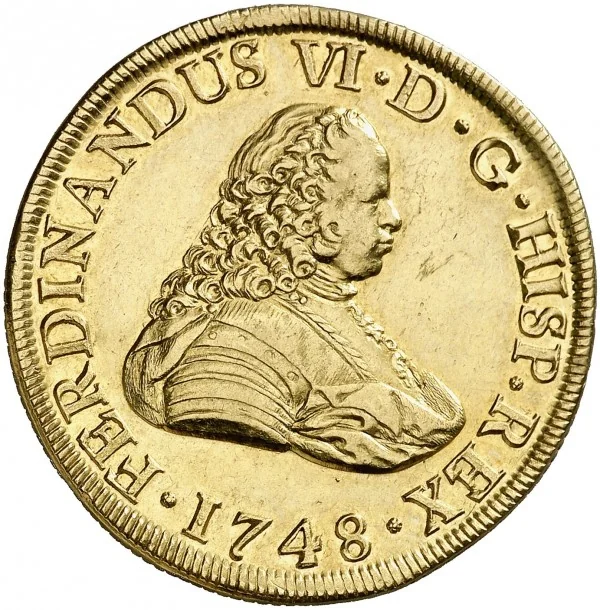

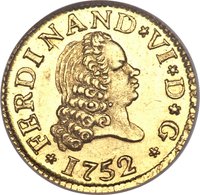
Obverse
Description:
Armored bust of Ferdinand VI, right-facing.
Inscription:
FERDINANDUS VI · D · G · HISP · REX
· 1748 ·
· 1748 ·
Script: Latin
Engraver: Tomás Francisco Prieto Martin
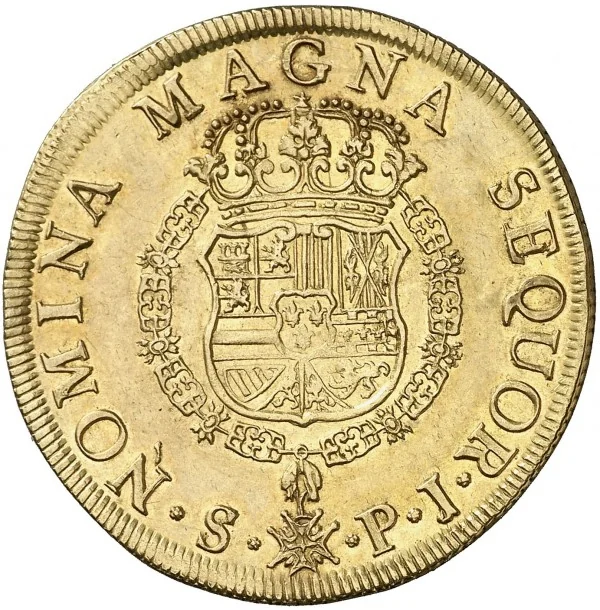
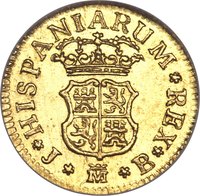
Reverse
Description:
Crowned Spanish coat of arms with the Golden Fleece.
Inscription:
NOMINA MAGNA SEQUOR
✿ S ✿ ✿ P ✿ J ✿
✿ S ✿ ✿ P ✿ J ✿
Script: Latin
Engraver: Tomás Francisco Prieto Martin
Edge
Categories
| Symbols> Coat of Arms |
Mints
| Name | Mark |
|---|---|
| Royal Mint of Madrid | (M) |
| Royal Mint of Seville | (S) |
Mintings
| Year | Mint Mark | Mintage | Quality | Collection |
|---|---|---|---|---|
| 1747 | MJ | — | ||
| 1747 | SPJ | — | ||
| 1748 | MJB | — | ||
| 1748 | SPJ | — |
Historical background
In 1747, Spain operated under a complex and strained monetary system, a legacy of the Habsburg era exacerbated by the ongoing War of the Austrian Succession (1740-1748). The primary unit was the silver real, with 8 reales making a peso or "piece of eight," and 20 reales constituting a gold escudo. However, the crown's chronic financial demands, particularly to fund its military campaigns, led to repeated debasements of the coinage. The government frequently reduced the silver or gold content in newly minted coins while mandating they have the same face value as older, purer coins. This practice, while providing short-term liquidity, eroded public trust and spurred widespread hoarding of older, higher-quality currency, leading to a chaotic circulation of coins of varying intrinsic worth.
The situation was further complicated by the circulation of numerous foreign coins, especially from Spain's American colonies and other European powers, which were often necessary to facilitate trade but added to the monetary confusion. Domestically, the economy also relied heavily on vellón, a crude coinage made from a copper alloy with trace silver. Originally a fiduciary currency, vellón had been over-issued for decades, causing severe inflation in everyday transactions and disproportionately burdening the poor. The result was a fractured system where the value of money was highly unstable, prices were volatile, and the disconnect between the official legal tender and its market value based on metal content was a persistent economic problem.
King Ferdinand VI, who ascended the throne in 1746, inherited this crisis. The monetary disorder directly hampered commerce, tax collection, and the state's ability to manage its debt. While major reforms would be initiated later in his reign, particularly with the currency stabilization project of 1750-1751, the year 1747 represents a point of acute strain. It was a period of assessment and growing recognition that Spain's imperial ambitions and fiscal health were unsustainable without a fundamental overhaul of its currency, laying the groundwork for the Bourbon monetary reforms that would follow.
The situation was further complicated by the circulation of numerous foreign coins, especially from Spain's American colonies and other European powers, which were often necessary to facilitate trade but added to the monetary confusion. Domestically, the economy also relied heavily on vellón, a crude coinage made from a copper alloy with trace silver. Originally a fiduciary currency, vellón had been over-issued for decades, causing severe inflation in everyday transactions and disproportionately burdening the poor. The result was a fractured system where the value of money was highly unstable, prices were volatile, and the disconnect between the official legal tender and its market value based on metal content was a persistent economic problem.
King Ferdinand VI, who ascended the throne in 1746, inherited this crisis. The monetary disorder directly hampered commerce, tax collection, and the state's ability to manage its debt. While major reforms would be initiated later in his reign, particularly with the currency stabilization project of 1750-1751, the year 1747 represents a point of acute strain. It was a period of assessment and growing recognition that Spain's imperial ambitions and fiscal health were unsustainable without a fundamental overhaul of its currency, laying the groundwork for the Bourbon monetary reforms that would follow.
✨ Legendary