

4 Hellers – Landgraviate of Hesse-Cassel
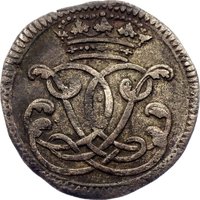
Obverse
Description:
Palm branches flanking a crowned coat of arms.
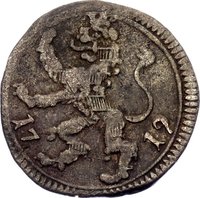
Reverse
Description:
Date top, denomination centered in border.
Inscription:
1719
* 4 *
* 4 *
Edge
Mints
| Name | Mark |
|---|---|
| Kassel | — |
Mintings
| Year | Mint Mark | Mintage | Quality | Collection |
|---|---|---|---|---|
| 1719 | — | — |
Historical background
In 1719, the currency situation in the Landgraviate of Hesse-Cassel was one of significant complexity and instability, a legacy of the broader monetary chaos within the Holy Roman Empire. The region operated within a fragmented system where multiple coinage authorities—the Emperor, the Imperial Circles, and the Landgrave himself—issued currency with varying standards. The primary accounting unit was the Reichsthaler, but the actual circulating coins included a confusing array of Gulden, Groschen, and Kreuzer from Hesse-Cassel, neighboring states, and even older, debased coins. This proliferation led to chronic uncertainty in trade, as the intrinsic silver content and exchange rates between these coins fluctuated constantly.
The root of the problem lay in the decades following the Thirty Years' War, during which rulers frequently debased their coinage to generate short-term revenue. By 1719, Landgrave Karl, who had inherited the throne in 1670, was nearing the end of his long reign and had struggled to impose lasting order. While attempts at monetary ordinances had been made, the practical reality was a market saturated with underweight and foreign coins, which discouraged commerce and complicated tax collection. This environment benefited money changers and speculators but created hardship for ordinary people and legitimate merchants, who faced unpredictable losses in everyday transactions.
Consequently, the year 1719 represented a point of ongoing financial strain rather than resolution. The need for a standardized, trustworthy currency was widely recognized as essential for economic development and the state's fiscal health. This pressing situation would set the stage for more comprehensive reforms under his successor, Landgrave Frederick I (who was also King of Sweden), and especially under Landgrave Frederick II later in the century, who would famously use Hesse-Cassel's reformed financial system to fund a lucrative military subsidy business.
The root of the problem lay in the decades following the Thirty Years' War, during which rulers frequently debased their coinage to generate short-term revenue. By 1719, Landgrave Karl, who had inherited the throne in 1670, was nearing the end of his long reign and had struggled to impose lasting order. While attempts at monetary ordinances had been made, the practical reality was a market saturated with underweight and foreign coins, which discouraged commerce and complicated tax collection. This environment benefited money changers and speculators but created hardship for ordinary people and legitimate merchants, who faced unpredictable losses in everyday transactions.
Consequently, the year 1719 represented a point of ongoing financial strain rather than resolution. The need for a standardized, trustworthy currency was widely recognized as essential for economic development and the state's fiscal health. This pressing situation would set the stage for more comprehensive reforms under his successor, Landgrave Frederick I (who was also King of Sweden), and especially under Landgrave Frederick II later in the century, who would famously use Hesse-Cassel's reformed financial system to fund a lucrative military subsidy business.
✨ Legendary